
What is xP&A (Extended Planning & Analysis)?
What is xP&A?
Extended Planning & Analysis (xP&A) is a cross-functional approach to planning that connects financial planning with operational planning across functions such as supply chain, sales, HR, and operations within a single, integrated framework.
xP&A Explained
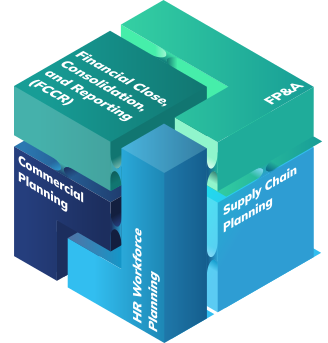
xP&A represents the evolution of Financial Planning & Analysis (FP&A) from a finance-centric discipline into a broader, enterprise-wide capability. Instead of planning happening in isolated functions, xP&A connects financial, operational, and strategic plans so that the entire organization operates from a shared, aligned view of the future.
In traditional organizations, finance, supply chain, sales, and operations often plan separately using different tools, assumptions, and timelines. This creates inconsistencies, delays, and misalignment. For example, a sales forecast may not align with supply chain capacity, or a financial plan may not reflect operational constraints.
xP&A addresses this by integrating planning across functions. Changes in one area – such as demand, pricing, or supply constraints – automatically flow through to financial forecasts, operational plans, and strategic decisions. This creates a more accurate, consistent, and responsive planning process.
xP&A is typically enabled by integrated planning platforms such as Board, which provide a unified environment where finance and business teams can collaborate, share data, and align decisions in real time.
Rather than being a single process, xP&A is an approach that brings together multiple planning activities – including budgeting, forecasting, scenario planning, and operational planning – into a connected system.
Why xP&A Matters
xP&A matters because modern organizations are too complex to plan effectively in silos.
It helps organizations:
- Align financial and operational plans across the business
- Improve collaboration between departments
- Increase forecast accuracy by using shared assumptions
- Respond faster to changes in demand, supply, or market conditions
- Provide leadership with a unified view of performance and plans
Without xP&A, organizations often face conflicting plans, duplicated effort, and delayed decision-making. For example, finance may revise forecasts without input from operations, or supply chain may adjust plans without reflecting financial impact.
xP&A ensures that all functions are working from the same version of the truth, improving both efficiency and decision quality.
It is particularly important for organizations undergoing transformation, scaling operations, or managing complex supply chains, where alignment across functions becomes critical.
How xP&A Works
Establish a Unified Data Model
xP&A begins with creating a shared data foundation that connects financial and operational data. This ensures that all functions are working from consistent definitions, assumptions, and metrics.
Integrate Planning Processes
Key planning processes are connected, including:
- financial planning and forecasting
- demand and supply planning
- workforce planning
- strategic planning
This allows inputs from one function to influence plans in others.
Enable Cross-Functional Collaboration
Teams across finance, supply chain, operations, and commercial functions collaborate on shared plans. This improves alignment and reduces the risk of conflicting assumptions.
Update Plans Continuously
As new data becomes available, plans are updated dynamically. This supports continuous planning and ensures that decisions reflect the latest information.
Support Scenario-Based Decision-Making
xP&A enables organizations to model different scenarios and understand their impact across the entire business, not just within a single function.
xP&A vs FP&A
| xP&A | FP&A |
Cross-functional and enterprise-wide | Primarily finance-focused |
Integrates financial and operational planning | Focuses on financial planning and analysis |
Involves multiple departments | Led by finance teams |
Supports enterprise-wide decision-making | Supports financial decision-making |
FP&A remains a critical component of xP&A, but xP&A extends its scope across the organization.
Connected Planning vs Siloed Planning
| Connected Planning | Siloed Planning |
Shared data and assumptions | Disconnected systems and data |
Cross-functional collaboration | Departmental planning |
Real-time updates | Static, periodic updates |
Aligned decisions | Conflicting priorities |
xP&A is a key enabler of connected planning, helping organizations move away from fragmented processes toward a more unified approach.
Tools for Cross-Functional Business Planning
To support xP&A, organizations adopt platforms that enable:
- Cross-functional planning across finance and operations
- Integration of financial and operational data
- Real-time collaboration and visibility
- Scenario modeling and analysis
These tools replace disconnected spreadsheets and siloed systems with a single planning environment.
Platforms like Board are designed to support this approach, enabling organizations to connect planning processes across the enterprise and improve alignment between strategy and execution.
Examples in Practice
Finance and Supply Chain Example
A company links demand forecasts with financial projections and production plans. When demand changes, supply chain and finance plans are updated simultaneously, ensuring alignment.
Retail Example
A retailer integrates merchandising plans, inventory forecasts, and financial targets, enabling better coordination of promotions, pricing, and stock levels.
Workforce Planning Example
An organization aligns hiring plans with revenue forecasts and operational needs, ensuring that workforce costs and capacity are aligned with business growth.
Executive Planning Example
Leadership reviews integrated plans that combine financial, operational, and strategic data, enabling better evaluation of trade-offs and priorities.
Key Benefits
- End-to-end visibility across the organization
- Improved collaboration between functions
- More accurate and consistent planning
- Faster and more aligned decision-making
- Reduced inefficiencies caused by siloed processes
Related Terms
FAQs
Explore how Board enables xP&A

Let’s see what Board can do for you.
Get a tour of the Agentic Planning Platform in action.