
What is Continuous Planning?
What is Continuous Planning?
Continuous Planning is an always-on approach where plans and forecasts dynamically adjust in real time using internal data and external signals, enabling accurate forecasting and confident, aligned decisions.
Continuous Planning connects finance and operations through integrated business planning (IBP), ensuring organizations operate from a unified, real-time view of the business.
It allows organizations to:
- Respond faster to change
- Test scenarios as conditions evolve
- Maintain plans that reflect the latest business reality
Unlike traditional planning, Continuous Planning evolves continuously as the business changes.
Why Traditional Planning No Longer Works
Traditional planning was built for a different world, one where change was slower, signals were limited, and decisions could wait.
Organizations relied on static planning cycles, including annual plans and periodic forecasts. By the time those plans were finalized, they were already outdated.
Today, markets shift daily. External signals from economic indicators to customer demand, reshape performance in real time.
According to McKinsey, finance teams often remain a step behind the business despite increased investment in FP&A, highlighting the limitations of traditional planning approaches.
This gap leaves finance and business leaders reacting too late rather than making confident, forward-looking decisions.
The Shift to Continuous Planning
Modern organizations are replacing static planning with Continuous Planning to keep pace with constant change.
Continuous Planning replaces periodic cycles with an always-on, real-time planning process. Plans and forecasts dynamically adjust using internal performance data and external signals.
At the same time, Integrated Business Planning (IBP) approaches bring strategy, finance, and operations together ensuring plans are aligned across the organization through a unified planning model.
This enables:
- Real-time planning and forecasting
- Continuous scenario analysis
- Faster, more confident decision-making
Planning is no longer something done on a cycle.
It becomes a continuous capability embedded in how a business operates.
Key Benefits of Continuous Planning
- Faster, more confident decisions
Decisions are based on real-time data, not outdated assumptions - Real-time scenario analysis
Teams can test scenarios instantly and evaluate trade-offs - More accurate forecasts
Forecasts continuously refine internal and external data - Enterprise-wide alignment
Integrated business planning connects finance and operations - Speed with control
Organizations move faster while maintaining governance
Continuous Planning vs Traditional Planning
Continuous Planning | Traditional Planning |
Always-on and dynamic | Static and periodic |
Driven by real-time data and external signals | Based on historical data |
Integrated business planning (IBP) | Siloed across functions |
Built for continuous change | Slow to adapt |
From Static Forecasts to Continuous Forecasting
At the core of Continuous Planning is a shift to accurate, real-time forecasting.
Forecasts are no longer updated periodically. They dynamically adjust as new data becomes available.
By combining:
- Internal business data
- External intelligence (market, economic, demand signals
Organizations can:
- Continuously refine forecasts
- Improve forecast accuracy
- Understand the impact of change instantly
Forecasting becomes more than accurate, it becomes predictive, contextual, and actionable.
The Role of External Intelligence
Continuous Planning expands beyond internal data by incorporating external intelligence.
This includes:
- Macroeconomic indicators
- Market trends
- Customer and demand signals
By integrating these signals into the planning process, organizations gain a forward-looking view of performance.
This enables:
- Earlier detection of change
- Better scenario planning
- More confident decisions
Introducing Board Agents
To operate in real time, planning must also become intelligent.
Board enables this through persona-based AI agents, trained on high-impact use cases.
These AI Agents:
- Understand the context of finance, supply chain, and operations
- Continuously monitor internal and external signals
- Support scenario analysis and decision-making
As conditions change, they don’t just update forecasts, they:
- Interpret what’s happening
- Explain the drivers behind the changes
- Recommend actions based on scenario outcomes
Persona-based AI agents connect data, decisions, and teams, enabling faster, more accurate, and more confident planning.
Importantly, they enhance human decision making rather than replace it, ensuring governance, trust, security and compliance.
A New Way to Run the Business
Continuous Planning is not an evolution of traditional planning.
It replaces it.
It transforms planning into a continuous, intelligent capability where plans and forecasts evolve with the business, adjust in real time using internal and external signals and decisions are made with confidence
- Planning is always-on
- Forecasts are always current
- Decisions are always informed and aligned
Continuous Planning doesn’t just support your business.
It becomes how your business runs.
Related Terms
FAQs
See how Board enables Continuous Planning
Board natively embeds analytical AI, generative AI, and domain-specific AI agents that continuously interpret data, simulate scenarios, and guide confident enterprise decisions, all from a single unified planning platform for finance and operations.
Explore the Board platform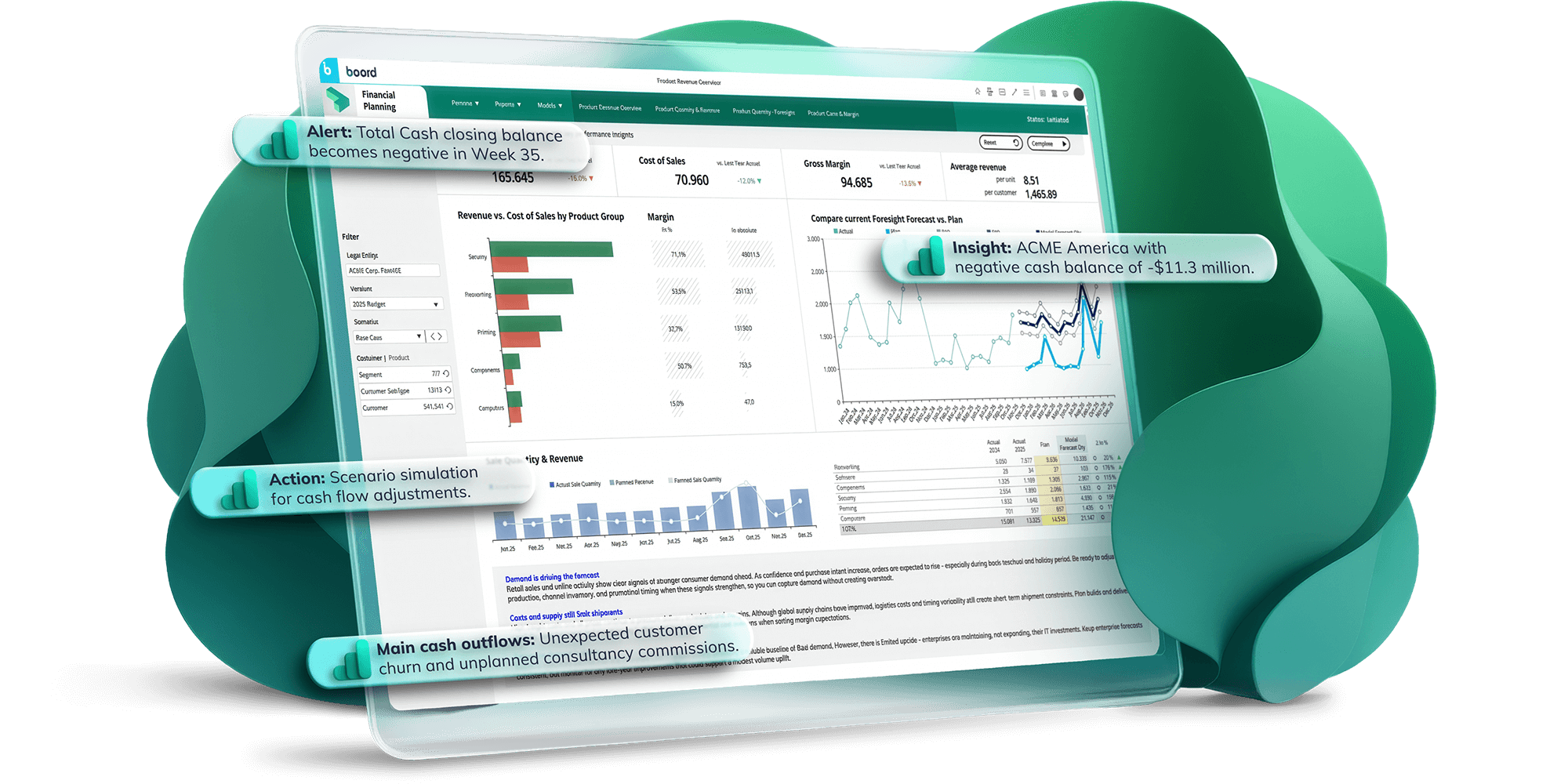

Let’s see what Board can do for you.
Get a tour of the Agentic Planning Platform in action.