
What is Budgeting?
What is Budgeting?
Budgeting is the process of creating a financial plan that outlines expected revenues, costs, and investments over a defined period, typically a fiscal year.
Budgeting Explained
Budgeting provides organizations with a structured framework for planning financial performance and allocating resources. It translates strategic objectives into financial targets, ensuring that spending, investment, and operational plans are aligned with business goals.
The budgeting process typically involves collaboration across multiple functions. Leadership defines strategic priorities and high-level targets, while departments contribute detailed plans based on operational needs. These inputs are consolidated into a company-wide financial plan.
Traditionally, budgeting has been an annual process, often time-consuming and rigid. However, many organizations are evolving their approach by integrating budgeting with forecasting, scenario planning, and driver-based planning to improve flexibility and responsiveness.
Modern planning platforms such as Board enable organizations to streamline budgeting by connecting financial and operational data, automating workflows, and improving collaboration across teams. This helps reduce reliance on spreadsheets and manual processes while increasing accuracy and transparency.
Budgeting is not just about setting numbers. It is about aligning the organization around a clear financial direction and ensuring that resources are deployed effectively to achieve strategic objectives.
Why Budgeting Matters
Budgeting helps organizations:
- Establish financial discipline and accountability
- Align spending with strategic priorities
- Provide a baseline for measuring performance
- Support investment planning and resource allocation
- Coordinate activities across departments
Without a structured budget, organizations risk misaligned priorities, uncontrolled spending, and limited visibility into performance.
Budgeting is particularly important for leadership teams, as it provides a clear framework for decision-making and performance management. It ensures that all parts of the organization are working toward the same financial goals.
At the same time, modern organizations recognize that budgeting alone is not sufficient. It must be complemented by forecasting and scenario planning to remain relevant in changing conditions.
How Budgeting Works
Set Strategic Objectives
The process begins with defining the organization’s strategic priorities, such as growth targets, cost optimization, investment plans, or market expansion.
Define Financial Targets
Leadership translates strategy into high-level financial targets, including:
- revenue goals
- cost limits
- profit expectations
- investment budgets
These targets provide direction for the rest of the organization.
Collect Departmental Inputs
Business units and departments develop detailed plans based on operational needs, such as:
- sales forecasts
- hiring plans
- marketing spend
- production requirements
These inputs reflect how each part of the organization will contribute to overall goals.
Consolidate and Review
Finance consolidates inputs into a unified budget and reviews them for:
- consistency with strategy
- feasibility
- alignment across departments
This stage often involves multiple iterations to refine assumptions and resolve conflicts.
Approve and Communicate
Once finalized, the budget is approved by leadership and communicated across the organization. It becomes the baseline for performance tracking.
Monitor and Adjust
Although budgets are typically fixed, organizations track actual performance against budget and use variance analysis to identify deviations and inform decisions.
Enterprise Budgeting and Forecasting Software
Organizations increasingly adopt enterprise budgeting and forecasting software to improve the efficiency and effectiveness of budgeting.
These platforms help:
- Automate data collection and consolidation
- Enable collaboration across teams
- Improve accuracy and consistency
- Reduce manual effort and cycle time
- Integrate budgeting with forecasting and analysis
Solutions like Board provide a unified environment for budgeting, forecasting, and performance management, enabling organizations to move beyond fragmented and spreadsheet-driven processes.
Budgeting vs Forecasting
Budgeting | Forecasting |
Sets financial targets | Predicts expected performance |
Typically fixed for a period | Continuously updated |
Focuses on control and accountability | Focuses on adaptability |
Annual or periodic | Ongoing process |
Budgeting provides direction, while forecasting ensures that plans remain relevant as conditions change.
Budgeting vs Strategic Planning
Budgeting | Strategic Planning |
Focuses on financial execution | Focuses on long-term direction |
Short- to medium-term horizon | Long-term horizon |
Quantifies plans in financial terms | Defines goals and priorities |
Strategic planning defines where the organization wants to go, while budgeting defines how resources will be allocated to get there.
Examples in Practice
Finance Example
A finance team sets annual revenue and cost targets aligned with company growth objectives. Departments submit budgets that are consolidated into a company-wide plan.
Supply Chain Example
A manufacturer budgets production costs, raw material purchases, and logistics expenses based on expected demand and capacity constraints.
Retail Example
A retailer creates budgets for inventory purchases, store operations, staffing, and promotions ahead of key trading periods.
Executive Planning Example
Leadership uses the budget to evaluate trade-offs between growth initiatives, cost control, and investment priorities.
Key Benefits
- Clear financial direction and targets
- Improved cost control and resource allocation
- Alignment across departments and functions
- Better performance tracking and accountability
- Stronger foundation for forecasting and analysis
Related Terms
FAQs
See how Board transforms enterprise budgeting
Board’s planning, budgeting, and forecasting software streamlines financial processes, speeds up reporting cycles through automation, and ensures accuracy with real-time data integration.
Explore Board's PB&F solution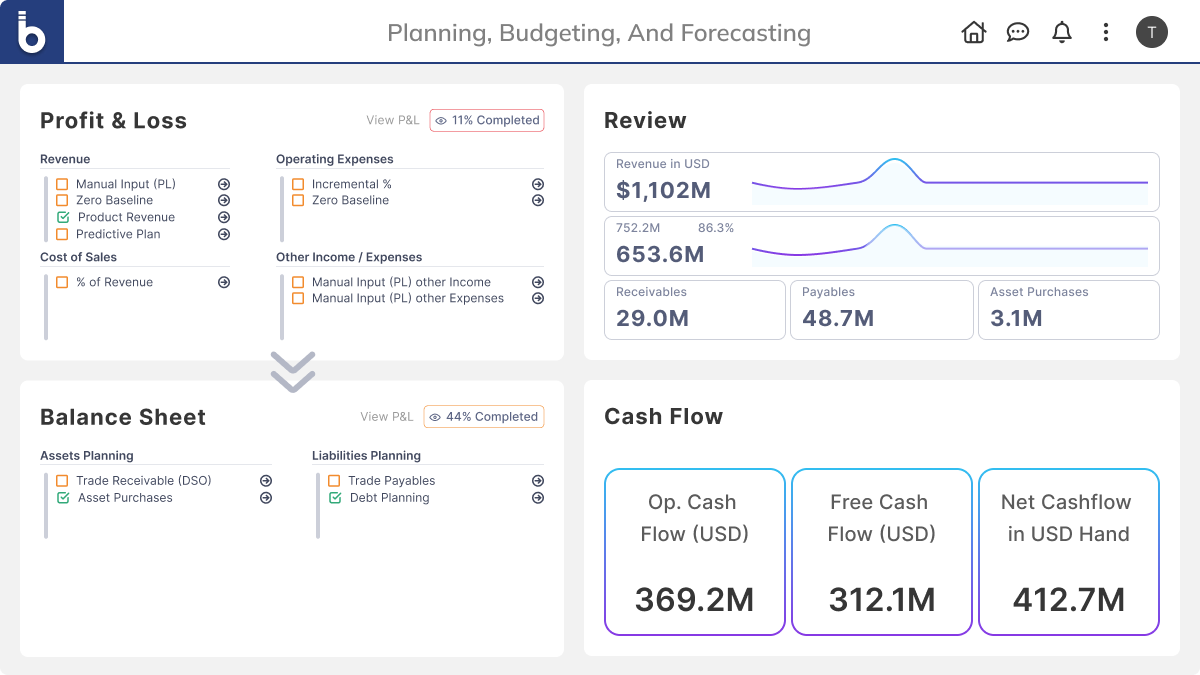

Let’s see what Board can do for you.
Get a tour of the Agentic Planning Platform in action.