
What is Supply Chain Planning?
What is Supply Chain Planning?
Supply chain planning is the process of aligning demand, supply, production, and inventory decisions to ensure products are delivered efficiently, cost-effectively, and in line with customer demand.
Supply Chain Planning Explained
Supply chain planning is a core business capability that ensures organizations can meet customer demand while balancing cost, efficiency, and operational constraints. It connects multiple planning activities – including demand planning, supply planning, production planning, and inventory management – into a coordinated process.
At a high level, supply chain planning answers a fundamental question:
How should the organization balance demand and supply to achieve its business goals?
To do this, organizations must consider a range of factors:
- expected customer demand
- production capacity
- supplier availability
- inventory levels
- logistics constraints
- cost and service trade-offs
Supply chain planning is inherently cross-functional. It requires collaboration between supply chain, finance, operations, procurement, and commercial teams. Decisions made in one area – such as increasing production or adjusting inventory levels – have direct implications for cost, working capital, and customer service.
In many organizations, supply chain planning has evolved from a series of disconnected processes into a more integrated approach. Platforms such as Board enable organizations to connect supply chain planning with financial and operational planning, providing a unified view of demand, supply, and performance.
This integration is critical in complex and volatile environments, where organizations must respond quickly to changes in demand, supply disruptions, or market conditions.
Internal linking opportunities
- Link to Demand Planning page
- Link to Supply Planning page
- Link to Inventory Planning page
- Link to S&OP page
- Link to IBP page
- Link to supply chain solution page
- Link to Board platform page
Why Supply Chain Planning Matters
Supply chain planning helps organizations:
- Ensure products are available when and where customers need them
- Balance service levels with cost and efficiency
- Reduce excess inventory and associated costs
- Improve responsiveness to changes in demand or supply
- Align operational decisions with financial objectives
Without effective supply chain planning, organizations may face:
- stockouts and lost sales
- excess inventory and working capital constraints
- inefficient production and logistics
- misalignment between demand and supply
In today’s environment, supply chains are increasingly complex and exposed to disruption. Effective planning is essential to maintaining resilience and performance.
How Supply Chain Planning Works
Demand Planning
The process begins with forecasting customer demand based on historical data, market trends, and business inputs. This provides the foundation for all subsequent planning activities.
Supply Planning
Supply plans are developed to meet expected demand, taking into account:
- production capacity
- supplier constraints
- lead times
- cost considerations
Production and Capacity Planning
Organizations determine how much to produce and when, ensuring that production aligns with demand while optimizing resource utilization.
Inventory Planning
Inventory levels are planned to balance availability and cost, ensuring that products are available without tying up excessive capital.
Alignment and Integration
Plans are reviewed and aligned across functions to ensure consistency with:
- financial targets
- operational constraints
- strategic priorities
Continuous Monitoring and Adjustment
Plans are updated regularly as new data becomes available, enabling organizations to respond to changes in demand, supply, or market conditions.
Supply Chain Planning vs Supply Chain Management
| Supply Chain Planning | Supply Chain Management |
Focuses on planning and decision-making | Focuses on execution and operations |
Forward-looking | Day-to-day management |
Includes forecasting and planning processes | Includes logistics, procurement, and fulfillment |
Supports strategic and tactical decisions | Supports operational execution |
Supply chain planning defines what should happen, while supply chain management ensures it is executed effectively.
Supply Chain Planning vs Demand Planning
| Supply Chain Planning | Demand Planning |
Covers end-to-end supply and demand alignment | Focuses specifically on forecasting demand |
Includes supply, production, and inventory decisions | Focuses on customer demand signals |
Broader and more integrated | More specialized |
Demand planning is a critical component of supply chain planning, but supply chain planning encompasses the full process.
Examples in Practice
Manufacturing Example
A manufacturer uses supply chain planning to align production schedules with demand forecasts, ensuring efficient use of capacity while minimizing inventory costs.
Retail Example
A retailer plans inventory across stores and distribution centers based on expected demand, ensuring product availability while avoiding overstocking.
Consumer Goods Example
A consumer goods company coordinates demand forecasts, supplier capacity, and production plans to maintain service levels while controlling costs.
Executive Planning Example
Leadership evaluates trade-offs between service levels, cost, and working capital, using supply chain planning to guide strategic decisions.
Key Benefits
- Improved product availability and customer service
- Reduced inventory and operational costs
- Better alignment between demand and supply
- Increased agility and responsiveness
- Stronger coordination across functions
Related Terms
- Demand Planning
- Supply Planning
- Inventory Planning
- S&OP (Sales & Operations Planning)
- Integrated Business Planning (IBP)
- Forecasting
- xP&A
FAQs
See how Board transforms supply chain planning
Board’s Supply Chain Planning software transforms planning from siloed guesswork to a continuous, scenario-driven process – delivering visibility, alignment, and agility across your entire network.
Learn more about supply chain planning with Board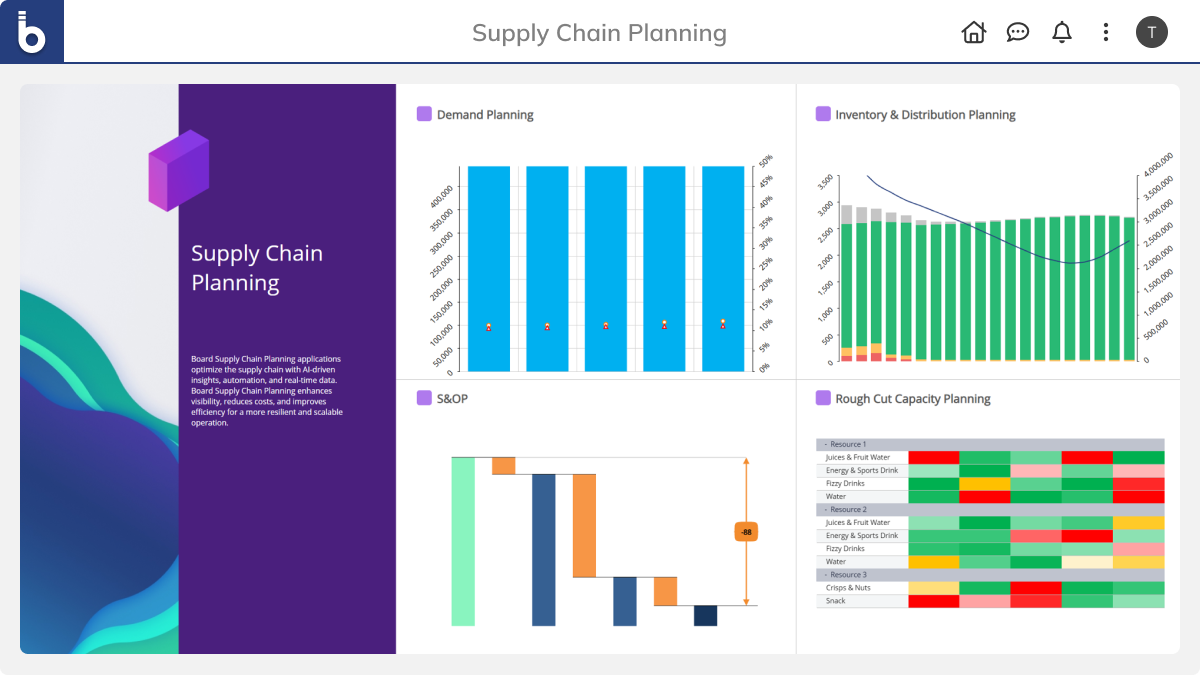

Let’s see what Board can do for you.
Get a tour of the Agentic Planning Platform in action.