
What is Supply Planning?
What is Supply Planning?
Supply planning is the process of determining how to meet forecasted demand by aligning production, procurement, and distribution with available resources, capacity, and constraints.
Supply Planning Explained
Supply planning ensures that an organization can fulfill expected demand efficiently and reliably. It translates demand plans into actionable supply decisions, such as how much to produce, what to procure, when to replenish inventory, and how to allocate resources across the supply chain.
While demand planning focuses on what customers are expected to buy, supply planning focuses on how the organization will deliver it.
Supply planning requires balancing multiple variables, including:
- production capacity
- supplier availability
- lead times
- inventory levels
- cost constraints
- service level targets
This makes it a complex, constraint-driven process. Organizations must continuously evaluate trade-offs between cost, efficiency, and service levels.
Supply planning is inherently cross-functional. It involves collaboration between:
- supply chain and operations, which manage production and logistics
- procurement, which manages suppliers and sourcing
- finance, which evaluates cost and working capital impact
- commercial teams, which provide demand inputs
In modern planning environments, supply planning is integrated with demand planning, inventory planning, and financial planning. Platforms such as Board enable organizations to connect these processes, allowing supply decisions to reflect both operational realities and financial objectives.
Supply planning is especially critical in industries with:
- complex manufacturing processes
- long or variable lead times
- global supply chains
- fluctuating demand
In these environments, effective supply planning is essential for maintaining service levels while controlling costs.
Why Supply Planning Matters
Supply planning helps organizations:
- Ensure that demand can be fulfilled reliably
- Optimize production and procurement decisions
- Balance cost, efficiency, and service levels
- Reduce supply chain disruptions and bottlenecks
- Improve alignment between operations and financial plans
Without effective supply planning, organizations may experience:
- stockouts and delayed deliveries
- excess production or inventory
- inefficient use of capacity
- increased operational costs
Supply planning is also key to resilience. When disruptions occur, such as supplier delays or demand shifts, strong supply planning capabilities enable organizations to adapt quickly and maintain performance.
How Supply Planning Works
Review Demand Plan
Supply planning begins with demand inputs, typically from demand planning or forecasting processes. This defines:
- expected sales volumes
- timing of demand
- product mix
Assess Capacity and Constraints
Organizations evaluate their ability to meet demand based on:
- production capacity
- workforce availability
- supplier constraints
- lead times
- logistics capabilities
This step identifies potential bottlenecks or limitations.
Develop Supply Plan
Based on demand and constraints, organizations create a supply plan that defines:
- production schedules
- procurement requirements
- inventory replenishment
- distribution plans
The goal is to meet demand as efficiently as possible.
Evaluate Trade-offs
Supply planning often involves trade-offs, such as:
- increasing production vs outsourcing
- holding more inventory vs risking stockouts
- prioritizing certain products or customers
These decisions are evaluated based on cost, service levels, and strategic priorities.
Align and Execute
Supply plans are aligned across functions to ensure consistency with:
- financial targets
- operational capabilities
- business priorities
Monitor and Adjust
Supply plans are updated regularly based on:
- changes in demand
- supply disruptions
- performance data
This enables organizations to respond quickly to changing conditions.
Supply Planning vs Demand Planning
Supply Planning | Demand Planning |
Focuses on how to meet demand | Focuses on predicting demand |
Driven by capacity and constraints | Driven by customer behavior and data |
Operational and execution-oriented | Analytical and forecast-driven |
Translates demand into action | Provides input for planning |
The two processes are closely linked and must be aligned for effective planning.
Supply Planning vs Inventory Planning
Supply Planning | Inventory Planning |
Focuses on production and sourcing decisions | Focuses on stock levels and replenishment |
Determines how supply is created | Determines how inventory is held |
Driven by capacity and constraints | Driven by demand and service levels |
Supply planning and inventory planning work together to ensure both availability and efficiency.
Examples in Practice
Manufacturing Example
A manufacturer develops production schedules based on demand forecasts and capacity constraints, ensuring that output aligns with expected sales.
Supply Chain Example
A company adjusts procurement plans based on supplier lead times and availability, ensuring that materials are available for production.
Retail Example
A retailer coordinates supply planning with inventory allocation to ensure that products are delivered to the right stores at the right time.
Disruption Scenario Example
An organization responds to a supplier delay by adjusting production plans and reallocating inventory to maintain service levels.
Key Benefits
- Improved ability to meet customer demand
- More efficient use of production and supply chain resources
- Reduced operational costs
- Better alignment between demand and supply
- Increased resilience to disruptions
Related Terms
FAQs
See how Board transforms supply planning
Board’s Supply Planning software helps organizations optimize procurement, inventory, and production plans. With segmentation, constraint-based logic, and scenario planning, you can balance service, cost, and margin in one connected process.
Learn more about Board's supply planning solution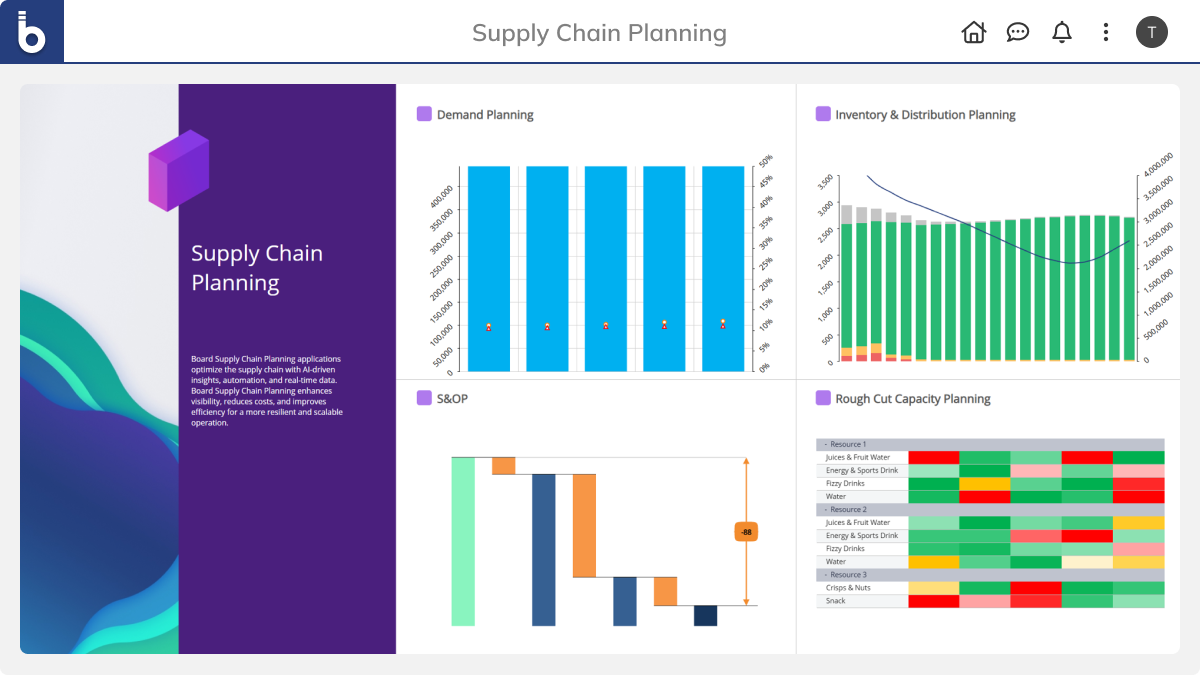

Let’s see what Board can do for you.
Get a tour of the Agentic Planning Platform in action.