
What is Inventory Planning?
What is Inventory Planning?
Inventory planning is the process of determining how much inventory to hold, where to hold it, and when to replenish it to meet customer demand while minimizing costs and optimizing working capital.
Inventory Planning Explained
Inventory planning ensures that organizations maintain the right balance between product availability and inventory investment. It connects demand forecasts with supply decisions to determine optimal stock levels across locations such as warehouses, distribution centers, and retail stores.
At its core, inventory planning answers a key business question:
How much inventory is needed to meet demand without overstocking or tying up excessive capital?
Too little inventory can result in stockouts, lost sales, and poor customer experience. Too much inventory can lead to increased holding costs, obsolescence, markdowns, and pressure on working capital. Inventory planning helps organizations navigate this trade-off.
Inventory planning is inherently cross-functional. It relies on inputs from:
- Demand planning, which provides forecasts of future sales
- Supply planning, which determines how products are sourced or produced
- Finance, which sets targets for working capital and profitability
- Retail or operations, which manage stock at store or location level
In modern organizations, inventory planning is increasingly integrated into broader planning processes. Platforms such as Board allow organizations to connect inventory planning with financial planning, demand forecasting, and supply chain decisions, creating a unified and responsive planning environment.
Inventory planning is particularly critical in industries with:
- large product assortments
- seasonal or volatile demand
- complex supply chains
- omnichannel distribution models
In these environments, effective inventory planning directly impacts both customer satisfaction and financial performance.
Why Inventory Planning Matters
Inventory planning helps organizations:
- Ensure product availability and improve service levels
- Reduce excess inventory and associated costs
- Optimize working capital and cash flow
- Improve operational efficiency
- Align supply chain decisions with financial objectives
Without effective inventory planning, organizations often experience:
- stockouts and lost revenue
- excess stock and markdowns
- inefficient use of capital
- misalignment between demand and supply
Inventory is often one of the largest assets on a company’s balance sheet. Managing it effectively is critical to both operational performance and financial health.
Inventory planning also plays a key role in enabling agility. When demand changes or supply disruptions occur, organizations with strong inventory planning capabilities can respond more quickly and effectively.
How Inventory Planning Works
Analyze Demand
Inventory planning begins with understanding expected demand using inputs from demand planning and forecasting. This includes:
- historical sales data
- seasonality
- promotional activity
- market trends
This provides the baseline for determining inventory requirements.
Determine Inventory Targets
Organizations define target inventory levels based on factors such as:
- service level goals
- lead times
- demand variability
- cost constraints
This may include setting safety stock levels to buffer against uncertainty.
Plan Replenishment
Replenishment plans determine:
- when to reorder inventory
- how much to order
- where to allocate stock
These decisions ensure that inventory is replenished efficiently without overstocking.
Allocate Inventory Across Locations
Inventory is distributed across:
- warehouses
- distribution centers
- retail stores
Allocation decisions ensure that stock is positioned where demand is expected.
Monitor and Adjust
Inventory plans are continuously monitored and updated based on:
- actual sales performance
- changes in demand
- supply chain constraints
This enables organizations to respond quickly to changes and maintain optimal inventory levels.
Inventory Planning vs Inventory Management
Inventory Planning | Inventory Management |
Focuses on future inventory decisions | Focuses on day-to-day inventory control |
Strategic and forward-looking | Operational and execution-focused |
Determines what inventory should be held | Tracks and manages existing inventory |
Supports planning and optimization | Supports execution and monitoring |
Inventory planning defines the strategy, while inventory management ensures that it is executed effectively.
Inventory Planning vs Demand Planning
Inventory Planning | Demand Planning |
Determines how much inventory to hold | Forecasts customer demand |
Focuses on stock levels and replenishment | Focuses on demand signals |
Balances availability and cost | Provides input for planning decisions |
Demand planning provides the input, while inventory planning determines how to respond.
Examples in Practice
Retail Example
A retailer plans inventory levels for seasonal products, ensuring that stores are stocked ahead of peak demand while avoiding excess inventory after the season ends.
Supply Chain Example
A manufacturer determines optimal inventory levels across distribution centers to balance service levels with transportation and storage costs.
E-commerce Example
An online retailer allocates inventory across fulfillment centers to ensure fast delivery while minimizing shipping costs.
Finance Example
Finance teams monitor inventory levels to manage working capital and ensure that inventory investment aligns with financial targets.
Key Benefits
- Improved product availability and customer satisfaction
- Reduced inventory costs and waste
- Better working capital management
- Increased operational efficiency
- Stronger alignment between demand, supply, and finance
Related Terms
FAQs
See how Board transforms inventory planning
Board’s Supply Planning software helps organizations optimize procurement, inventory, and production plans. With segmentation, constraint-based logic, and scenario planning, you can balance service, cost, and margin in one connected process.
Learn more about Board's supply planning solution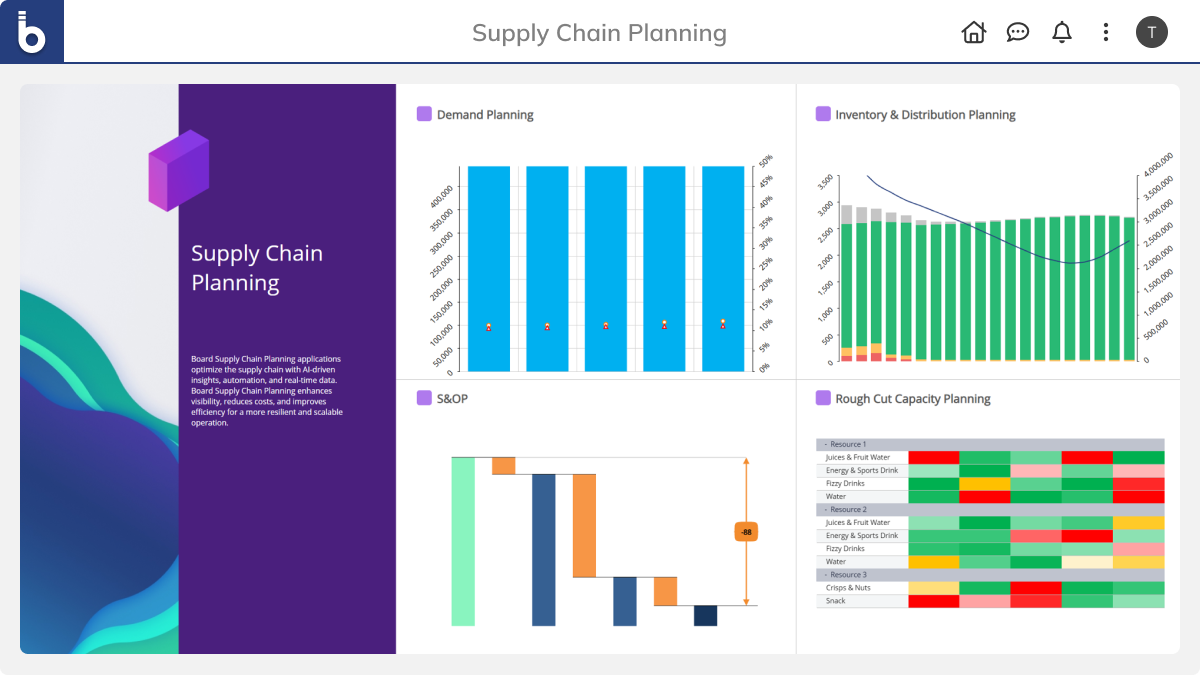

Let’s see what Board can do for you.
Get a tour of the Agentic Planning Platform in action.