
What is Demand Planning?
What is Demand Planning?
Demand planning is the process of forecasting customer demand to ensure that products are available at the right time, in the right quantities, and at the right locations.
Demand Planning Explained
Demand planning is a core supply chain capability that helps organizations anticipate future customer demand and align their operations accordingly. It sits at the intersection of forecasting, supply chain planning, and business strategy, ensuring that demand signals are translated into actionable plans.
At its core, demand planning goes beyond simply predicting sales. It involves combining historical data, market trends, commercial inputs, and business assumptions to create a realistic and aligned view of future demand. This demand plan is then used to guide decisions across production, inventory, procurement, and distribution.
Demand planning is inherently cross-functional. Sales, marketing, finance, and supply chain teams all contribute inputs, such as promotional plans, pricing changes, market conditions, and strategic initiatives. This ensures that demand forecasts reflect both data and real business activity.
In modern organizations, demand planning is increasingly supported by integrated planning platforms such as Board, which connect demand forecasts with financial plans, inventory strategies, and operational decisions. This allows organizations to move from disconnected forecasting processes to a more unified and responsive planning approach.
Demand planning is particularly important in industries with high variability, seasonality, or complex supply chains. In these environments, inaccurate demand planning can lead to stockouts, excess inventory, lost sales, or increased costs.
Why Demand Planning Matters
Demand planning helps organizations:
- Ensure product availability and improve customer satisfaction
- Reduce excess inventory and associated costs
- Align supply chain operations with expected demand
- Improve forecast accuracy and planning reliability
- Support better decision-making across functions
Without effective demand planning, organizations often operate reactively, responding to demand after it occurs rather than preparing for it. This can lead to inefficiencies, missed revenue opportunities, and increased operational risk.
Demand planning also plays a critical role in financial performance. Accurate demand forecasts directly impact revenue projections, cost planning, and working capital management.
How Demand Planning Works
Collect and Analyze Data
Demand planning begins with gathering relevant data, including:
- historical sales data
- seasonal trends
- market and economic indicators
- customer behavior
- promotional and pricing plans
This data provides the foundation for forecasting demand.
Generate a Demand Forecast
Using this data, organizations create an initial forecast using methods such as:
- statistical models
- trend analysis
- predictive analytics
This forecast provides a baseline view of expected demand.
Incorporate Business Inputs
The forecast is then adjusted based on inputs from across the business, including:
- sales pipeline and customer insights
- marketing campaigns and promotions
- product launches
- pricing strategies
This ensures the forecast reflects real-world conditions.
Align Across Functions
Demand plans are reviewed and aligned across departments to ensure consistency with:
- supply chain capacity
- production plans
- financial targets
This step is critical for avoiding misalignment between demand and supply.
Monitor and Update
Demand plans are updated regularly as new data becomes available. This allows organizations to respond quickly to changes in demand patterns.
Demand Planning vs Forecasting
| Demand Planning | Forecasting |
Focuses on aligning demand with business operations | Focuses on predicting future outcomes |
Incorporates cross-functional inputs | Often data-driven and statistical |
Drives supply chain decisions | Provides baseline predictions |
More operational and collaborative | More analytical |
Forecasting is a key component of demand planning, but demand planning extends beyond forecasting to include alignment and execution.
Demand Planning vs Demand Forecasting
| Demand Planning | Demand Forecasting |
End-to-end process | Specific forecasting activity |
Includes collaboration and alignment | Focuses on prediction |
Drives business decisions | Produces forecast outputs |
Demand forecasting is one step within the broader demand planning process.
Examples in Practice
Supply Chain Example
A manufacturer forecasts demand for its products and uses this information to plan production schedules, ensuring that capacity is aligned with expected sales.
Retail Example
A retailer forecasts seasonal demand for key product categories and adjusts inventory levels, promotions, and staffing to match expected customer activity.
Finance Example
Finance teams use demand plans to inform revenue forecasts, cost projections, and working capital planning.
Sales and Marketing Example
Sales and marketing teams provide input on promotions and campaigns, which are incorporated into demand plans to improve forecast accuracy.
Key Benefits
- Improved product availability and customer satisfaction
- Reduced inventory costs and waste
- Better alignment between demand and supply
- More accurate financial planning
- Increased agility in responding to market changes
Related Terms
- Supply Chain Planning
- Demand Forecasting
- Supply Planning
- Inventory Planning
- S&OP (Sales & Operations Planning)
FAQs
See how Board transforms demand planning
Board’s Supply Chain Planning software transforms planning from siloed guesswork to a continuous, scenario-driven process – delivering visibility, alignment, and agility across your entire network.
Learn more about demand planning with Board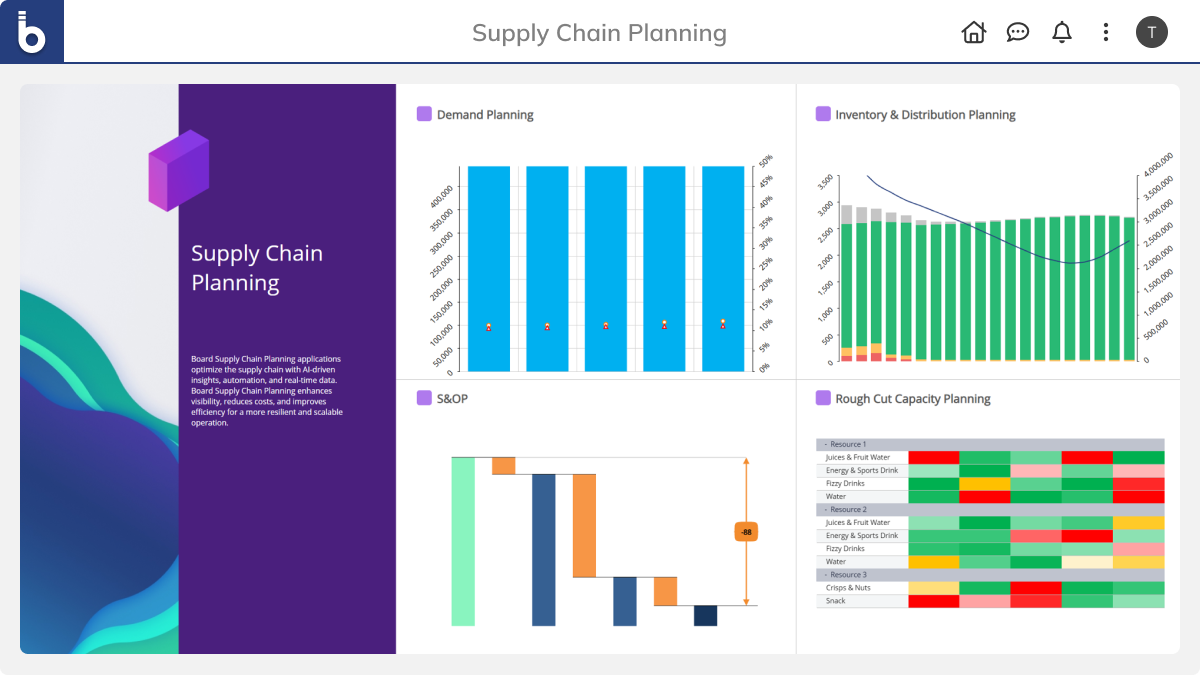

Let’s see what Board can do for you.
Get a tour of the Agentic Planning Platform in action.