
What is Demand Forecasting?
What is Demand Forecasting?
Demand forecasting is the process of predicting future customer demand using historical data, trends, and analytical methods to support planning and decision-making.
Demand Forecasting Explained
Demand forecasting is a core planning activity that helps organizations estimate how much customers will buy over a given period. It provides the foundation for a wide range of business decisions, from inventory and production planning to financial forecasting and resource allocation.
At its core, demand forecasting focuses on predicting future demand as accurately as possible. It uses a combination of:
- historical sales data
- statistical models
- market trends
- business assumptions
to generate forecasts that reflect likely future outcomes.
Demand forecasting is used across multiple functions:
- Supply chain to plan production and inventory
- Retail to forecast sales at product and store level
- Finance to support revenue forecasting
- Operations to align capacity and resources
While demand forecasting is often data-driven, it is not purely technical. It typically involves collaboration between teams such as sales, marketing, and finance, who provide context around promotions, product launches, and market conditions.
Modern planning platforms such as Board enable organizations to combine statistical forecasting with business inputs, creating more accurate and aligned demand forecasts. These platforms also allow forecasts to be updated continuously as new data becomes available.
Demand forecasting is particularly important in environments with:
- variable or seasonal demand
- large product portfolios
- fast-changing market conditions
- complex supply chains
In these environments, even small improvements in forecast accuracy can have a significant impact on performance.
Why Demand Forecasting Matters
Demand forecasting helps organizations:
- Anticipate customer demand more accurately
- Improve product availability and customer service
- Reduce excess inventory and associated costs
- Support better production and supply decisions
- Improve financial planning and revenue forecasting
Without accurate demand forecasts, organizations often operate reactively, responding to demand after it occurs rather than planning ahead. This can lead to:
- stockouts and lost sales
- excess inventory and markdowns
- inefficient use of resources
- misalignment between functions
Demand forecasting provides the foundation for proactive planning, enabling organizations to make better decisions and respond more effectively to change.
How Demand Forecasting Works
Collect Historical and External Data
The process begins by gathering relevant data, including:
- historical sales data
- seasonal patterns
- market trends
- external factors such as economic conditions
This data provides the basis for forecasting.
Apply Forecasting Models
Organizations use a range of methods to generate forecasts, including:
- statistical models
- trend analysis
- time-series forecasting
- predictive analytics and machine learning
These models identify patterns and project them into the future.
Incorporate Business Inputs
Forecasts are adjusted based on input from:
- sales teams
- marketing campaigns
- product launches
- pricing changes
This ensures forecasts reflect real business activity.
Generate and Review Forecasts
Forecasts are produced at different levels, such as:
- product or SKU level
- category level
- regional or store level
They are reviewed and validated to ensure accuracy and relevance.
Monitor and Update
Demand forecasts are updated regularly based on:
- actual sales performance
- changing market conditions
- new business inputs
This ensures forecasts remain accurate over time.
Demand Forecasting vs Demand Planning
| Demand Forecasting | Demand Planning |
Focuses on predicting demand | Focuses on aligning operations to meet demand |
Analytical and model-driven | Cross-functional and decision-driven |
Produces forecast outputs | Uses forecasts to guide business decisions |
Demand forecasting is a key component of demand planning.
Demand Forecasting vs Forecasting
| Demand Forecasting | Forecasting |
Focuses specifically on customer demand | Broader concept across business functions |
Often more granular | Can be high-level or financial |
Operational and supply chain-focused | Used across finance, operations, and strategy |
Demand forecasting is a specialized type of forecasting.
Examples in Practice
Retail Example
A retailer forecasts demand for seasonal products at SKU and store level, ensuring that inventory is aligned with expected sales.
Supply Chain Example
A manufacturer forecasts demand for finished goods, enabling production and procurement planning.
Finance Example
Finance teams use demand forecasts to inform revenue projections and financial planning.
Promotion Example
A retailer forecasts increased demand from a promotional campaign, adjusting inventory and supply plans accordingly.
Key Benefits
- Improved forecast accuracy
- Better product availability and customer satisfaction
- Reduced excess inventory and costs
- More efficient production and supply planning
- Stronger alignment across functions
Related Terms
FAQs
See how Board transforms demand forecasting
Board’s Supply Chain Planning software transforms planning from siloed guesswork to a continuous, scenario-driven process – delivering visibility, alignment, and agility across your entire network.
Explore Board's Demand Planning solution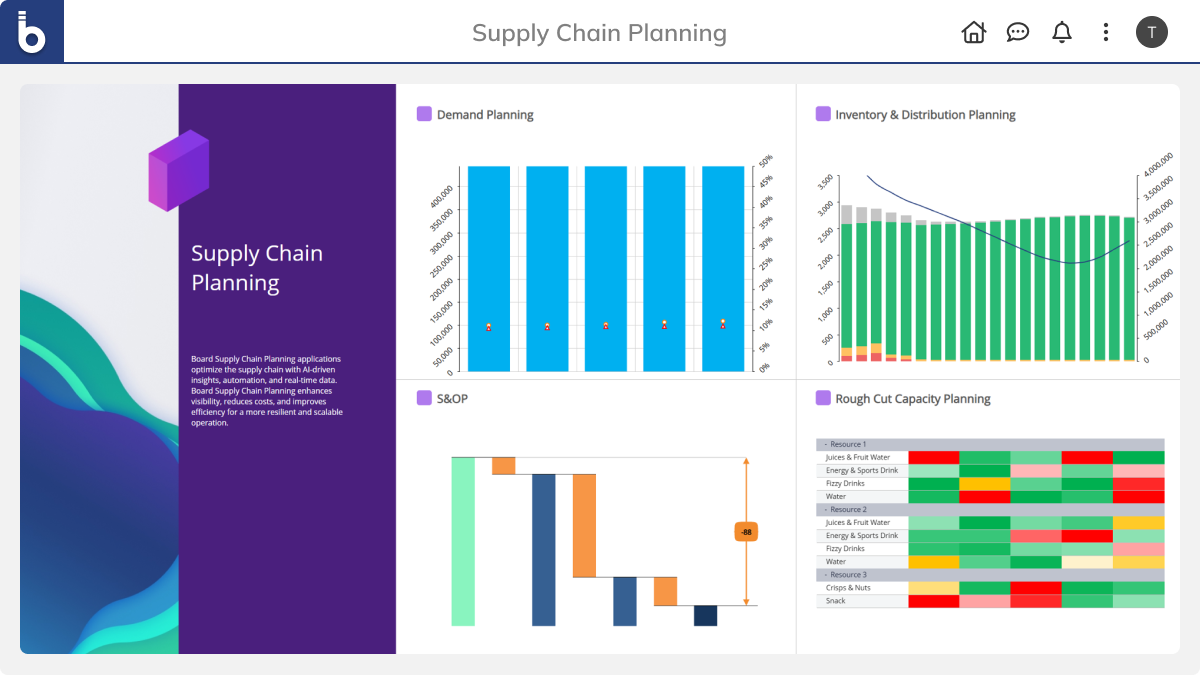

Let’s see what Board can do for you.
Get a tour of the Agentic Planning Platform in action.