
What is S&OP (Sales & Operations Planning)?
What is S&OP?
Sales & Operations Planning (S&OP) is a cross-functional process that aligns demand, supply, and financial plans to ensure that an organization can meet customer demand efficiently while achieving business objectives.
S&OP Explained
Sales & Operations Planning (S&OP) is a structured, collaborative planning process that brings together key functions – including sales, supply chain, operations, and finance – to create a unified plan for the business.
At its core, S&OP ensures that demand and supply are balanced. It connects forecasts of customer demand with the organization’s ability to produce, source, and deliver products. This alignment helps organizations avoid stockouts, excess inventory, and inefficient operations.
S&OP is typically conducted on a regular cycle, often monthly, and involves reviewing performance, updating forecasts, evaluating constraints, and making decisions about how to adjust plans.
Unlike siloed planning approaches, S&OP creates a single, agreed-upon plan that all functions work from. This improves coordination, reduces conflicts between departments, and enables more effective decision-making.
Modern organizations increasingly use integrated planning platforms such as Board to support S&OP. These platforms connect data across functions, automate workflows, and provide real-time visibility into performance and plans, enabling faster and more informed decisions.
S&OP is particularly important in organizations with:
- complex supply chains
- fluctuating demand
- multiple product lines
- global operations
In these environments, alignment between demand and supply is critical to maintaining performance and customer satisfaction.
Why S&OP Matters
S&OP helps organizations:
- Align demand and supply across the business
- Improve customer service and product availability
- Reduce excess inventory and operational costs
- Enhance cross-functional collaboration
- Support better decision-making at both operational and executive levels
Without S&OP, organizations often experience:
- misalignment between demand forecasts and supply capabilities
- inefficiencies in production and inventory
- conflicting priorities across departments
- delayed or reactive decision-making
S&OP provides a structured way to coordinate planning across functions, ensuring that decisions are made with a full understanding of their impact across the business.
How S&OP Works
S&OP typically follows a structured cycle with several key steps:
Data Gathering and Performance Review
Organizations begin by reviewing:
- historical performance
- sales and demand trends
- inventory levels
- supply chain performance
This provides a baseline for planning and identifies key issues.
Demand Planning
Teams develop updated demand forecasts based on:
- sales data
- market trends
- customer insights
- promotional plans
This defines expected demand for the planning period.
Supply Planning
Supply plans are created to meet demand, taking into account:
- production capacity
- supplier constraints
- inventory availability
- logistics considerations
Reconciliation and Scenario Planning
Demand and supply plans are compared to identify gaps or imbalances. Organizations evaluate:
- supply constraints
- excess inventory risks
- cost and service trade-offs
Scenario planning may be used to assess different options.
Executive Review and Decision-Making
Leadership reviews the proposed plans and makes decisions to:
- resolve imbalances
- adjust priorities
- align plans with strategic objectives
The result is a single, approved plan for the organization.
S&OP vs IBP (Integrated Business Planning)
| S&OP | IBP |
Focuses on balancing demand and supply | Extends S&OP to include financial and strategic planning |
Primarily operational | More strategic and enterprise-wide |
Short- to medium-term horizon | Includes longer-term planning |
Supply chain-led | Cross-functional and executive-led |
IBP builds on S&OP by incorporating financial planning and strategic alignment across the business.
S&OP vs Demand Planning
| S&OP | Demand Planning |
End-to-end alignment process | Focuses on forecasting demand |
Cross-functional | Primarily analytical |
Includes supply and operations | Focuses on customer demand |
Demand planning is a key input into S&OP.
Examples in Practice
Manufacturing Example
A manufacturer uses S&OP to align production plans with demand forecasts, ensuring capacity is used efficiently while meeting customer demand.
Retail Example
A retailer aligns demand forecasts, inventory plans, and supply chain decisions to ensure product availability during peak seasons.
Consumer Goods Example
A consumer goods company uses S&OP to coordinate promotions, demand forecasts, and production schedules across multiple regions.
Executive Planning Example
Leadership uses S&OP to evaluate trade-offs between service levels, cost, and inventory, ensuring alignment with business goals.
Key Benefits
- Improved alignment between demand and supply
- Better customer service and product availability
- Reduced inventory and operational costs
- Stronger collaboration across functions
- Faster and more informed decision-making
Related Terms
- Supply Chain Planning
- Demand Planning
- Supply Planning
- Integrated Business Planning (IBP)
- Forecasting
FAQs
See how Board transforms S&OP
Seamlessly integrate and collaborate with sales, operations, and finance to optimize inventory levels, minimize disruptions, and maximize profitability.
Learn more about Board's S&OP solution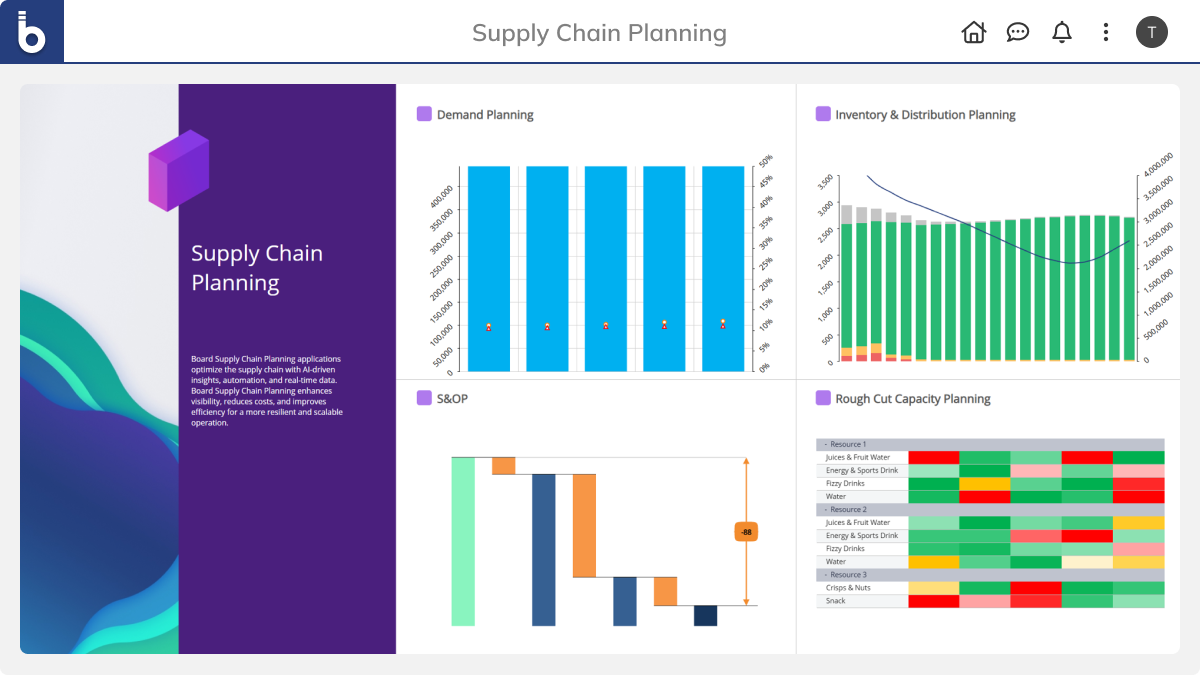

Let’s see what Board can do for you.
Get a tour of the Agentic Planning Platform in action.