
What is Scenario Planning?
What is Scenario Planning?
Scenario planning is the process of modeling and evaluating different possible future outcomes based on varying assumptions, enabling organizations to assess risks, explore opportunities, and support better decision-making under uncertainty.
Scenario Planning Explained
Scenario planning helps organizations prepare for uncertainty by exploring how changes in key variables could impact business performance. Instead of relying on a single forecast, it allows teams to develop multiple potential scenarios – such as best case, worst case, and most likely – and understand their implications.
These scenarios are typically based on changes in factors such as demand, pricing, costs, supply chain conditions, market trends, or macroeconomic shifts. By modeling these variations, organizations can see how sensitive their plans are to change and where risks or opportunities may emerge.
Scenario planning is widely used across finance, supply chain, retail, and corporate strategy. In finance, it supports forecasting and performance planning. In supply chain, it helps anticipate disruptions or demand fluctuations. In retail, it supports decisions around inventory, pricing, and promotions.
Modern planning platforms such as Board enable scenario planning at scale by allowing organizations to create, compare, and update multiple scenarios within a single environment. This removes the need for disconnected models and manual consolidation, making the process faster, more collaborative, and more reliable.
Scenario planning does not aim to predict exactly what will happen. Instead, it helps organizations understand what could happen and how they should respond. This shift from prediction to preparedness is what makes it such a critical capability in complex and rapidly changing environments.
Why Scenario Planning Matters
Scenario planning helps organizations:
- Prepare for uncertainty and reduce risk
- Evaluate strategic options before committing resources
- Identify potential opportunities and threats earlier
- Improve the quality and speed of decision-making
- Align stakeholders around a shared view of possible outcomes
In volatile environments, relying on a single plan can leave organizations exposed. Scenario planning provides a structured way to think through uncertainty and develop more resilient strategies.
It is particularly valuable for leadership teams who need to make decisions with incomplete information. By understanding a range of possible outcomes, they can make more informed and confident choices.
Scenario planning also improves alignment across functions. Finance, operations, and commercial teams can evaluate the same scenarios and understand how changes in one area affect the rest of the business.
How Scenario Planning Works
Define Key Variables and Uncertainties
The process begins by identifying the factors that are most likely to influence performance. These may include:
- demand levels
- pricing changes
- cost fluctuations
- supply chain constraints
- economic conditions
- competitive dynamics
Focusing on the most impactful variables ensures that scenarios remain relevant and actionable.
Develop Scenarios
Organizations then create a set of distinct scenarios based on different assumptions. Common approaches include:
- best case, worst case, and most likely
- optimistic, baseline, and downside
- specific event-driven scenarios, such as supply disruption or demand surge
Each scenario represents a coherent and plausible version of the future.
Model Financial and Operational Impact
Using financial models or planning tools, organizations translate each scenario into measurable outcomes, such as:
- revenue
- costs
- margins
- cash flow
- inventory levels
- capacity requirements
This step is critical because it turns abstract scenarios into concrete insights.
Compare Scenarios and Evaluate Trade-offs
Once scenarios are modeled, decision-makers compare outcomes to understand:
- potential risks and downside exposure
- opportunities for growth or improvement
- trade-offs between different decisions
This helps organizations prioritize actions and allocate resources more effectively.
Define Actions and Contingency Plans
The final step is deciding how to respond. This may include:
- adjusting forecasts or budgets
- reallocating resources
- changing pricing or production plans
- preparing contingency plans for specific risks
Scenario planning is most valuable when it leads to clear, actionable decisions rather than remaining a theoretical exercise.
Scenario Planning vs Forecasting
| Scenario Planning | Forecasting |
Explores multiple possible futures | Predicts a single expected outcome |
Focuses on uncertainty and variability | Focuses on likely performance |
Supports strategic decision-making | Supports planning and tracking |
Often used for “what if” analysis | Often used for ongoing updates |
Forecasting and scenario planning are complementary. Forecasting provides a baseline view of expected performance, while scenario planning explores how that performance could change under different conditions.
Scenario Planning vs Financial Modeling
| Scenario Planning | Financial Modeling |
Focuses on defining and comparing scenarios | Focuses on building the analytical structure |
Often strategic and decision-oriented | Often analytical and calculation-driven |
Uses models to evaluate outcomes | Provides the engine for scenario analysis |
Financial modeling is often used to quantify scenarios, while scenario planning provides the framework for comparing them and making decisions.
Examples in Practice
Finance Example
A finance team models different revenue scenarios based on changes in sales pipeline conversion rates. This helps adjust forecasts and spending plans before the end of the quarter.
Supply Chain Example
A manufacturer evaluates scenarios based on potential disruptions to key suppliers. By modeling the impact on production, costs, and delivery timelines, the business can prepare alternative sourcing strategies.
Retail Example
A retailer creates scenarios for different levels of seasonal demand. This helps optimize inventory levels, staffing, and promotional activity to balance risk and opportunity.
Corporate Strategy Example
A strategy team models scenarios for entering a new market, including varying levels of customer adoption, competitive response, and cost structure. This supports investment decisions and risk assessment.
Executive Planning Example
Leadership evaluates scenarios based on macroeconomic conditions such as inflation or demand slowdown. This helps shape strategic priorities and contingency planning.
Key Benefits
- Better preparedness for uncertainty
- More informed and confident decision-making
- Improved alignment across functions
- Faster response to changing conditions
- Stronger strategic planning and risk management
Related Terms
FAQs
See how Board enhances scenario planning
Board helps you maintain control over critical initiatives, assess how decisions impact financials, and ensure full alignment across the enterprise.
Explore Board for strategic planning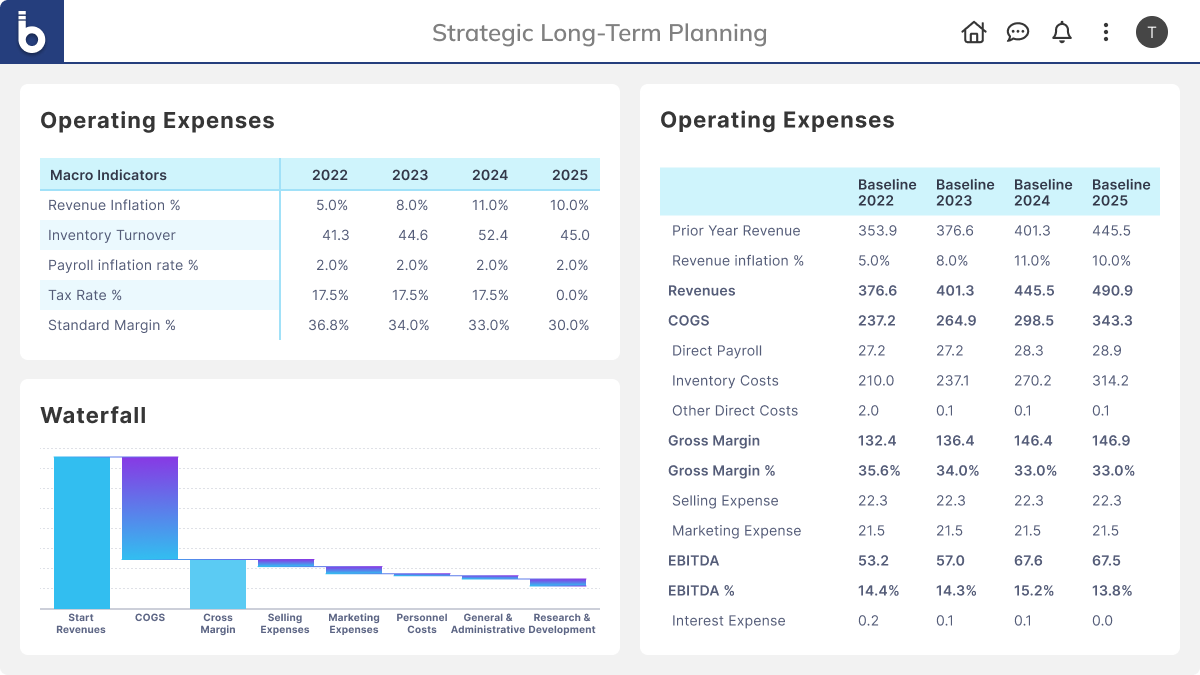

Let’s see what Board can do for you.
Get a tour of the Agentic Planning Platform in action.