
What is Financial Modeling?
What is Financial Modeling?
Financial modeling is the process of creating a structured representation of a company’s financial performance to evaluate decisions, forecast outcomes, and understand the potential impact of different business scenarios.
Financial Modeling Explained
Financial modeling helps organizations translate business assumptions into financial outcomes. It gives finance teams and business leaders a way to test how changes in revenue, costs, investment, pricing, demand, headcount, or market conditions could affect performance over time.
At its core, a financial model connects inputs, assumptions, calculations, and outputs. Inputs might include sales growth, customer demand, labor costs, or capital expenditure. The model then uses these assumptions to calculate outputs such as revenue, margin, profit, cash flow, or return on investment.
Financial modeling is widely used in FP&A, corporate strategy, budgeting, forecasting, and investment planning. It supports both short-term decisions – such as revising a forecast – and longer-term decisions such as evaluating acquisitions, entering new markets, launching products, or funding transformation programs.
Traditionally, financial modeling has often been done in spreadsheets. While spreadsheets remain common, they can become difficult to manage as businesses grow more complex. Version control issues, inconsistent assumptions, and limited collaboration can all reduce confidence in the outputs. Integrated planning platforms such as Board help organizations scale financial modeling by connecting data, assumptions, and planning processes in a more governed and collaborative environment.
Financial modeling is especially valuable in complex organizations because it helps decision-makers move beyond intuition. Instead of asking “What do we think will happen?”, teams can ask “What does the model suggest will happen if these assumptions change?” That shift creates a more disciplined and transparent approach to planning.
Why Financial Modeling Matters
Financial modeling matters because it allows organizations to make better decisions with greater clarity and confidence.
It helps organizations:
- Evaluate strategic decisions before committing resources
- Understand the financial impact of different scenarios
- Improve planning accuracy by linking assumptions to outcomes
- Create transparency around business drivers
- Support collaboration between finance and operational teams
- Reduce reliance on instinct or fragmented analysis
In many organizations, leaders need to make decisions under uncertainty. They may be considering a change in pricing, an investment in expansion, a shift in sourcing strategy, or a hiring plan tied to growth targets. Financial modeling helps quantify the likely impact of those decisions and compare options in a structured way.
It also strengthens communication. When finance can explain not just the result, but the assumptions and mechanics behind it, business stakeholders are more likely to trust the analysis and align around decisions.
For organizations pursuing transformation, financial modeling can also be a critical planning tool. It helps quantify expected value, assess risks, and track whether initiatives are likely to deliver the intended financial outcomes.
How Financial Modeling Works
Define the Business Question
A financial model should start with a clear purpose. Common questions include:
- What happens to profit if sales growth slows?
- How will a pricing change affect margin?
- Can the business fund a planned investment?
- What is the likely return on a strategic initiative?
- How would a supply chain disruption affect revenue and cost?
Starting with the business question ensures the model is useful rather than overly complex.
Establish Inputs and Assumptions
The next step is defining the variables the model will use. These may include:
- revenue growth rates
- sales volumes
- pricing assumptions
- cost inflation
- headcount plans
- production capacity
- working capital assumptions
- capital expenditure
- tax rates or financing costs
These assumptions should be transparent, documented, and regularly reviewed.
Build the Logic and Relationships
The model then connects these assumptions through formulas and business logic. For example:
- revenue may be driven by price x volume
- labor cost may be driven by headcount x average salary
- operating margin may be affected by mix, input costs, and utilization
- cash flow may depend on payment timing, investment plans, and working capital movements
This is where the model becomes more than a calculator – it becomes a representation of how the business works.
Generate Outputs
Outputs depend on the purpose of the model, but often include:
- revenue
- gross margin
- operating profit
- EBITDA
- cash flow
- return on investment
- breakeven analysis
- scenario comparisons
The outputs should be presented in a way that supports decision-making, not just technical analysis.
Test Scenarios and Sensitivities
One of the most valuable uses of financial modeling is testing how outcomes change when assumptions move. This may include:
- best-case, worst-case, and most likely scenarios
- sensitivity testing on pricing, demand, or cost assumptions
- downside planning for disruption or delayed growth
- upside planning for expansion or improved performance
This is what makes financial modeling such an important companion to scenario planning and forecasting.
Review and Update
A model is only useful if it reflects current business conditions. Inputs and assumptions should be revisited regularly, especially when the model is used for ongoing planning rather than one-off analysis.
Integrated platforms help here by connecting models to live or refreshed business data rather than leaving them static.
Financial Modeling vs Forecasting
Financial Modeling | Forecasting |
Focuses on evaluating assumptions and scenarios | Focuses on predicting future outcomes |
Often used for decision analysis and planning | Often used for ongoing performance outlook |
Can be one-off or recurring | Usually recurring |
Explores “what if” questions | Estimates “what is likely” to happen |
The two are closely related. Forecasting often depends on financial modeling, and financial models frequently use forecast assumptions. The difference is mainly one of purpose. Forecasting is about estimating future performance. Financial modeling is about understanding how different assumptions and decisions shape that performance.
Financial Modeling vs Scenario Planning
Financial Modeling | Scenario Planning |
The analytical structure used to calculate outcomes | The process of comparing different possible futures |
Often focused on formulas, logic, and assumptions | Often focused on strategic choices and uncertainty |
Can support a single case or many cases | Usually involves multiple scenarios |
Scenario planning often relies on financial models to quantify each scenario. In that sense, financial modeling is frequently the engine behind scenario analysis.
Examples in Practice
FP&A Example
A finance team builds a financial model to assess how a slower sales pipeline conversion rate would affect quarterly revenue, operating margin, and hiring plans. The model helps the business decide whether to adjust spending before the quarter closes.
Supply Chain Example
A manufacturer models the financial impact of longer lead times and rising raw material costs. By connecting operational assumptions with margin and working capital outcomes, the business can evaluate sourcing alternatives and production plans.
Retail Example
A retailer builds a model to test how changes in pricing, promotion intensity, and product mix could affect revenue and gross margin during a peak trading season. This supports better commercial planning and inventory decisions.
Corporate Strategy Example
A strategy team uses financial modeling to evaluate a market expansion initiative. The model estimates revenue potential, investment requirements, payback period, and downside risk under different adoption scenarios.
Transformation Example
An organization planning a finance transformation program uses a financial model to quantify expected efficiency gains, implementation costs, and long-term return on investment. This helps leadership assess whether the initiative is financially viable.
Key Benefits
- Better decision support for strategic and operational choices
- Clearer visibility into how business drivers affect financial outcomes
- More robust scenario analysis and sensitivity testing
- Stronger alignment between finance and the wider business
- Improved transparency and confidence in planning assumptions
- Greater consistency when models are built in a governed planning environment
Related Terms
FAQs
See how Board transforms financial modeling
Board’s planning, budgeting, and forecasting software streamlines financial processes, speeds up reporting cycles through automation, and ensures accuracy with real-time data integration.
Explore Board's PB&F solution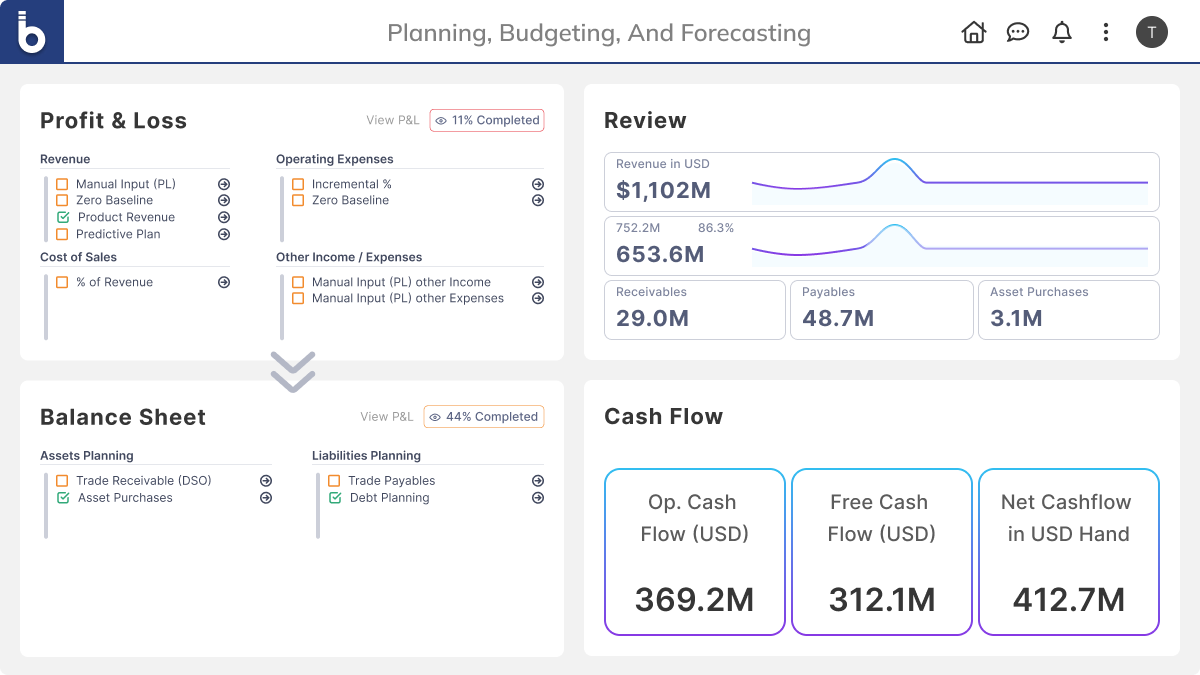

Let’s see what Board can do for you.
Get a tour of the Agentic Planning Platform in action.