
What is EPM (Enterprise Performance Management)?
What is EPM?
Enterprise Performance Management (EPM) is the set of processes, methodologies, and technologies organizations use to define strategic goals, plan and budget against them, and monitor, analyze, and report on performance to improve business outcomes. EPM connects strategy, finance, and operations so that leadership can see how the organization is performing against its objectives and adjust course when needed.
EPM Explained
EPM brings together budgeting, forecasting, financial consolidation, reporting, and analytics into a single discipline focused on managing the performance of the entire enterprise rather than a single department.
Where FP&A is typically owned by the finance function and focuses on financial planning and analysis, EPM is broader in scope. It spans finance, operations, sales, supply chain, and HR, linking strategic targets to operational plans and the financial results that follow from them. Many organizations treat FP&A as a core component within their wider EPM strategy.
At its core, EPM is built around a continuous cycle: organizations set strategic and financial goals, translate those goals into budgets and plans, execute against those plans, and then measure, report, and analyze actual performance against targets. Insights from that analysis feed back into the next planning cycle, creating a closed loop between strategy and execution.
As organizations face more volatility and complexity, EPM increasingly relies on integrated, cloud-based platforms such as Board. These platforms unify data from across the business, automate consolidation and reporting, and give finance and business leaders a single source of truth for performance, replacing fragmented spreadsheets and disconnected systems.
Why EPM Matters
EPM matters because it gives organizations a structured way to connect strategy with execution and to course-correct quickly when performance diverges from plan.
It helps organizations:
- Align financial and operational plans with strategic objectives
- Get a unified, accurate view of performance across business units and entities
- Close, consolidate, and report financial results faster and more reliably
- Identify variances and their root causes earlier
- Make faster, better-informed decisions in the face of change
Without a structured EPM approach, performance data tends to live in disconnected spreadsheets and systems across departments, making it difficult to get a consistent, timely view of how the business is actually performing.
For CFOs and other senior leaders, EPM is a key lever for driving accountability across the organization. It provides the visibility and control needed to manage growth, cost, risk, and performance against strategic targets.
How EPM Works
EPM is generally structured around five interconnected processes:
Strategic Planning
Organizations define long-term goals and the key performance indicators (KPIs) that will be used to measure progress toward them. This sets the direction for all downstream planning.
Budgeting and Forecasting
Strategic goals are translated into detailed budgets and forecasts across departments, business units, and entities. These plans set financial and operational targets for the period ahead.
Financial Consolidation and Close
Actual results from across the organization, including multiple entities, currencies, and ownership structures, are consolidated into a single, accurate set of financial statements.
Reporting and Analysis
Consolidated actuals are compared against budgets and forecasts to surface variances. Analysts and finance teams investigate the drivers behind those variances.
Modeling and Optimization
Organizations use scenario modeling to test the impact of different assumptions or decisions, helping leadership choose the path most likely to improve future performance.
EPM vs FP&A
| EPM | FP&A |
|---|---|
Enterprise-wide in scope | Primarily owned by the finance function |
Includes consolidation, close, and reporting | Focused on budgeting, forecasting, and analysis |
Connects strategy, finance, and operations | Connects financial plans to operational drivers |
Encompasses FP&A as one of its components | A core discipline within a broader EPM strategy |
In practice, the two overlap significantly and are often delivered on the same planning platform, but EPM describes the wider management discipline, while FP&A describes the finance team’s specific planning and analysis activities within it.
How EPM Fits into Modern Planning Platforms
EPM is a foundational layer of the broader Enterprise Planning Platform used by complex organizations.
These platforms:
- Connect strategic planning with financial and operational execution
- Automate consolidation, close, and regulatory reporting
- Provide a single source of truth across finance, supply chain, HR, and sales
- Support continuous planning rather than static, calendar-driven cycles
This reflects a broader shift toward connected, enterprise-wide planning, where organizations move away from siloed, function-specific tools toward a unified platform that manages performance across the entire business. EPM sits at the center of this model, providing the framework that ties strategic intent to operational and financial results.
Examples in Practice
Finance Example
A finance team consolidates results from dozens of legal entities each month, then compares consolidated actuals against budget to flag underperforming business units to leadership.
Operations Example
An operations leader tracks KPIs tied to cost and efficiency targets set during strategic planning, using EPM reporting to identify where performance is falling behind plan.
Sales Example
A sales organization links its performance targets to the company’s broader financial plan, ensuring incentive structures and quotas stay aligned with overall enterprise goals.
Executive Example
Leadership uses EPM dashboards to evaluate how current performance compares with strategic targets and to model the impact of potential changes in investment or resourcing.
Key Benefits
- A single, accurate view of performance across the enterprise
- Faster, more reliable financial consolidation and close
- Stronger alignment between strategy, finance, and operations
- Earlier visibility into variances and their root causes
- Greater agility in adjusting plans as conditions change
Related Terms
- FP&A (Financial Planning & Analysis)
- Budgeting
- Forecasting
- Continuous Planning
- Scenario Planning
- Variance Analysis
- xP&A (Extended Planning & Analysis)
- Integrated Business Planning (IBP)
FAQs
See how Board transforms enterprise performance management
Board’s EPM software connects strategic planning, budgeting, consolidation, and reporting on a single platform – giving finance and business leaders the speed, accuracy, and confidence to manage performance through volatility.
Explore Board's EPM solution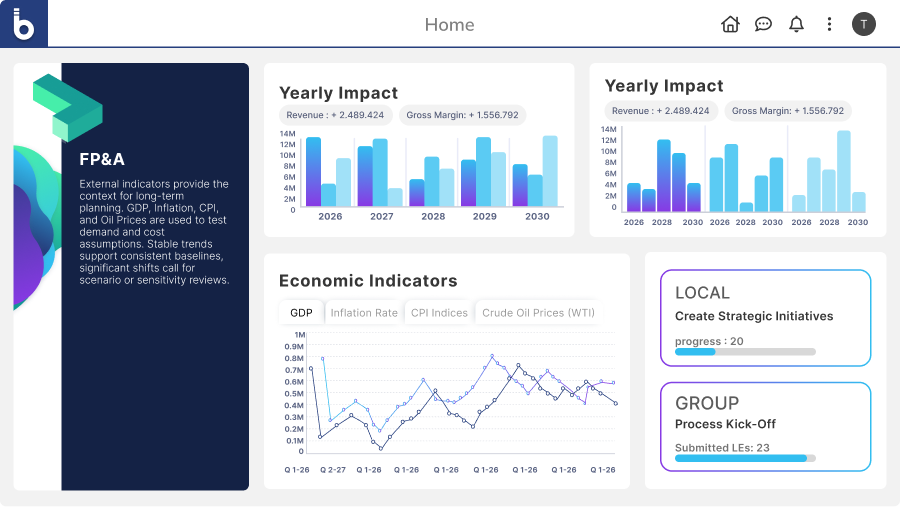

Let’s see what Board can do for you.
Get a tour of the Agentic Planning Platform in action.