
What is FP&A (Financial Planning & Analysis)?
What is FP&A?
Financial Planning & Analysis (FP&A) is the process of budgeting, forecasting, and analyzing financial performance to support strategic decision-making and improve business outcomes across an organization.
FP&A Explained
FP&A is a core function within modern finance teams, focused on helping organizations plan for the future rather than just report on the past. It brings together financial data, operational inputs, and business assumptions to create a forward-looking view of performance.
Unlike traditional accounting, which focuses on historical reporting and compliance, FP&A is inherently proactive. It enables organizations to anticipate outcomes, evaluate trade-offs, and adjust plans as conditions change.
FP&A also plays a central role in connecting finance with the wider business. It links financial results to operational drivers such as sales performance, supply chain activity, workforce planning, and customer demand. This ensures that financial plans are grounded in how the business actually operates.
As organizations become more complex, FP&A increasingly relies on integrated planning platforms such as Board. These platforms unify data, automate processes, and enable collaboration across functions, allowing finance teams to move from manual, fragmented workflows to more scalable and strategic planning.
FP&A is not just a reporting function – it is a decision support function that helps leadership understand where the business is heading and what actions to take.
Why FP&A Matters
FP&A is critical because it enables organizations to make better decisions with greater confidence.
It helps organizations:
- Align financial plans with strategic objectives
- Improve visibility into performance and key drivers
- Respond more quickly to changes in market conditions
- Support leadership with data-driven insights
- Optimize resource allocation across the business
In fast-changing environments, static plans quickly become outdated. FP&A provides a continuous view of performance, enabling organizations to adjust course as needed.
For CFOs and finance leaders, FP&A is a key lever for driving performance. It provides the insight needed to balance growth, cost control, risk, and investment decisions.
How FP&A Works
Budgeting
FP&A teams develop budgets that set financial targets for revenue, costs, and investment. These budgets align with strategic priorities and provide a baseline for performance.
Forecasting
Forecasts are updated regularly to reflect actual performance and changing assumptions. This helps organizations maintain an up-to-date view of expected outcomes.
Variance Analysis
FP&A teams analyze differences between actual results and plans to understand what is driving performance. This helps identify risks, opportunities, and areas that require action.
Scenario Planning
Scenario planning allows FP&A teams to evaluate different potential outcomes and assess their impact on the business. This supports better strategic decision-making.
Business Partnering
FP&A teams work closely with other functions such as sales, supply chain, and operations to ensure that financial plans reflect real business activity and support decision-making across the organization.
FP&A vs Accounting
FP&A | Accounting |
Forward-looking | Historical |
Focused on planning and analysis | Focused on reporting and compliance |
Supports decision-making | Ensures accuracy and regulatory compliance |
Continuous and dynamic | Period-based and structured |
Both are essential, but they serve different purposes within the finance function.
Tools for FP&A Teams
Modern FP&A teams rely on advanced planning tools to manage increasingly complex processes.
These include:
- Enterprise planning platforms that connect financial and operational data
- Scenario modeling tools to evaluate different outcomes
- Analytics solutions for real-time performance tracking
Organizations increasingly look for FP&A software with scenario modeling to support more flexible and responsive planning.
Platforms like Board provide a unified environment for budgeting, forecasting, and analysis, helping FP&A teams move beyond spreadsheets and disconnected systems.
Planning Software for CFOs
CFOs require planning platforms that provide both strategic insight and operational control.
Key capabilities include:
- Real-time visibility into financial and operational performance
- Scenario modeling for evaluating strategic decisions
- Alignment between finance and the wider business
- Scalable planning across multiple functions and regions
This has driven demand for planning software for CFOs that supports enterprise-wide planning rather than isolated financial processes.
How FP&A Fits into Modern Planning Platforms
FP&A is a foundational component of broader planning platforms used by complex organizations.
These platforms:
- Connect finance with supply chain, operations, and commercial teams
- Enable cross-functional collaboration
- Support continuous planning and forecasting
- Provide a single source of truth for decision-making
This reflects a shift toward connected planning vs siloed planning, where organizations replace fragmented processes with integrated planning.
FP&A sits at the center of this model, acting as the hub that connects financial outcomes with operational activity.
Examples in Practice
Finance Example
A finance team updates its forecast monthly based on sales pipeline performance and cost trends, enabling leadership to adjust spending and investment decisions.
Supply Chain Example
A manufacturer links demand forecasts with financial projections, ensuring that production and cost plans align with expected revenue.
Retail Example
A retailer connects sales forecasts, inventory planning, and financial targets, enabling better coordination across merchandising, operations, and finance.
Executive Planning Example
Leadership uses FP&A insights to evaluate trade-offs between growth initiatives, cost control, and profitability targets.
Key Benefits
- Better decision-making based on data and insight
- Improved forecast accuracy and planning reliability
- Greater visibility into business performance
- Stronger alignment between strategy and execution
- Increased agility in responding to change
Related Terms
- Budgeting
- Forecasting
- Rolling Forecast
- Scenario Planning
- Financial Modeling
- xP&A
- Continuous Planning
- Planning Automation
FAQs
See how Board transforms enterprise FP&A
Board’s FP&A software connects corporate and business unit finance teams with continuous planning, dynamic forecasting, and scenario modeling – enabling FP&A to deliver speed, accuracy, and confidence through volatility.
Explore Board's FP&A solution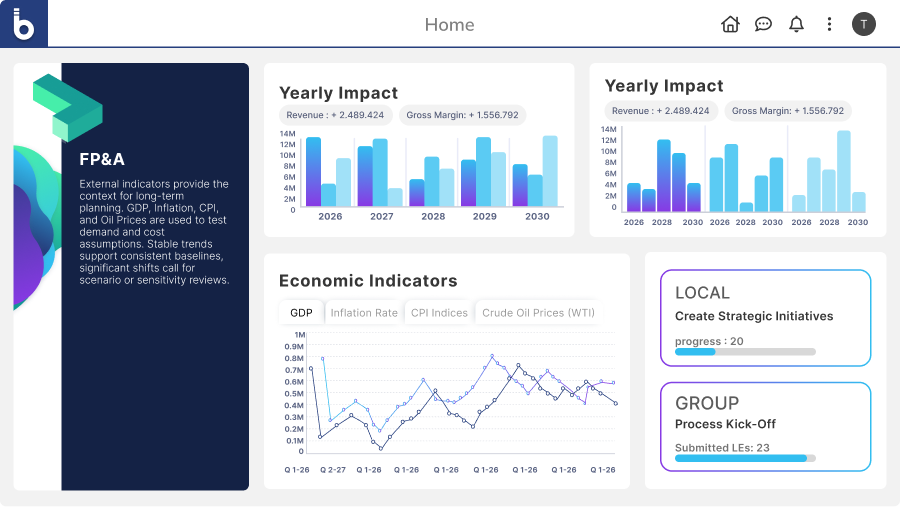

Let’s see what Board can do for you.
Get a tour of the Agentic Planning Platform in action.