
What is Merchandise Planning?
What is Merchandise Planning?
Merchandise planning is the process of planning product sales, inventory levels, and financial performance to ensure the right products are available in the right quantities to meet customer demand while achieving business targets.
Merchandise Planning Explained
Merchandise planning is a core retail discipline that connects commercial strategy with financial performance. It focuses on determining what products to sell, how much to sell, and how much inventory is needed to meet demand while delivering target revenue, margin, and inventory outcomes.
At its core, merchandise planning translates business goals into actionable plans. Retailers define targets for sales, margins, and inventory, then build plans that align product ranges, buying decisions, and stock levels with those targets.
Merchandise planning sits at the intersection of multiple functions:
- Finance, which defines revenue and margin targets
- Merchandising, which selects products and categories
- Supply chain, which ensures products are available
- Retail operations, which execute sales across channels
This makes it a highly cross-functional process that requires coordination and alignment across the organization.
Modern merchandise planning is increasingly data-driven and dynamic. Retailers use historical sales data, demand forecasts, and performance insights to continuously refine plans. Integrated planning platforms such as Board enable organizations to connect merchandise planning with financial planning, inventory management, and supply chain decisions, ensuring consistency and responsiveness.
Merchandise planning is particularly important in retail environments with:
- seasonal demand patterns
- large product assortments
- multiple channels (store and e-commerce)
- fast-changing customer preferences
In these environments, effective planning is critical to balancing product availability with financial performance.
Why Merchandise Planning Matters
Merchandise planning helps retailers:
- Align product strategy with financial targets
- Optimize inventory investment and reduce excess stock
- Improve sales and margin performance
- Ensure product availability across locations and channels
- Support better buying and allocation decisions
Without effective merchandise planning, retailers may face:
- overstocking and markdowns
- stockouts and lost sales
- misaligned product ranges
- inconsistent performance across stores or channels
Merchandise planning provides a structured approach to balancing demand, inventory, and financial outcomes, helping retailers maximize both revenue and profitability.
How Merchandise Planning Works
Define Financial Targets
The process begins with setting targets for:
- sales revenue
- gross margin
- inventory levels
- stock turnover
These targets are typically aligned with broader business and financial plans.
Develop Category Plans
Retailers create plans at category level, defining:
- expected sales by product category
- margin targets
- inventory investment
This ensures that each category contributes to overall business objectives.
Plan Inventory Levels
Inventory is planned to support expected sales while minimizing excess stock. This includes:
- determining how much inventory to buy
- planning stock levels over time
- balancing availability with cost
Align with Assortment and Buying
Merchandise plans inform:
- product selection (assortment planning)
- buying decisions
- supplier engagement
This ensures that product ranges align with demand and financial goals.
Monitor and Adjust
Merchandise plans are continuously monitored and updated based on:
- actual sales performance
- changes in demand
- inventory levels
This allows retailers to adjust plans and respond to changing conditions.
Merchandise Planning vs Assortment Planning
Merchandise Planning | Assortment Planning |
Focuses on financial and inventory targets | Focuses on product selection |
Determines how much to buy and sell | Determines what products to offer |
Financial and performance-driven | Product and customer-driven |
Assortment planning is a key component of merchandise planning, but merchandise planning provides the financial framework.
Merchandise Planning vs Retail Planning
Merchandise Planning | Retail Planning |
Focuses on product, inventory, and financial targets | Covers end-to-end retail planning |
Category and product-focused | Broader, cross-functional process |
Key component of retail planning | Umbrella planning process |
Retail planning includes merchandise planning alongside other processes such as forecasting and pricing.
Examples in Practice
Apparel Retail Example
A fashion retailer plans seasonal collections, setting sales and margin targets for each category and determining how much inventory to purchase for each product line.
Consumer Goods Example
A retailer plans product ranges across categories, aligning inventory levels with expected demand and financial targets.
Omnichannel Example
A retailer plans inventory across both physical stores and online channels, ensuring that product availability supports sales across all touchpoints.
Finance and Merchandising Example
Finance and merchandising teams collaborate to align product plans with revenue and margin targets, ensuring that commercial decisions support financial performance.
Key Benefits
- Improved alignment between product strategy and financial targets
- Better inventory management and reduced excess stock
- Increased sales and margin performance
- Stronger coordination across merchandising, finance, and supply chain
- Greater agility in responding to demand changes
Related Terms
FAQs
See how Board transforms merchandise planning
Master merchandising with superior efficiency and accuracy.
Explore Board's merchandise planning solution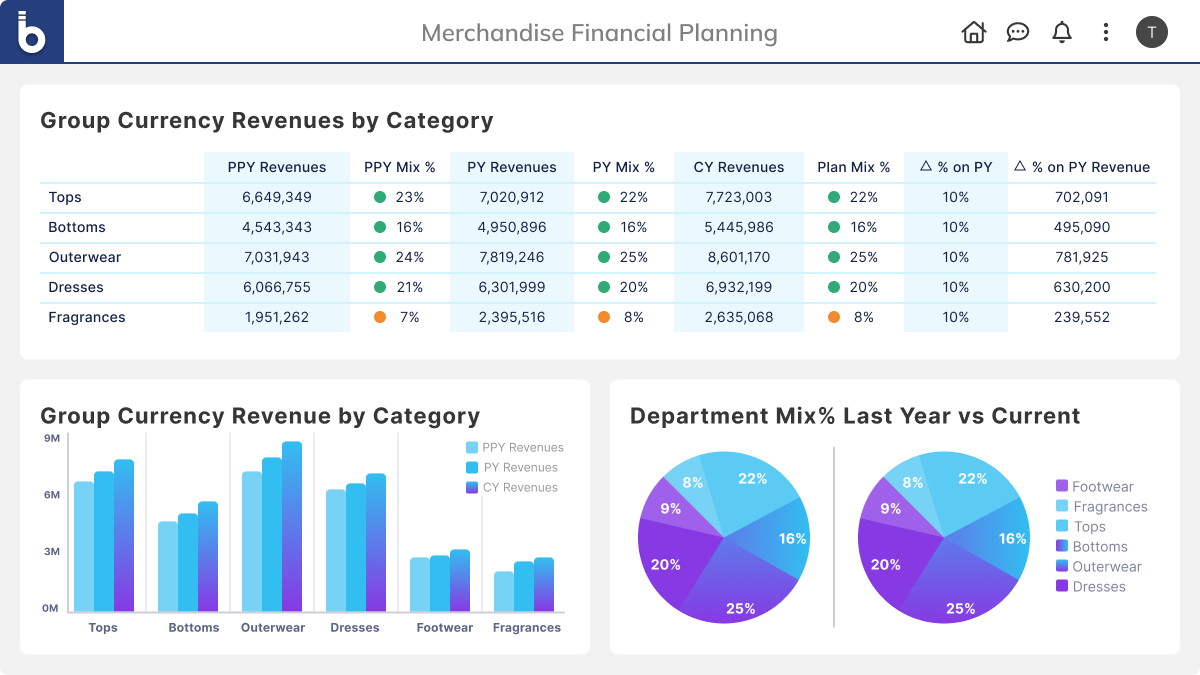

Let’s see what Board can do for you.
Get a tour of the Agentic Planning Platform in action.