
What is Open-to-Buy (OTB)?
What is Open-to-Buy (OTB)?
Open-to-Buy (OTB) is a retail planning method used to determine how much inventory a retailer can purchase within a given period while staying within budget and financial targets.
Open-to-Buy Explained
Open-to-Buy (OTB) is a core retail planning process that helps organizations control inventory investment and align purchasing decisions with financial goals. It ensures that retailers buy the right amount of stock at the right time without overcommitting capital or understocking key products.
At its simplest, OTB answers a key question:
How much inventory can we afford to buy, and when should we buy it?
OTB works by comparing:
- planned sales
- planned inventory levels
- actual performance to date
- committed orders
From this, retailers calculate how much inventory remains “open” to buy within a specific period.
OTB is typically managed at different levels:
- category
- department
- store or channel
This allows retailers to control inventory investment while maintaining flexibility to respond to changes in demand.
OTB is closely linked to merchandise planning, inventory planning, and financial planning. It translates high-level financial targets into practical buying decisions, helping retailers stay on track throughout the season.
Modern planning platforms such as Board enable retailers to manage OTB dynamically, connecting it with real-time sales data, demand forecasts, and financial plans. This allows organizations to move beyond static spreadsheets and make faster, more informed buying decisions.
OTB is particularly important in retail environments with:
- seasonal demand
- fast-changing trends
- large product assortments
- tight margin control
In these environments, effective OTB management helps balance availability, risk, and profitability.
Why Open-to-Buy Matters
OTB helps retailers:
- Control inventory investment and avoid overbuying
- Maintain flexibility to respond to changing demand
- Reduce excess stock and markdowns
- Improve cash flow and working capital management
- Align buying decisions with financial targets
Without effective OTB management, retailers may:
- overstock and tie up capital in unsold inventory
- miss opportunities due to underbuying
- lose control of inventory budgets
- experience margin erosion due to markdowns
OTB provides a structured way to manage these risks while supporting more agile and responsive decision-making.
How Open-to-Buy Works
Set Financial and Inventory Targets
Retailers begin by defining:
- planned sales
- target inventory levels
- desired stock-to-sales ratios
- margin expectations
These targets are typically set during merchandise planning.
Track Actual Performance
As the period progresses, retailers monitor:
- actual sales
- current inventory levels
- outstanding purchase orders
This provides a real-time view of performance against plan.
Calculate Open-to-Buy
OTB is calculated by determining how much inventory can still be purchased based on:
- planned inventory levels
- current stock
- committed purchases
- expected sales
This calculation shows the remaining “budget” available for buying.
Adjust Buying Decisions
Retailers use OTB to:
- increase purchases if demand is strong
- reduce or delay purchases if demand is weaker
- reallocate budgets across categories or products
This enables more responsive and data-driven buying.
Update Continuously
OTB is typically updated regularly, often weekly or monthly, to reflect:
- changes in demand
- sales performance
- inventory levels
This ensures that buying decisions remain aligned with current conditions.
Open-to-Buy vs Inventory Planning
Open-to-Buy (OTB) | Inventory Planning |
Focuses on how much inventory can be purchased | Focuses on overall inventory levels and strategy |
Financial and budget-driven | Operational and supply-driven |
Short-term and tactical | Short- to medium-term planning |
Guides buying decisions | Guides stock positioning and replenishment |
OTB is a key tool within the broader inventory planning process.
Open-to-Buy vs Merchandise Planning
Open-to-Buy (OTB) | Merchandise Planning |
Tactical buying control | Strategic planning framework |
Focuses on current buying decisions | Focuses on overall financial targets |
Updated frequently | Set periodically |
Merchandise planning sets the direction, while OTB ensures execution stays on track.
Examples in Practice
Fashion Retail Example
A fashion retailer uses OTB to manage seasonal buying. As certain products sell faster than expected, the retailer increases orders for high-performing items while reducing orders for slower-moving products.
Department Store Example
A retailer allocates OTB budgets across departments, ensuring that each category stays within its inventory limits while maintaining flexibility to respond to trends.
Omnichannel Example
A retailer adjusts OTB across online and store channels based on real-time sales performance, shifting investment toward higher-performing channels.
Finance and Merchandising Example
Finance and merchandising teams use OTB to ensure that inventory purchases remain aligned with working capital targets and margin goals.
Key Benefits
- Better control of inventory investment
- Increased flexibility in buying decisions
- Reduced risk of overstocking and markdowns
- Improved alignment between merchandising and finance
- Stronger cash flow and working capital management
Related Terms
FAQs
See how Board transforms retail Open-to-Buy (OTB)
Transform your OTB for smarter buying and sharper profits.
Explore Board's OTB/WSSI solution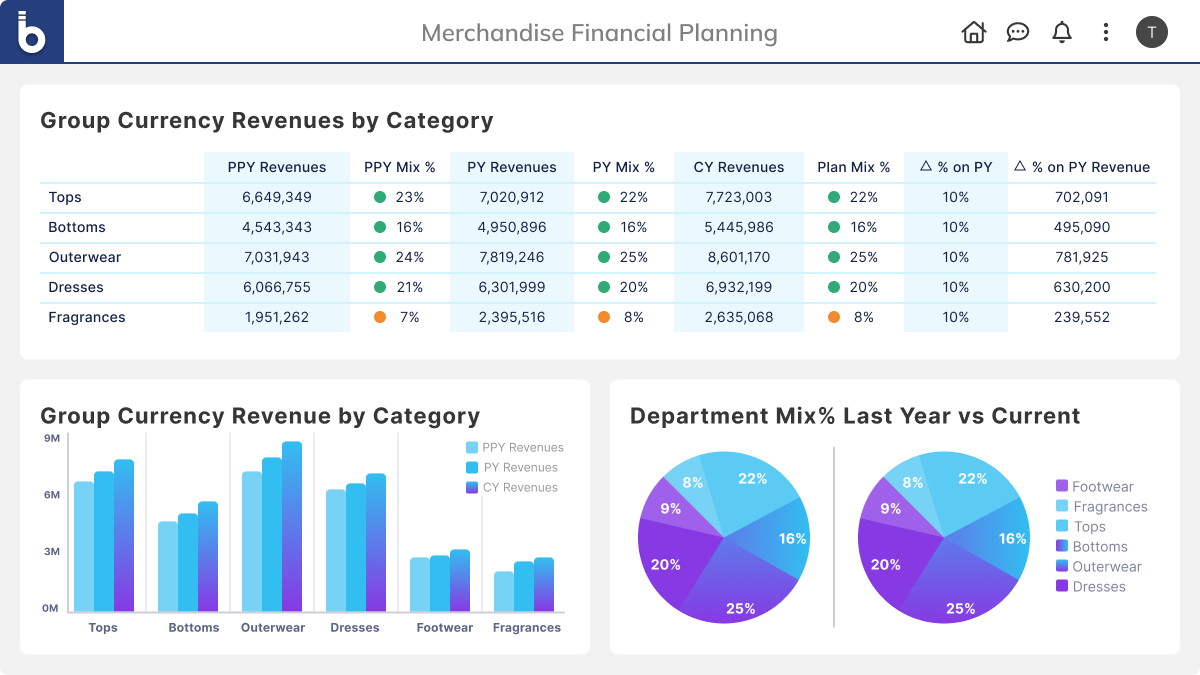

Let’s see what Board can do for you.
Get a tour of the Agentic Planning Platform in action.