
What is Assortment Planning?
What is Assortment Planning?
Assortment planning is the process of selecting which products to offer, where to offer them, and in what quantities to meet customer demand while maximizing sales and profitability.
Assortment Planning Explained
Assortment planning is a core retail discipline focused on defining the mix of products that will be available to customers across stores, regions, and channels. It determines what products a retailer sells and how those products are distributed across the business.
At its core, assortment planning answers three key questions:
- Which products should we offer?
- Where should they be offered?
- How broad or deep should the assortment be?
Assortment decisions are influenced by multiple factors, including:
- customer preferences and buying behavior
- store formats and locations
- product performance and historical sales
- seasonal trends
- brand and category strategy
Assortment planning sits within the broader retail planning process and works closely with merchandise planning, demand forecasting, and inventory planning. While merchandise planning defines financial targets and inventory levels, assortment planning defines the actual product mix needed to achieve those targets.
Modern assortment planning is highly data-driven. Retailers use customer insights, sales data, and analytics to optimize assortments at a granular level – often tailoring product selections by store, region, or channel.
With integrated planning platforms such as Board, retailers can connect assortment decisions with financial plans, demand forecasts, and inventory strategies. This ensures that product selection is aligned with both customer demand and business performance goals.
Assortment planning is particularly important in retail environments with:
- large product catalogs
- diverse customer segments
- multiple store formats or channels
- fast-changing trends and preferences
In these environments, the right assortment can significantly impact sales, margins, and customer experience.
Why Assortment Planning Matters
Assortment planning helps retailers:
- Offer the right products to meet customer demand
- Increase sales by aligning assortments with customer preferences
- Improve margins through better product mix
- Reduce excess inventory and markdowns
- Optimize space and product allocation across stores and channels
Poor assortment planning can lead to:
- irrelevant or unbalanced product offerings
- missed sales opportunities
- excess stock in low-performing products
- inconsistent customer experience across locations
By aligning product selection with both demand and financial goals, assortment planning helps retailers deliver better outcomes across the business.
How Assortment Planning Works
Analyze Customer and Sales Data
Retailers begin by analyzing:
- historical sales performance
- customer preferences and behavior
- product trends and seasonality
This helps identify which products and categories perform best.
Define Assortment Strategy
Retailers establish guidelines for product selection, including:
- breadth (number of categories)
- depth (variety within categories)
- brand and pricing mix
This ensures assortments align with brand positioning and customer expectations.
Localize Assortments
Assortments are tailored based on:
- store location and demographics
- regional preferences
- channel (store vs online)
This enables more relevant product offerings.
Align with Merchandise and Financial Plans
Assortment decisions are aligned with:
- sales and margin targets
- inventory plans
- buying and sourcing strategies
This ensures that product selection supports overall business objectives.
Monitor and Optimize
Retailers continuously evaluate assortment performance based on:
- sales and margin results
- sell-through rates
- customer feedback
Adjustments are made to optimize performance over time.
Assortment Planning vs Merchandise Planning
Assortment Planning | Merchandise Planning |
Focuses on product selection | Focuses on financial and inventory targets |
Defines what products to sell | Defines how much to sell and stock |
Customer and product-driven | Financial and performance-driven |
Both processes work together to ensure that product strategy aligns with financial goals.
Assortment Planning vs Inventory Planning
Assortment Planning | Inventory Planning |
Determines product mix | Determines stock levels |
Focuses on selection and variety | Focuses on quantity and allocation |
Customer-focused | Operational and efficiency-focused |
Assortment planning defines what should be sold, while inventory planning ensures it is available.
Examples in Practice
Fashion Retail Example
A fashion retailer selects seasonal collections based on trends and customer preferences, tailoring assortments for different store locations and regions.
Grocery Retail Example
A grocery retailer adjusts product assortments based on local demand, ensuring that stores stock items relevant to their customer base.
Omnichannel Example
A retailer offers a broader assortment online while curating a more focused selection in physical stores, balancing variety with space constraints.
Category Planning Example
A retailer optimizes product mix within a category to improve sales and margins, removing underperforming items and introducing new products.
Key Benefits
- Improved customer satisfaction through relevant product offerings
- Increased sales through better alignment with demand
- Higher margins through optimized product mix
- Reduced excess inventory and markdowns
- More effective use of store space and inventory
Related Terms
FAQs
See how Board transforms assortment planning
Dynamically align assortment plans to your customers.
Explore Board's assortment planning solution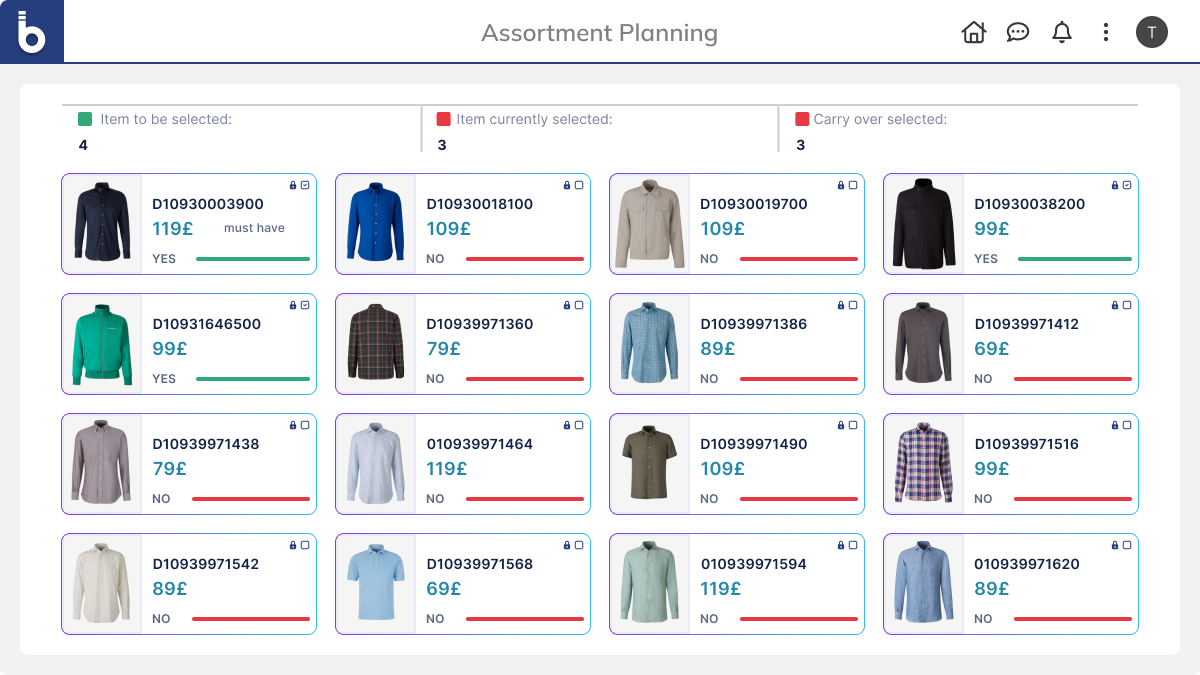

Let’s see what Board can do for you.
Get a tour of the Agentic Planning Platform in action.