

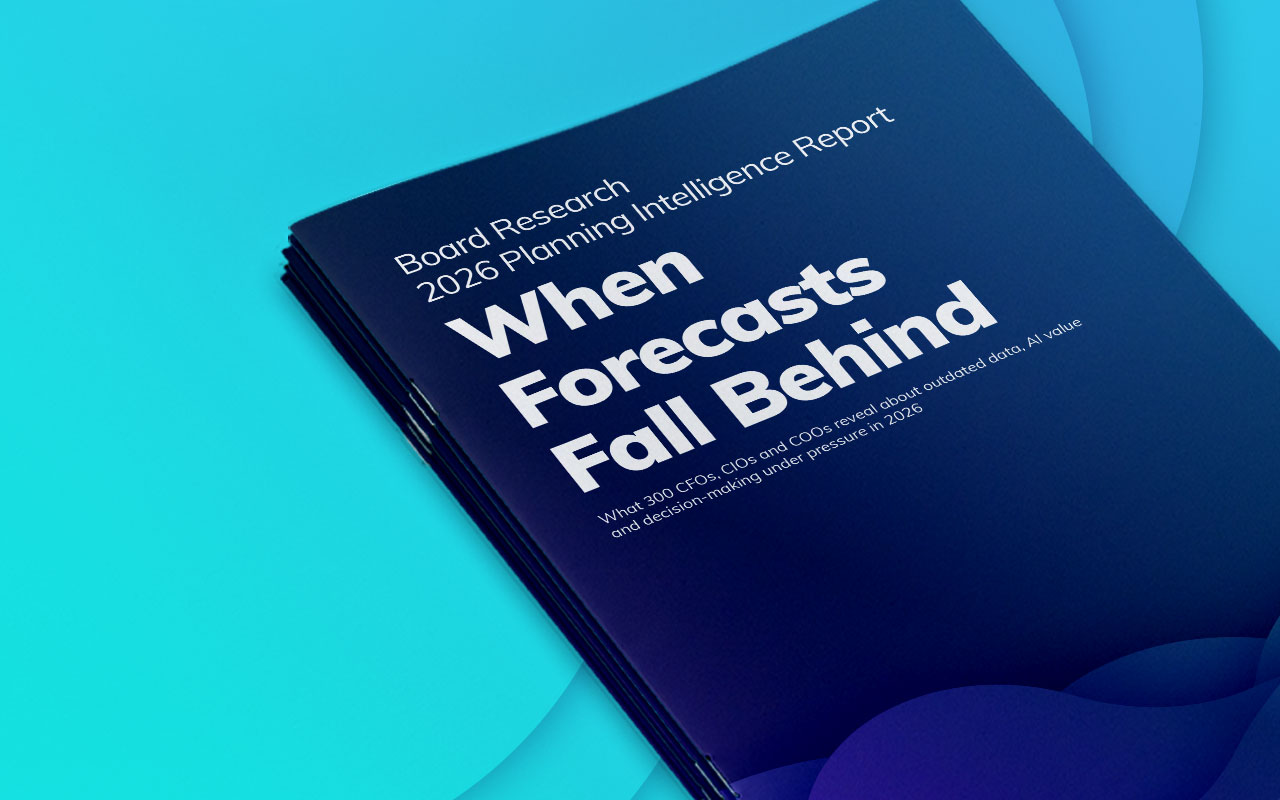
The 2026 Planning Intelligence Report
When Forecasts Fall Behind
What 300 CFOs, CIOs and COOs reveal about outdated data, AI value, and decision-making under pressure in 2026.
Enterprise planning is moving faster than the data behind it.
Forecasts are only useful if they reflect the assumptions leaders are using to make decisions.
Yet 83% of executives say their board has acted on a forecast they already knew was outdated. Forty percent say that decision had significant business consequences.
At the same time, 85% of executives say pressure to make faster decisions has increased over the past year, while only 27% can adjust a plan in real time.
This report explores the gap between executive confidence and planning reality, and what it means as AI takes on a larger role in enterprise decision-making.
Why this report matters
Enterprise planning is entering a new phase. The challenge is no longer simply producing a forecast.
The challenge is keeping plans connected to:
- Current data
- Changing assumptions
- Cross-functional accountability
- AI-driven recommendations
- Business execution
Without that connection, organizations risk making high-stakes decisions with information that is accurate in construction but outdated in context.
This report shows where planning processes are most vulnerable, how finance, technology, and operations differ in their readiness, and what leaders can do to make decisions with greater confidence.
AI is moving ahead of proven value. Planning teams need a clearer path from investment to impact.
Companies are investing heavily in AI, even when current returns remain uneven.
Fifty-nine percent of executives say their AI investment exceeds the value delivered so far. Among that group, 92% still plan to increase spending over the next 12 months.
The report examines why AI continues to attract investment, where executives are seeing measurable planning benefits, and why governance, context, and decision rights are becoming critical as AI becomes more embedded in the planning process.
Featured findings: From forecast freshness to enterprise execution
Discover what 300 enterprise executives reveal about:
Outdated forecasts
83% say their board acted on a forecast known to be outdated.
AI investment and value
59% say AI investment exceeds the value delivered so far.
Strategic influence
61% cite large language models among the external sources that most influence strategic decisions.
Cross-functional trust
60% of CFOs fully trust the other two functions to make well-informed decisions under pressure, compared with 52% of CIOs and 36% of COOs.
The report shows how outdated data, siloed planning processes, and uneven AI governance can affect the quality, speed, and accountability of enterprise decisions.
What you’ll learn:
See how outdated forecasts reach the board, why accuracy alone is not enough, and how planning teams can make the age and relevance of forecast assumptions more visible.
Understand why nearly half of executives are very confident in their ability to adjust plans quickly, while most still need hours, days, or longer to replan.
Explore why companies continue to increase AI spending, even when many executives say investment currently exceeds delivered value.
Learn how large language models compare with peers, vendors, analysts, and consultants as sources of strategic input for the C-suite.
Compare how CFOs, CIOs, and COOs view planning agility, agentic AI adoption, measurable ROI, governance, and trust across functions.
Review six practical actions for keeping plans current, connected, governed, and aligned with execution.
Recommended for:
CFOs
CIOs
COOs
Enterprise Planning Leaders
Finance Transformation Leaders
AI Transformation Leaders
Digital Transformation Leaders
Operations & Supply Chain Leaders
What you’ll learn:
See how outdated forecasts reach the board, why accuracy alone is not enough, and how planning teams can make the age and relevance of forecast assumptions more visible.
Understand why nearly half of executives are very confident in their ability to adjust plans quickly, while most still need hours, days, or longer to replan.
Explore why companies continue to increase AI spending, even when many executives say investment currently exceeds delivered value.
Learn how large language models compare with peers, vendors, analysts, and consultants as sources of strategic input for the C-suite.
Compare how CFOs, CIOs, and COOs view planning agility, agentic AI adoption, measurable ROI, governance, and trust across functions.
Review six practical actions for keeping plans current, connected, governed, and aligned with execution.
Recommended for:
CFOs
CIOs
COOs
Enterprise Planning Leaders
Finance Transformation Leaders
AI Transformation Leaders
Digital Transformation Leaders
Operations & Supply Chain Leaders
You may also be interested in





Let’s see what Board can do for you.
Get a tour of the Agentic Planning Platform in action.