
What is Inventory Management?
What is Inventory Management?
Inventory management is the process of tracking, controlling, and optimizing inventory levels to ensure products are available when needed while minimizing costs and inefficiencies.
Inventory Management Explained
Inventory management focuses on the day-to-day control and execution of inventory, ensuring that stock is accurately tracked, stored, and moved throughout the supply chain.
While inventory planning determines how much inventory should be held, inventory management ensures that inventory is:
- accurately recorded
- properly stored
- efficiently replenished
- available for fulfillment
It covers operational activities such as:
- stock tracking and monitoring
- warehouse management
- order fulfillment
- replenishment execution
- inventory accuracy and auditing
Inventory management systems provide real-time visibility into stock levels, enabling organizations to track inventory across locations such as warehouses, distribution centers, and retail stores.
It is a critical capability in industries such as:
- retail
- manufacturing
- e-commerce
- distribution
where inventory availability directly impacts customer experience and operational efficiency.
Modern platforms such as Board increasingly integrate inventory management data with planning processes, enabling organizations to connect operational execution with financial and strategic planning. This helps bridge the gap between what is planned and what actually happens.
Inventory management is essential for ensuring that inventory decisions made during planning are executed effectively in real-world operations.
Why Inventory Management Matters
Inventory management helps organizations:
- Ensure accurate and up-to-date inventory records
- Improve product availability and order fulfillment
- Reduce stock discrepancies and errors
- Optimize warehouse and storage efficiency
- Minimize carrying costs and waste
Without effective inventory management, organizations may face:
- inaccurate stock data
- delayed or failed order fulfillment
- excess or obsolete inventory
- operational inefficiencies
Inventory management plays a critical role in maintaining both operational performance and customer satisfaction.
It also supports financial control by ensuring that inventory levels are accurately reflected and managed in line with business expectations.
How Inventory Management Works
Track Inventory in Real Time
Organizations use systems to monitor:
- stock levels
- inventory movements
- location of products
This ensures accurate visibility across the supply chain.
Manage Stock Across Locations
Inventory is managed across:
- warehouses
- distribution centers
- retail stores
This includes tracking transfers, receipts, and shipments.
Execute Replenishment
Inventory management ensures that stock is replenished based on:
- reorder points
- demand signals
- supply availability
This keeps inventory levels aligned with operational needs.
Support Order Fulfillment
Inventory systems ensure that products are:
- picked
- packed
- shipped
efficiently and accurately to meet customer demand.
Monitor Accuracy and Performance
Organizations regularly check:
- inventory accuracy
- stock discrepancies
- shrinkage or loss
to maintain reliable inventory data.
Inventory Management vs Inventory Planning
| Inventory Management | Inventory Planning |
Focuses on execution and control | Focuses on strategy and forecasting |
Manages current inventory | Determines future inventory levels |
Operational and real-time | Forward-looking and analytical |
Ensures accuracy and availability | Optimizes stock levels and investment |
Inventory planning defines what should happen, while inventory management ensures it happens correctly.
Inventory Management vs Supply Chain Management
| Inventory Management | Supply Chain Management |
Focuses on inventory control | Covers end-to-end supply chain processes |
Operational and detailed | Strategic and broad |
Manages stock levels and movement | Manages sourcing, production, and logistics |
Inventory management is a key component of overall supply chain management.
Examples in Practice
Retail Example
A retailer tracks inventory across stores and warehouses, ensuring that products are available for customers and replenished as needed.
E-commerce Example
An online retailer uses inventory systems to manage stock across fulfillment centers, ensuring fast and accurate order delivery.
Manufacturing Example
A manufacturer tracks raw materials and finished goods to ensure production runs smoothly without delays.
Warehouse Example
A distribution center manages inventory movements, ensuring accurate stock levels and efficient storage.
Key Benefits
- Improved inventory accuracy and visibility
- Better product availability and fulfillment
- Reduced operational errors and inefficiencies
- Lower inventory carrying costs
- Stronger control over stock and assets
Related Terms
FAQs
See how Board transforms inventory management
Board’s Supply Chain Planning software transforms planning from siloed guesswork to a continuous, scenario-driven process – delivering visibility, alignment, and agility across your entire network.
Explore Board's supply chain solutions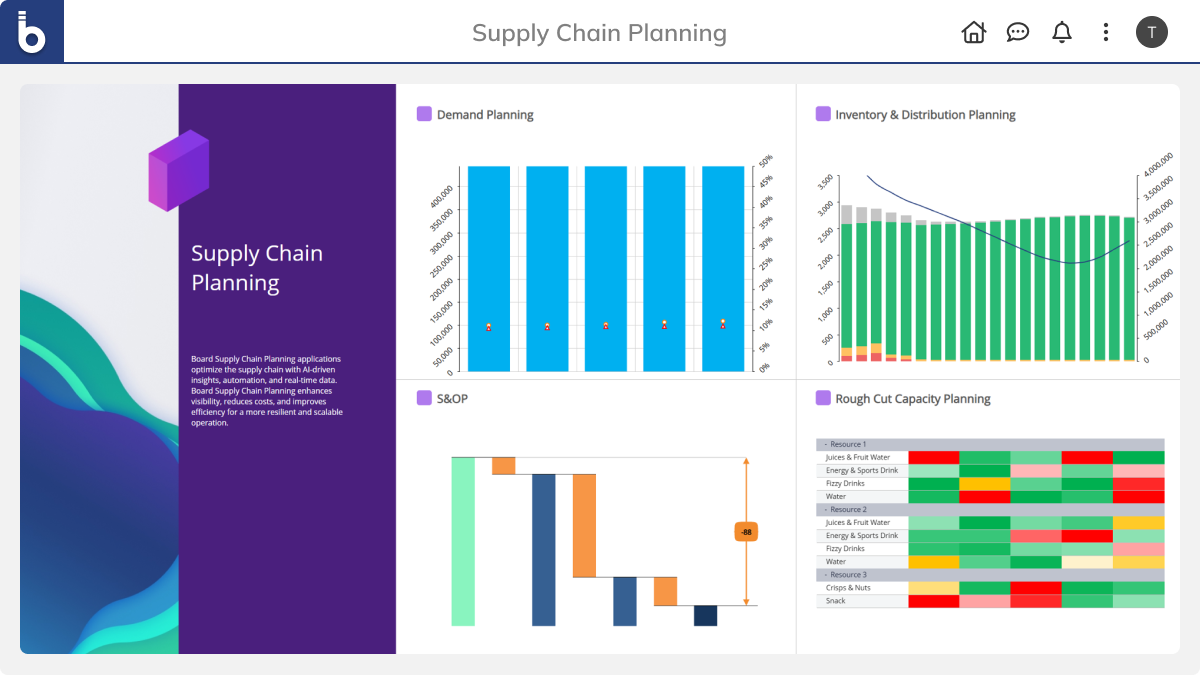

Let’s see what Board can do for you.
Get a tour of the Agentic Planning Platform in action.