This website will offer limited functionality in this browser. We only support the recent versions of major browsers like Chrome, Firefox, Safari, and Edge.
Getting Ready for Agentic Supply Chains Starts with Decision Coherence
Why Decision Archetypes Matter — and How Better Agency Builds on Them Supply chains are operating in a state of sustained volatility. Demand shifts faster, supply risk is persistent, and cost and…
Why Decision Archetypes Matter — and How Better Agency Builds on Them
Supply chains are operating in a state of sustained volatility. Demand shifts faster, supply risk is persistent, and cost and margin pressure leave little tolerance for slow or misaligned decisions.
Over the past decade, most organisations have responded by investing in planning tools, optimisation engines, and greater operational visibility. Yet many CSCOs describe the same lived reality: when conditions change, decisions still slow down, disconnect, and drift out of alignment across the enterprise.
The constraint today is no longer data or planning sophistication. It is how decisions are owned — and how coherently they hold together over time.
By decision coherence, we mean the extent to which decisions across strategy, planning, and execution remain logically aligned as conditions change. In coherent decision environments, assumptions are explicit and shared, trade-offs are evaluated deliberately, and decisions made at one horizon do not undermine outcomes at another. When coherence breaks down, decisions may be locally rational, but collectively sub-optimal.
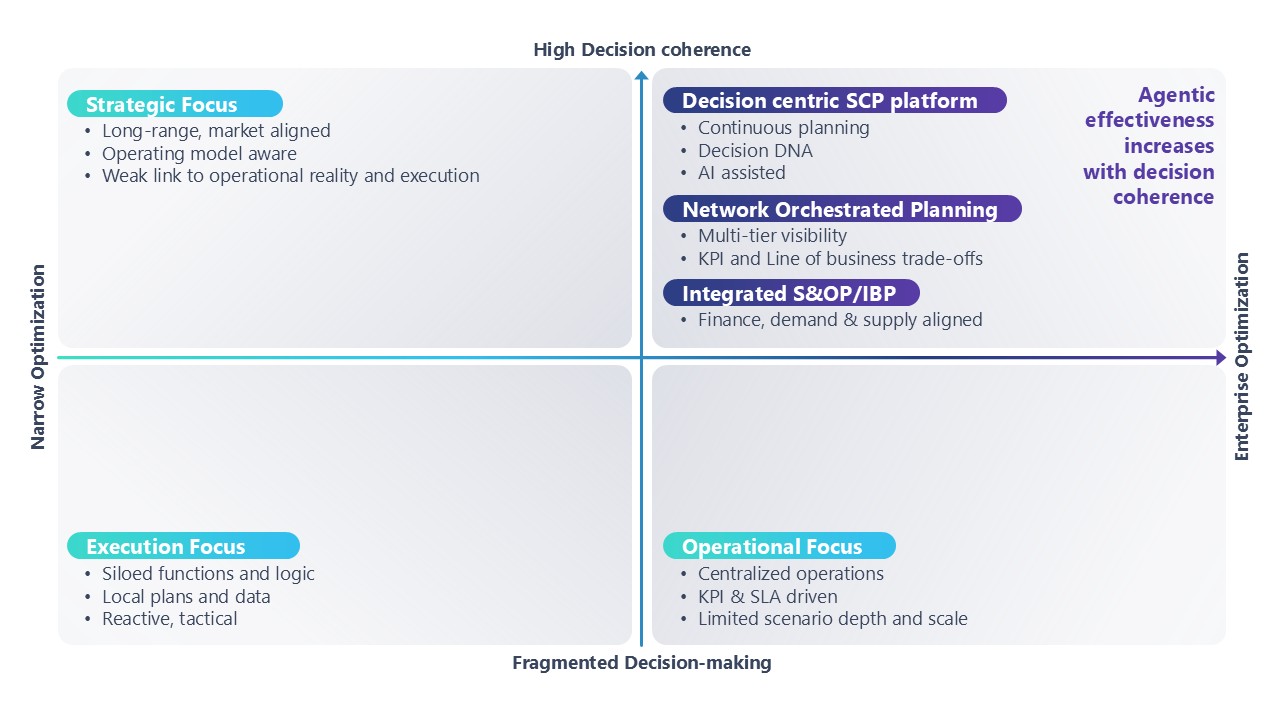
The decision archetype grid above captures this reality. It also reveals why getting ready for agentic supply chains starts with decision design, not technology.
The decision archetypes: understanding your decision coherence
This grid is not a maturity curve and not a technology map. It is a decision framework that explains why some supply chains respond effectively to volatility while others stall. Decision archetypes in SCP:
It describes operating models along two dimensions:
Decision ownership (horizontal axis) Local optimisation → Enterprise optimisation
According to Gartner, fewer than 20% of supply chains operate with mature, continuous planning capabilities that keep decisions aligned across horizons. For most organisations, decision latency — not forecast accuracy — is now the primary limiter of performance.
Execution Focus: local optimization, high cost
In the lower-left quadrant, decision-making is highly localised.
Typical characteristics include:
Siloed functional teams
Spreadsheet-driven planning
Local plans optimised in isolation
Decisions are made close to the problem, but rarely with awareness of enterprise-wide consequences. Trade-offs surface late, responses are reactive, and different parts of the organisation often pull in conflicting directions.
At this stage, introducing more automation or agents rarely helps. Agency amplifies fragmentation because the underlying decision framework is incoherent.
Gartner analysis shows that organizations operating with fragmented, function-led planning typically carry 10–15% higher inventory levels than peers, driven by late trade-offs and local optimisation. Decision cycles in these environments often extend into weeks, limiting responsiveness during disruption.
Strategic Focus: insight without decision scale
Moving up the grid improves coherence, but ownership remains local.
Organisations in the Strategic Advisory archetype invest in:
Long-range planning
Scenario analysis
Executive-level strategic insight
Strategic intent is clearer, but execution linkage is weak. When conditions change, strategic decisions struggle to translate into tactical and operational action, and local optimisation quickly re-emerges.
Here, analytics and early agentic capabilities improve insight quality, but agency remains advisory. Without enterprise decision ownership, even good decisions fail to propagate coherently.
Gartner research indicates that fewer than 30% of strategic supply-chain decisions are consistently reflected in tactical and operational plans once volatility is introduced.
Operational Focus: visibility without orchestration
Shifting to the right side of the grid centralises decision ownership.
Operational focus provides:
Centralised visibility
KPI- and SLA-driven management
Faster detection of issues
Visibility improves materially, but decision-making often remains reactive. Scenario depth is limited, planning horizons remain disconnected, and trade-offs are escalated late.
Agentic capabilities here typically optimise alerting and response speed. Agency improves reaction time, not orchestration, because decision coherence is still limited.
Gartner has observed that control-tower-led organisations often improve issue detection speed by 20–30%, but see far smaller gains in service, cost, or inventory outcomes. Visibility improves awareness, but not decision quality.
Integrated S&OP / IBP: the inflection point
The move into the upper-right quadrant marks a genuine step change.
Integrated S&OP and IBP introduce:
Enterprise decision ownership
Alignment across finance, demand, and supply
Structured, financially constrained trade-offs
This is where decision quality begins to compound.
However, most still operate on monthly or weekly cycles, leaving decision latency exposed during periods of rapid change.
This is also where agency starts to add real value — shifting from episodic automation to continuous, assisted decisioning within an established decision framework.
Gartner benchmarks show that organisations with mature S&OP or IBP practices typically achieve:
5–10% improvement in inventory productivity
2–5% improvement in service levels
Network-Orchestrated Planning: scaling decisions across the ecosystem
As complexity increases, leading organisations move further up the grid.
Network-orchestrated planning extends decision-making beyond the enterprise to include:
Multi-tier supply visibility
Supplier and partner trade-offs
Ecosystem-level optimisation
Here, agentic capabilities help manage complexity by monitoring signals, exploring scenarios, and highlighting second-order impacts — without replacing human judgement.
Gartner research on resilient supply chains shows that organisations with multi-tier visibility and network-level scenario planning recover from major disruptions 30–50% faster than those optimising only within the enterprise.
Decision-Centric Supply Chains: better agency in its proper role
At the top of the grid sits the decision-centric supply chain.
In this archetype:
Strategic, tactical, and operational decisions remain coherently linked
Scenarios are evaluated continuously, not episodically
Trade-offs propagate deliberately across demand, supply, capacity, and cost
This is where better agency reaches its full value — as a persistent decision partner that senses change, generates options, and tests consequences within clear enterprise guardrails.
Gartner identifies decision latency reduction as a defining characteristic of high-performing supply chains. Organisations moving toward continuous, scenario-driven decision models can reduce decision cycle times by up to 50%, enabling faster trade-offs without sacrificing governance.
The Role of Agentic: from automation to assisted decisioning
As supply chains move into enterprise-aligned decision archetypes on the grid, a subtle but important shift occurs. The role of technology moves beyond automation and optimisation toward assisted decisioning.
In this context, agentic supply chain capabilities are best understood not as autonomous actors, but as persistent decision-support mechanisms operating within an established decision framework. Their value lies in helping teams sense change earlier, explore trade-offs faster, and maintain decision coherence as conditions evolve.
Critically, the effectiveness of agentic capabilities is determined by where an organisation sits on the decision archetype grid. In fragmented or control-tower–led environments, agents tend to accelerate local reactions without resolving underlying trade-offs. In enterprise-aligned models—particularly where S&OP and IBP provide shared assumptions and governance—they help sustain decision quality under volatility.
This distinction is essential. Agentic supply chains do not replace S&OP, IBP, or governance structures. They enable AND extend them, enabling continuous evaluation of scenarios, constraints, and outcomes across planning horizons—while accountability remains firmly with human decision-makers.
Understanding your current decision coherence
The grid reinforces three practical truths:
You cannot automate or “agent” your way out of fragmented decision models
Decision archetypes provide the context required to apply agency responsibly
Better agency amplifies coherent decision frameworks — it does not replace them
For CSCOs, the question is no longer:
Which tools or agents should we deploy next?
It is:
Which decision archetype are we operating in — and what level of agency does that framework actually support?
Answering that question is what enables organisations to move from fragmented execution to truly decision-centric supply chains — with evidence, not hype, and a high state of readiness for agentic supply chain.