This website will offer limited functionality in this browser. We only support the recent versions of major browsers like Chrome, Firefox, Safari, and Edge.
Speed Isn’t Strategy: Unlocking More Value from Demand Sensing
Demand sensing improves short term accuracy, but real retail advantage comes from interpreting structural change and orchestrating decisions across finance, merchandising, and supply chain.
Executive Summary :
Demand sensing improves speed and short-term accuracy. But speed is not the same as strategic insight.
In structurally volatile markets, the advantage lies in interpretation — not detection.
The real value is unlocked when signals are orchestrated into confident decisions within a continuous planning architecture.
Demand sensing IS valuable.
It reduces latency.
It improves short-term forecast accuracy.
It strengthens replenishment and allocation.
In volatile markets, that matters.
Retailers should be doing it. But here’s the strategic question most organizations haven’t fully answered:
What happens after the quick fix, new signal detected?
Because detecting a change is not the same as understanding whether the market itself is changing. And that distinction is where value is either captured — or lost.
Speed Is Not the Same as Insight
The industry conversation around demand sensing is dominated by speed:
Faster detection
More external signals
Higher-frequency refresh cycles
Reduced forecast error
All of this improves operational responsiveness. But most demand sensing engines are built to minimize deviation from a baseline. They assume the baseline is broadly stable.
In today’s retail environment, that assumption is increasingly fragile.
Customer behavior is shifting.
Channel economics are evolving.
Category relevance is moving.
Margin dynamics are under pressure.
The real challenge is not volatility. It is structural drift.
Interpreting ‘the Signal’ : Correction, Shift, or Structural Change?
There are fundamentally different types of demand change:
Shift – Multi-period acceleration or deceleration of an existing trend.
Structural Change – A deeper evolution in customer behaviour, category economics, or channel mix.
Most demand sensing solutions are excellent at Level 1.
Some extend into Level 2.
Very few are designed to help executives determine Level 3.
And yet Level 3 is where strategic advantage lives. Reacting quickly to noise is helpful.
Recognizing structural change early is transformative.
The Risk of Optimizing the Wrong Response
Consider a fashion retailer entering early spring.
Lightweight tailoring and occasional wear begin outperforming forecast by +18% versus plan. Demand sensing correctly identifies the uplift. Allocation is increased. Replenishment accelerates.
Operationally, this is success. But the more important question is: why?
Is this simply favorable weather?
Is it a one-off event cycle?
Or is it the first signal of a broader behavioural return to formal dressing?
If the uplift is margin-dilutive due to promotional pressure, scaling volume may erode profitability. If it reflects channel migration, inventory may need repositioning rather than expansion.
If it signals a sustained lifestyle shift, the retailer’s future assortment architecture — not just this week’s replenishment plan — may need to change.
Demand sensing detects the signal. Strategic planning determines its meaning.
If organisations do not connect sensing to financial, commercial, and supply decisions, they risk optimising the wrong response — faster.
Retailers rarely fail because they missed the signal.
They fail because they misinterpreted it.
Sensing Without Orchestration Is Acceleration Without Direction
Demand sensing operates at the signal layer. Strategic response requires coordinated decisions across:
Merchandising
Supply Chain
Finance
Commercial strategy
That is not a forecasting problem. It is an orchestration problem.
A high-frequency signal might justify a tactical allocation correction.
But persistent signal patterns — interpreted within financial guardrails and strategic objectives — might justify broader structural action.
The difference is not speed.
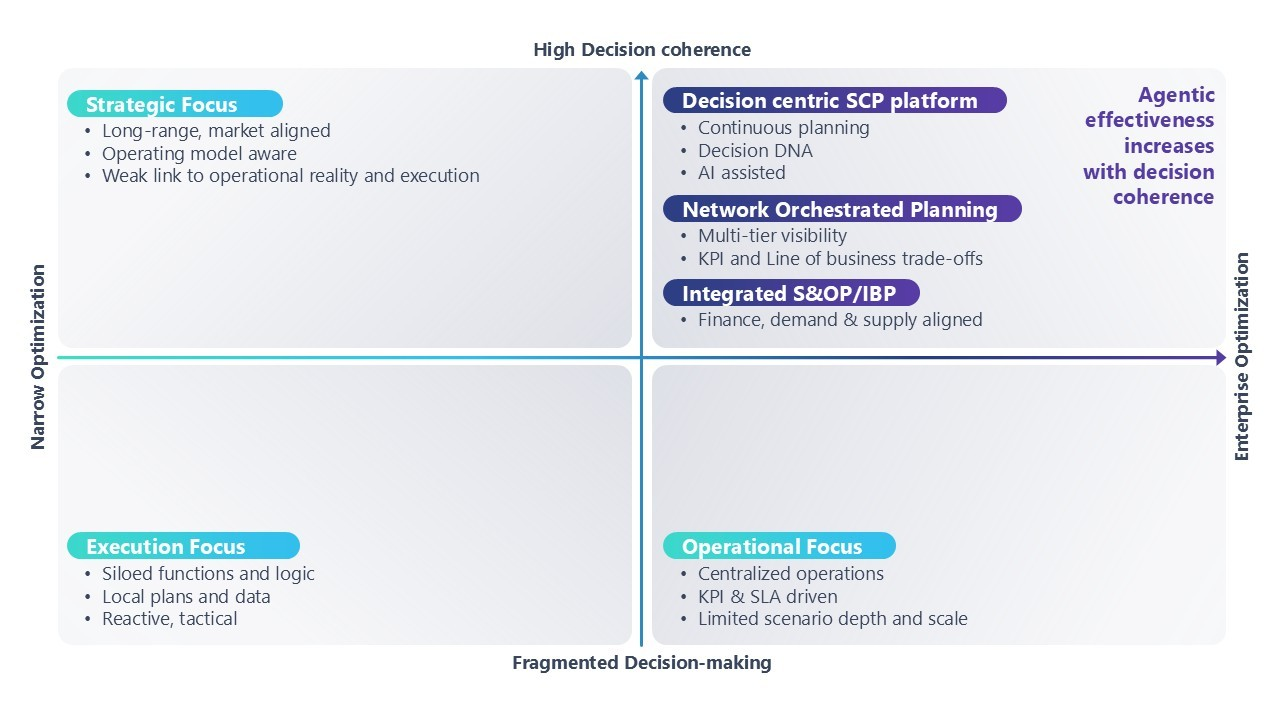
It is decision coherence.
Figure:
RETAIL DECISIONS. fig 1.
And coherence requires architectural alignment between sensing, financial planning, merchandising strategy, and supply execution — enabling confident decisions within a continuous planning environment.
If You’re Doing Demand Sensing — Good
Demand sensing is not the problem.
It is a strength. But many retailers are under-leveraging the insight it generates. What’s often missing is the structured connection between those signals and:
• Financial impact modelling
• Scenario evaluation
• Cross-functional trade-offs
• Strategic category decisions
That is where additional value can be unlocked.
Not just by replacing sensing.
But by connecting it.
From Detection to Strategic Foresight
When demand signals are integrated into a broader planning architecture, they become more powerful.
Persistent patterns trigger scenario modelling.
Margin impact is simulated before commercial decisions are locked.
Supply constraints are evaluated against strategic priorities.
Financial guardrails shape response options.
Demand sensing becomes an input into foresight — not just a correction engine.
Signals inform. Scenarios test. Finance frames. Merchandising and supply decide.
That is orchestration.
And in environments where volatility increasingly masks structural change, orchestration becomes a competitive capability — strengthening continuous planning and enabling confident decisions across the enterprise.
The Executive Question
The most important planning question is no longer:
“Can we sense demand faster?”
It is:
“Can we determine when demand is signalling structural change — and align the organisation accordingly?”
Retail advantage will not go to the organisation with the fastest signal.
It will go to the organisation that interprets structural drift earliest — and coordinates a confident response across commercial and financial planning.
If you are investing in demand sensing, you are already strengthening your signal layer.
The next opportunity is to connect those signals into a coherent decision architecture — one that links volatility to strategy, margin, and supply positioning.
Because in structurally volatile markets, sensing is only the beginning.
The real value is unlocked when signals become strategy.
And as planning architectures evolve, a natural next question emerges: what role can agentic capabilities play in strengthening demand planning itself — not as a replacement for human judgement, but as a disciplined amplifier of signal interpretation and cross-functional coordination? That is where the next stage of maturity begins.