This website will offer limited functionality in this browser. We only support the recent versions of major browsers like Chrome, Firefox, Safari, and Edge.
Gen AI Is Flipping Customer 360 on Its Head — And Retail Planning Must Adapt
Generative AI is changing how shoppers discover, compare, and buy products. Learn why retailers must move from Customer 360 to continuous merchandising decisions.
For years, retailers pursued the idea of the perfect Customer 360.
The ambition was clear: unify transactions, loyalty data, browsing behavior, demographics, store interactions, digital engagement, and purchasing history into one complete customer view.
The retailer that knew the customer best would win.
But generative AI is changing that model fundamentally.
Not incrementally.
Fundamentally.
Because for the first time in modern retail, the customer journey is increasingly beginning outside the retailer’s ecosystem.
And that changes everything.
The Customer Journey Is Escaping the Retailer
Consumers are no longer simply navigating retailer websites, apps, marketplaces, or search bars.
They are asking AI:
“Find me the best waterproof hiking jacket under £200.”
“Suggest a capsule wardrobe for a two-week trip to Italy.”
“What’s the best sofa for a small apartment with pets?”
“Find me sustainable running shoes with good arch support.”
“Plan me a summer holiday with sailing, great food, and quiet beaches.”
These interactions are radically different from traditional ecommerce behavior.
They contain:
intent
context
emotion
constraints
trade-offs
preferences
lifestyle signals
budget sensitivity
timing
substitution logic
In many cases, customers are now sharing richer information with AI systems than they ever shared directly with retailers.
That means the traditional Customer 360 model is no longer the sole center of gravity for retail intelligence.
The AI increasingly becomes part of the customer layer itself.
And in the AI commerce era, visibility becomes a planning problem.
Planning Outcomes Will Increasingly Be Determined by What’s Not in Your Data
Historically, retail planning relied heavily on internal enterprise signals:
historical sales
inventory positions
replenishment patterns
promotions
pricing history
demand forecasts
loyalty behavior
But generative AI introduces an entirely new signal layer.
A layer retailers often do not own.
The next generation of retail performance may depend less on what sits inside traditional data warehouses — and more on how effectively retailers can interpret:
conversational demand
emerging intent
contextual shopping behavior
AI-mediated discovery journeys
sentiment shifts
substitution patterns
external market signals
macroeconomic behavior
real-time consumer narratives
This is where traditional planning models begin to struggle.
Most retail planning systems were designed for periodic forecasting cycles and structured historical analysis.
And increasingly, planning performance depends on how quickly retailers can sense, interpret, and respond to those shifts.
The Shift From Forecasting to Continuous Merchandising Decisions
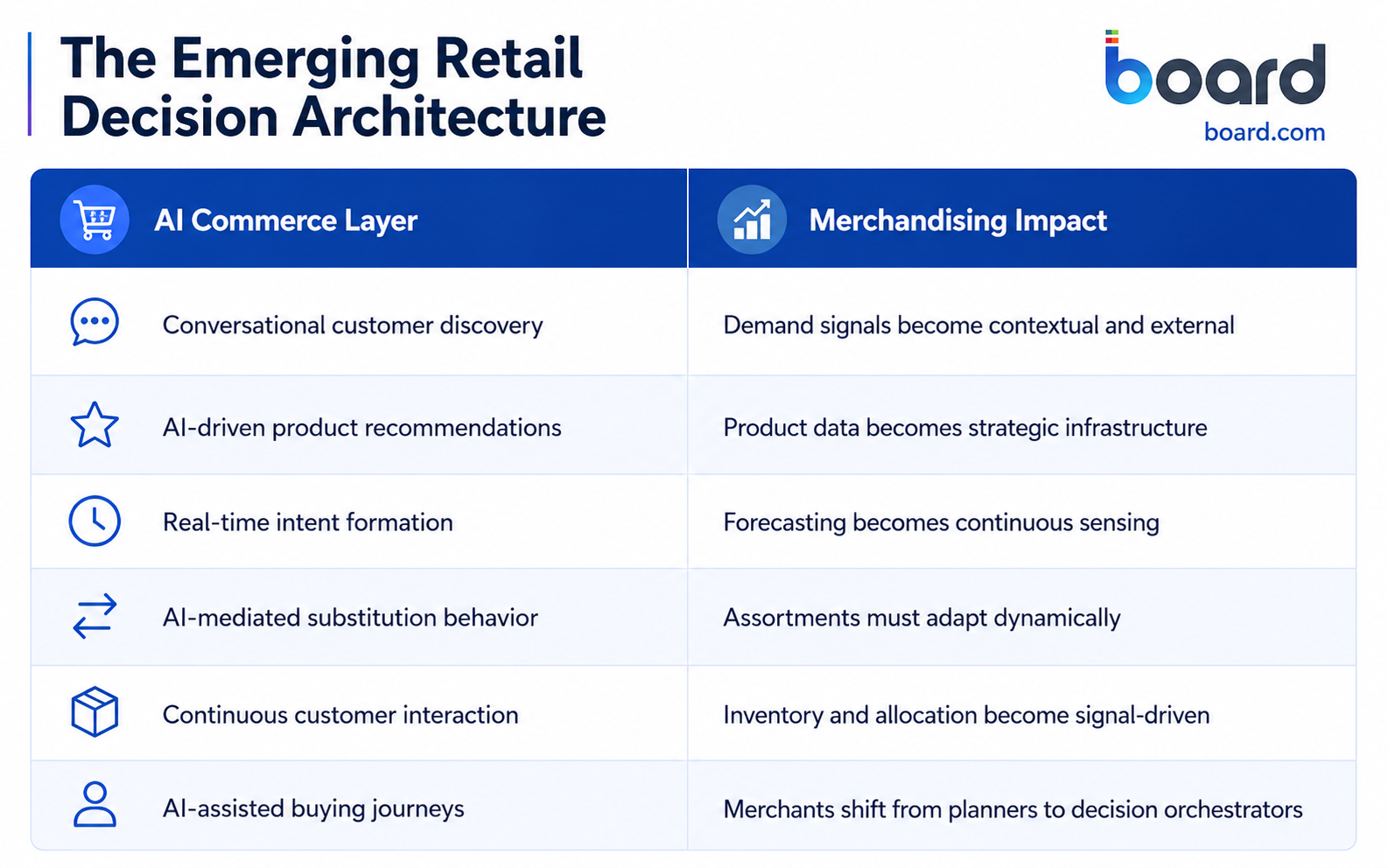
This is why retail planning is moving beyond traditional forecasting.
The next evolution is continuous merchandising decision-making.
Not just:
“What will demand be next quarter?”
But:
“What is demand becoming right now?”
“What products are emerging in relevance?”
“Where is margin exposure increasing?”
“Which assortments are becoming less discoverable?”
“Where should inventory move before the market reacts?”
“What trade-offs should merchants make immediately?”
The retailers leading this transition are building planning environments capable of continuously orchestrating:
assortment
inventory
allocation
replenishment
pricing
margin
fulfillment
and financial trade-offs
…in near real time.
This is where generative and agentic AI begin reshaping merchandising itself.
Not as a chatbot layer. Not as a productivity add-on.
But as part of the operational decision system.
The implication is significant:
Retailers no longer compete purely on products or prices.
They compete on merchandising decision velocity.
Why This Changes Merchandising More Than Marketing
At first glance, generative AI appears to be a customer experience story.
In reality, it may become an operational merchandising story first.
Because once AI starts influencing:
discovery
recommendations
substitutions
channel preference
product visibility
demand concentration
promotional responsiveness
…the pressure shifts directly onto merchandising and planning teams.
Traditional merchandising was built around:
seasonal cycles
category reviews
periodic assortment decisions
scheduled allocation updates
manually coordinated planning workflows
But AI-driven commerce creates a more fluid environment.
Assortments may need to adapt faster. Inventory decisions may need to become more dynamic. Replenishment cycles may compress. Trade-offs may need to be evaluated continuously.
This changes the role of the merchant entirely.
The future merchant spends less time assembling spreadsheets and more time orchestrating decisions:
balancing margin and service
evaluating AI recommendations
shaping assortments dynamically
managing strategic trade-offs
coordinating human and AI workflows
The merchant increasingly becomes a decision orchestrator.
This is why modern retail planning is evolving from periodic forecasting cycles toward continuously orchestrated merchandising decisions.
The challenge is no longer simply understanding what sold yesterday.
It is continuously interpreting what customers are trying to achieve — and synchronizing assortments, inventory, pricing, and operational decisions fast enough to respond intelligently.
Product Data Becomes Strategic Infrastructure
In the generative AI era, product data becomes something far more important than ecommerce content management.
It becomes:
discoverability infrastructure
recommendation infrastructure
merchandising infrastructure
planning infrastructure
AI reasoning infrastructure
AI systems can only recommend, rank, compare, substitute, or reason over products if the underlying data is rich enough to support contextual interpretation.
That requires retailers to rethink product information entirely.
The winners will increasingly invest in:
semantic product attribution
contextual metadata
intent-aware product relationships
fulfillment-aware inventory visibility
margin-aware assortment logic
dynamic product hierarchies
connected operational and financial data
Poor product data no longer just impacts conversion rates.
It reduces the probability that products appear meaningfully inside AI-driven shopping journeys at all.
And fragmented retail data increasingly creates fragmented AI outcomes.
The Retailers That Win Will Be the Most Decision Ready
The winners of the next retail era may not simply be the retailers with:
the largest AI budgets
the biggest data lakes
the most copilots
the most AI experiments
They may be the retailers that become:
most context aware
most operationally synchronized
most semantically connected
most assortment aware
most inventory aware
and most capable of making continuous merchandising decisions under uncertainty
This is where retail AI strategy converges with planning strategy.
The future retail platform is no longer simply:
commerce
ERP
forecasting
analytics
It becomes a retail decision system.
One capable of continuously:
sensing demand
interpreting intent
simulating trade-offs
orchestrating inventory
aligning operational and financial decisions
recommending actions
coordinating human and AI workflows
As enterprises move toward autonomous-ready operating environments, merchandising teams will increasingly rely on AI to augment, orchestrate, and continuously support decision-making across the business.
From Customer 360 to Decision 360
The next generation of retail performance will not be determined solely by who owns the most customer data.
It will be determined by who can continuously turn changing signals into confident merchandising decisions fastest.
That requires more than AI-powered search. More than recommendation engines. More than better product attribution.
It requires a connected merchandising decision environment capable of synchronizing:
Range & Assortment Planning
Merchandise Financial Planning
Allocation & Replenishment
Forecasting
Inventory optimization
and AI-assisted merchandising workflows
As generative AI reshapes how customers discover and buy products, retailers must evolve from periodic planning cycles toward continuous, AI-assisted merchandising orchestration.
Because in the AI commerce era, the winners will not simply be the retailers with the best products.
They will be the retailers that can continuously make the best merchandising decisions.