This website will offer limited functionality in this browser. We only support the recent versions of major browsers like Chrome, Firefox, Safari, and Edge.
AI Needs Context: The Case for External Data in Enterprise Performance Management
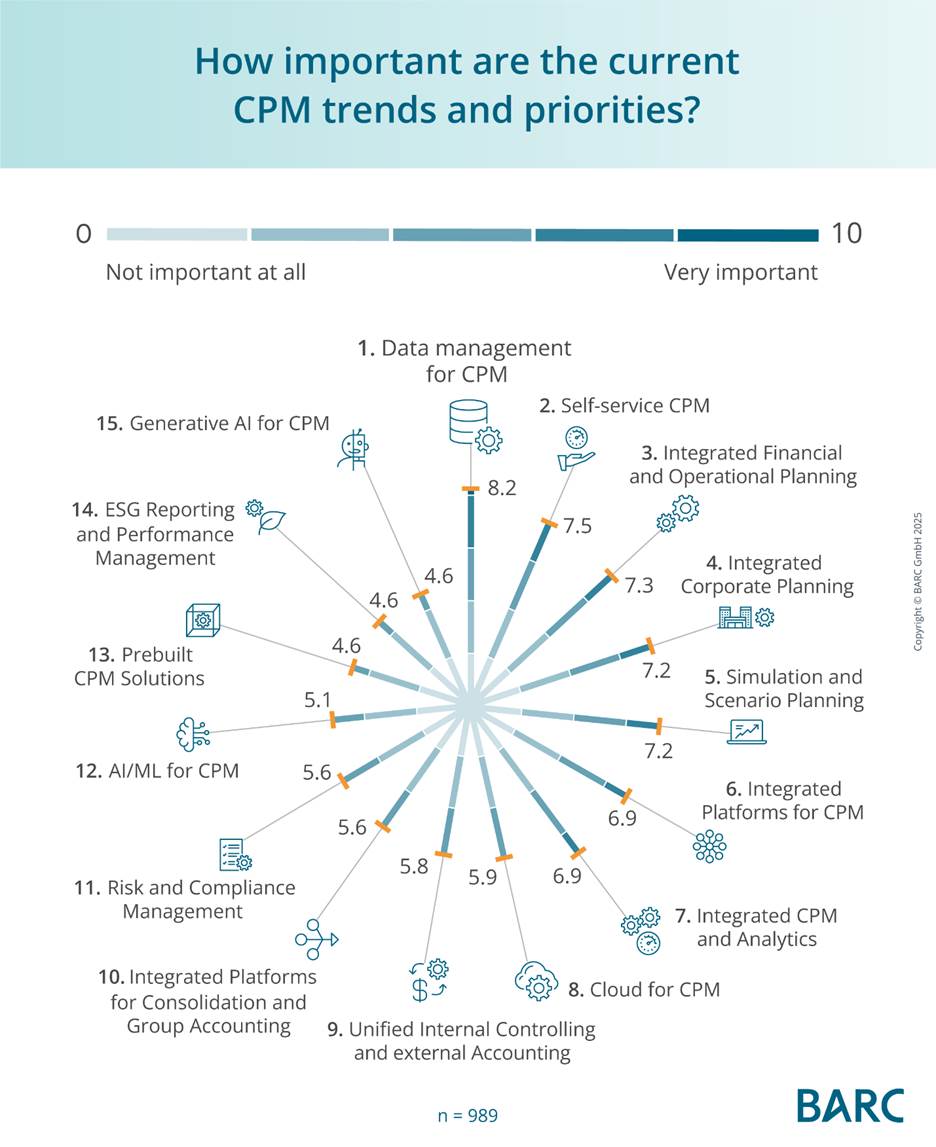
The CPM Trend Monitor 2026 delivers a clear message for finance leaders: while artificial intelligence dominates vendor roadmaps, data management is the top priority in enterprise performance management. With an…
The CPM Trend Monitor 2026 delivers a clear message for finance leaders: while artificial intelligence dominates vendor roadmaps, data management is the top priority in enterprise performance management.
With an importance score of 8.2 out of 10, data management ranks first across company sizes, industries, and regions. The report states: “High-quality, consistent and reliable data forms the foundation for effective decision-making and drives innovation. Establishing this solid data foundation is also an essential prerequisite for leveraging advanced technologies such as AI.”
By comparison, AI and machine learning for CPM rank 12th out of 15 trends, scoring 5.1. Business users rate it even lower at 4.9, compared to 6.3 from vendors. The gap is telling. Ambition for AI is high, but adoption lags. One of the most frequently cited barriers is unsuitable data foundations.
This disconnect exposes a broader issue. Strong internal data governance is essential, but it is not sufficient. AI is increasingly embedded across enterprise performance management (EPM) and financial planning & analysis (FP&A), powering predictive forecasting, anomaly detection, and scenario modeling. Organizations expect faster insights, more accurate forecasts, and more confident decisions.
Yet even well-governed internal data reflects only what is happening inside the enterprise. It does not capture the economic forces, market shifts, and external signals that shape performance. Without that context, AI models risk reinforcing historical patterns, missing inflection points, and creating false confidence in volatile conditions.
Internal Data Alone Has Limits
Internal data remains the backbone of planning and performance management. Revenue history, cost structures, workforce metrics, and operational volumes are critical inputs for forecasting and analysis.
However, forecasts grounded primarily in historical trends assume continuity. When markets evolve gradually, that assumption can hold. When disruption accelerates, it breaks down.
Internal metrics typically show what happened, not why it happened. Declining margins, slowing sales or rising costs are visible internally, but the underlying drivers — inflationary pressure, supply constraints, labor market shifts, or competitive disruption — often originate outside the organization.
AI models trained exclusively on internal data inherit these blind spots. During stable periods, internally focused predictive models may appear highly accurate, reinforcing trust. During disruption, those same models might struggle to detect turning points or structural change.
Volatility is no longer episodic. As BARC’s Resilient Planning in Volatile Markets research highlights, organizations now operate amid persistent economic uncertainty, regulatory shifts, supply chain instability, and changing customer expectations. In this environment, historical performance alone is an incomplete guide to the future.
Why External Data Matters
External data extends the analytical view beyond enterprise boundaries. It introduces signals that influence financial outcomes and enables AI models to incorporate broader context into forecasts and scenarios.
Consider a regional grocery retailer planning demand, inventory and staffing based on historical sales data. In stable conditions, those patterns may provide reasonable guidance. But when consumer behavior shifts rapidly or supply chains tighten, forecasts anchored solely in past performance quickly lose relevance.
Incorporating external signals such as market demand indicators, mobility trends, economic data, or supply chain metrics provides earlier visibility into changing conditions. Emerging surges in essential goods, shifts in shopping behavior, or logistics constraints may be detectable in external datasets before they appear in internal sales figures.
With this added context, finance and operations teams can adjust forecasts proactively, refine scenarios, and respond more confidently.
Common categories of external data include:
Macroeconomic indicators such as GDP growth, inflation, and interest rates
Industry benchmarks and market performance metrics
Commodity prices, energy costs and logistics indexes
Labor market data and wage trends
Customer demand signals and sentiment data
When integrated effectively with internal data, these inputs move analytics beyond descriptive reporting. They enable multi-variable analysis that strengthens explanatory insight and improves forecast robustness.
AI In Enterprise Performance Management
AI is becoming a core capability within modern EPM platforms. It supports predictive forecasting, intelligent variance analysis, automated scenario generation, and driver-based planning. Organizations are also exploring generative and agent-based approaches to assist with narrative reporting and decision support, typically with a human in the loop to provide oversight and institutional context.
The promise is clear: faster insight, greater efficiency, and more forward-looking analysis.
But the effectiveness of these capabilities depends directly on the data ecosystem supporting them. AI models are only as strong as the scope, relevance, and quality of the data they ingest.
Internal data will always remain foundational. Clean, consistent, and well-governed data is essential for reliable planning, compliance and performance measurement. However, relying solely on internal perspectives limits AI’s ability to anticipate change.
Sense Change Early and Prepare
Organizations that fail to incorporate external drivers into planning risk reacting too late. They may see performance deterioration only after it appears in financial results, rather than identifying leading indicators in advance.
External data provides the context that allows AI-enabled EPM systems to:
Anticipate change rather than simply extrapolate the past
Better explain performance drivers
Strengthen scenario planning under uncertainty
Improve forecast resilience in volatile markets
The CPM Trend Monitor makes clear that data management is the foundation for AI. The next step is expanding that foundation to include relevant external signals.
AI is not a shortcut around data discipline. It amplifies the strengths and weaknesses of the underlying data environment. Organizations that combine strong internal governance with structured external data integration will be better positioned to unlock AI’s full potential.
In a volatile environment, context is not optional. It is the difference between reacting to disruption and anticipating it.
AI is only as strong as the data ecosystem supporting it. And that ecosystem must extend beyond enterprise boundaries.
The Next Step for Finance Leaders
Finance leaders should resist the temptation to treat AI as a feature upgrade. Instead, they should treat it as a data strategy transformation.
That means strengthening internal governance while deliberately incorporating the external signals that shape performance. The organizations that succeed will not be those with the most AI tools. They will be those with the most complete data context.
In a volatile environment, competitive advantage will belong to companies that can anticipate shifts. Not just report on them.