This website will offer limited functionality in this browser. We only support the recent versions of major browsers like Chrome, Firefox, Safari, and Edge.
Meet the Board Architect Agent: A New Way to Create, Assess, and Evolve Enterprise Planning Applications
Enterprise planning applications are rarely static. Business models change. Reporting requirements expand. New entities, products, channels, and approval steps are introduced. Planning teams add scenarios, revise calculations, and adapt workflows…
Enterprise planning applications are rarely static.
Business models change. Reporting requirements expand. New entities, products, channels, and approval steps are introduced. Planning teams add scenarios, revise calculations, and adapt workflows as the organization evolves.
Yet changing a planning application can still be slow and expensive. Requirements may be scattered across process documents, spreadsheets, presentations, and the knowledge of a few experienced developers. On top of this, existing models can be difficult to understand, while even modest enhancements may require extensive discovery, redesign, testing, and rework.
The Board Architect Agent, currently in preview, is designed to change this.
Our newest Board Agent will help organizations manage the full lifecycle of an enterprise planning application: creating new solutions from existing business assets, assessing applications already in use, and evolving those applications through controlled, traceable changes.
Supporting Planning Applications as Living Systems
Let’s start with a simple premise every planner and solutions architect understands, generating a data model is only one part of building an enterprise planning solution.
An enterprise planning application may include multiple multidimensional models, various business hierarchies, and numerous calculations, reports, security rules, workflows, approvals, version logic, and semantic definitions. These components are highly interdependent. A change to one area will affect calculations, user experiences, controls, and downstream processes elsewhere.
That is why enterprise planning is fundamentally different from generating a document, dashboard, or isolated piece of code.
The Board Architect Agent is being developed with this broader lifecycle in mind. Rather than treating each requirement as a one-time model-generation task, it is designed to understand the application, its structure, and its business context before proposing what should happen next.
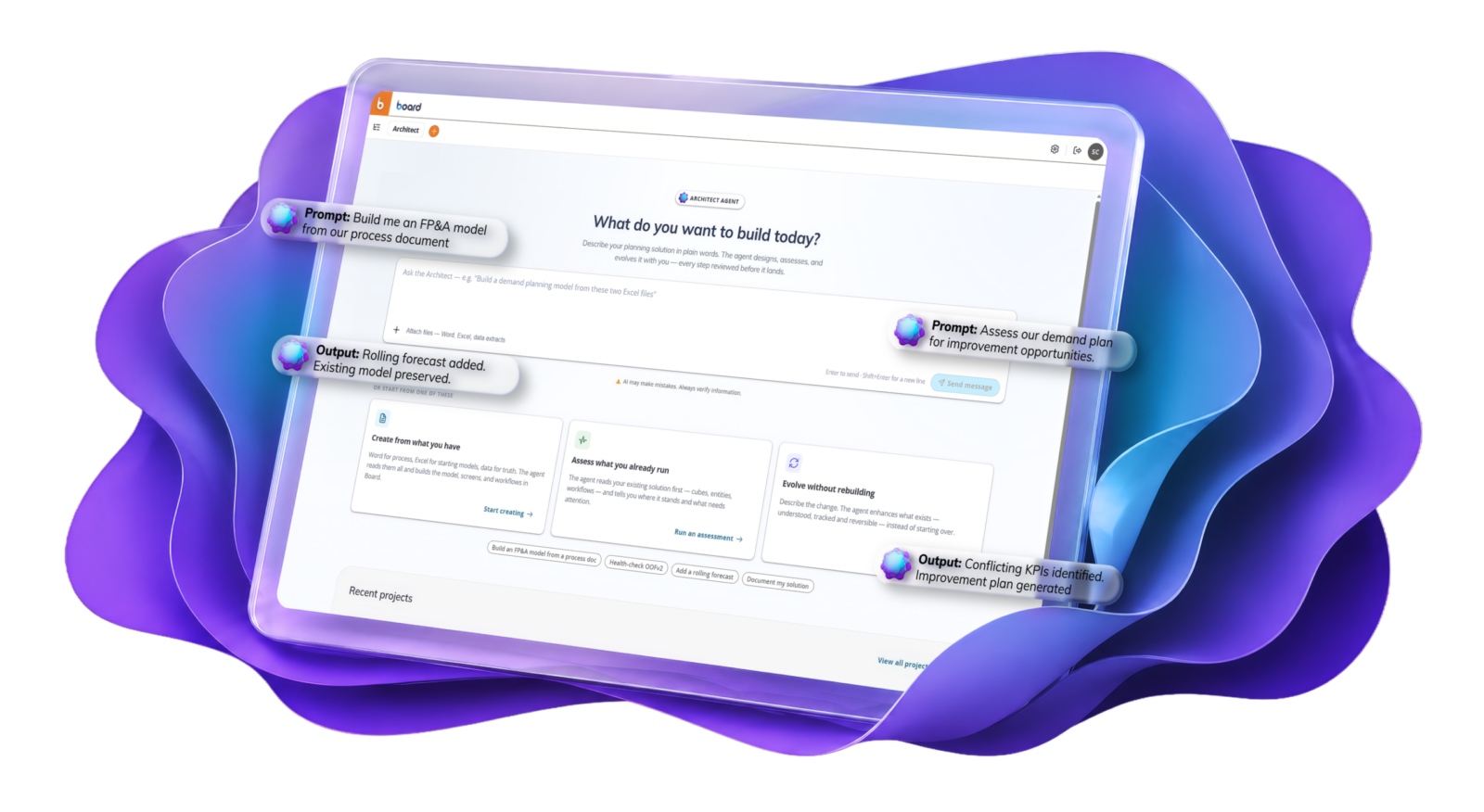
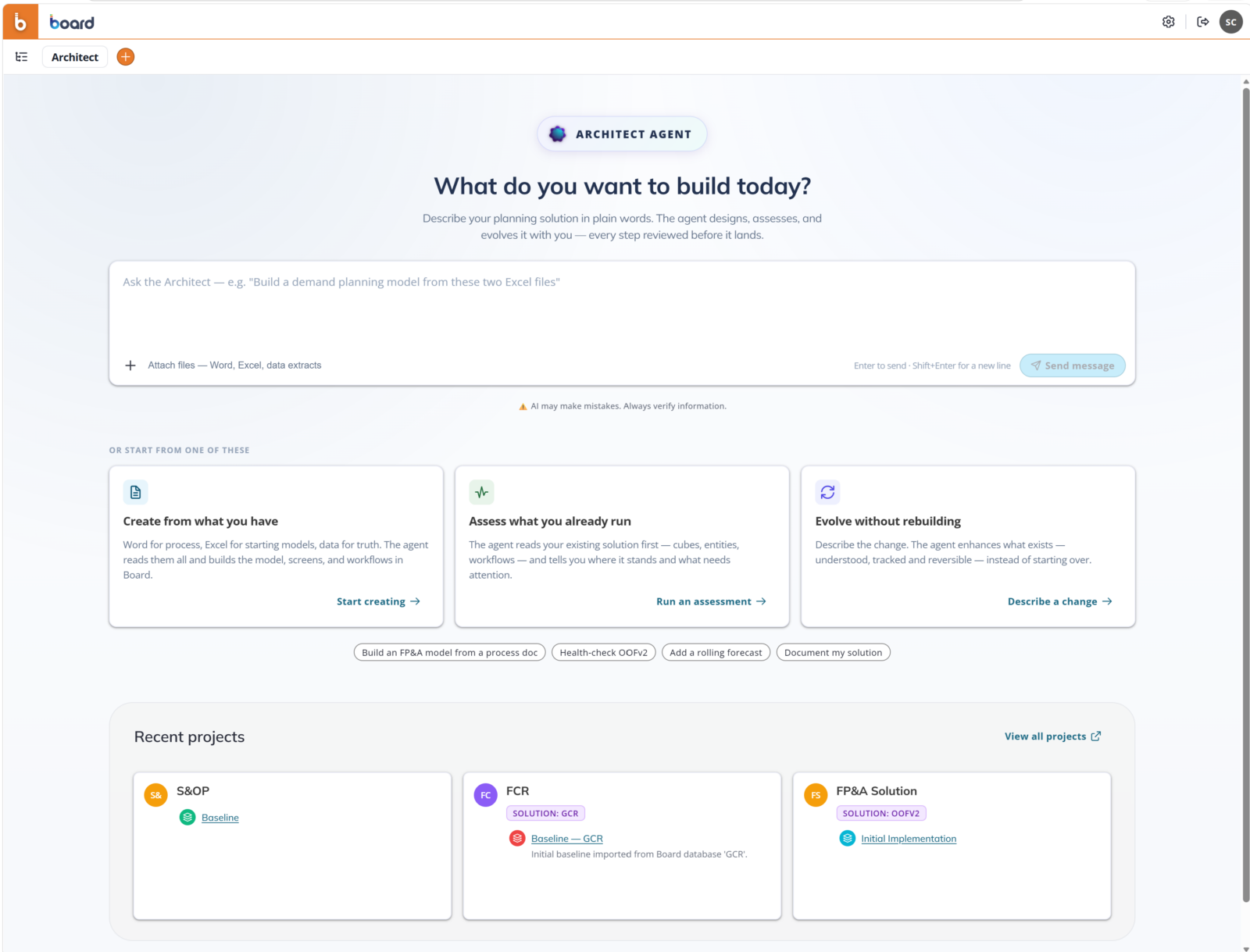
We are organizing its capabilities are around three key actions: Create. Assess. Evolve.
Create: Turn Existing Business Assets into Working Planning Applications
Most planning initiatives do not begin with a blank page.
Organizations already have process descriptions, policy documents, PowerPoint presentations, Excel models, data extracts, prototypes, diagrams, and existing proof-of-concept applications. The challenge is translating those materials into a new, coherent, governed planning solution.
The Board Architect Agent is designed to use those existing assets as a starting point.
Process documents and specifications can help define workflows and approval requirements. Spreadsheets, flat files, SQL sources, and prototypes can inform dimensions, hierarchies, measures, and model structures. Trusted business data can then help validate relationships, calculations, and the shape of the proposed application.
From those inputs, our new agent can propose elements such as:
Entities and hierarchies
Cubes and measures
Planning model structures
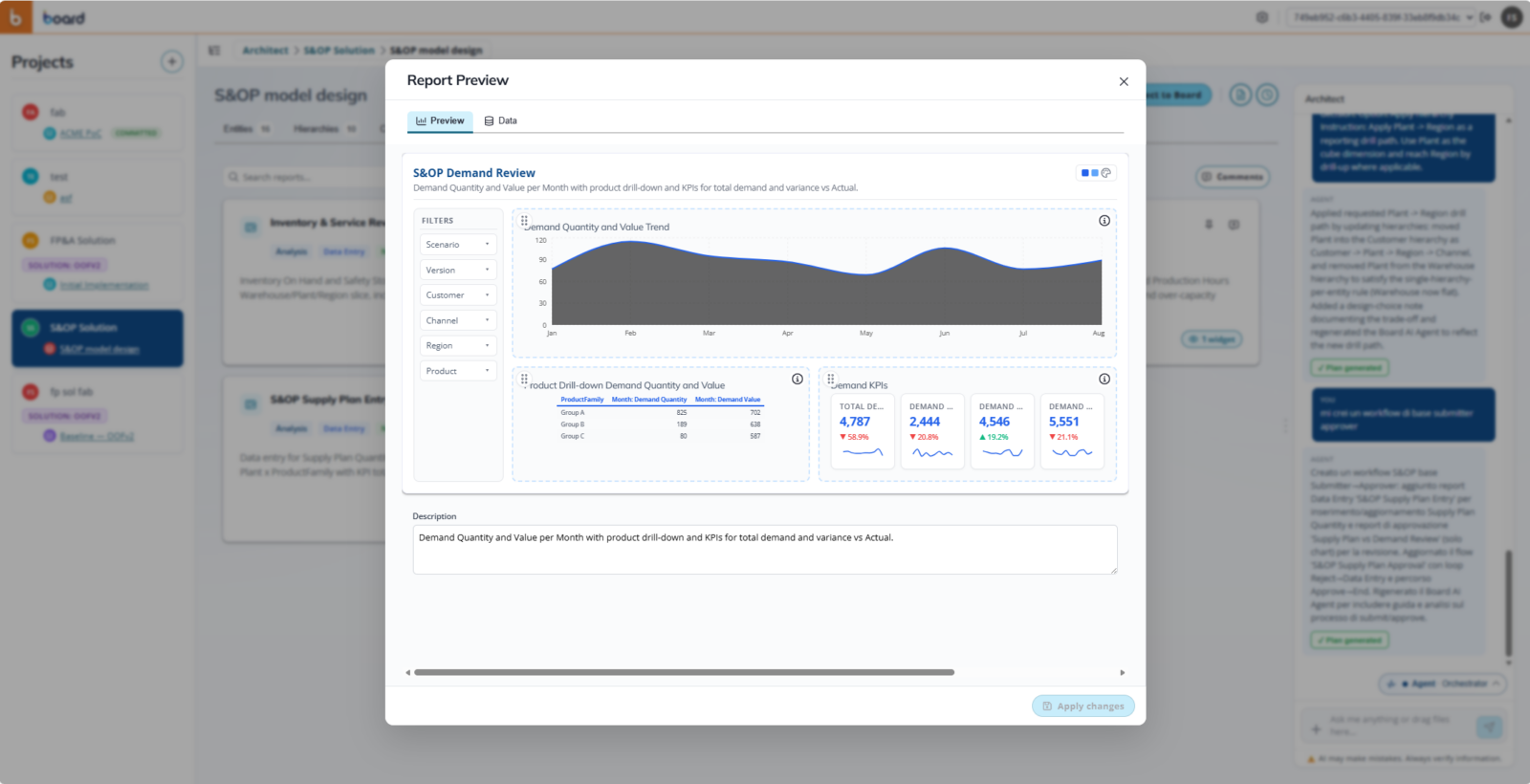
Reports and screens
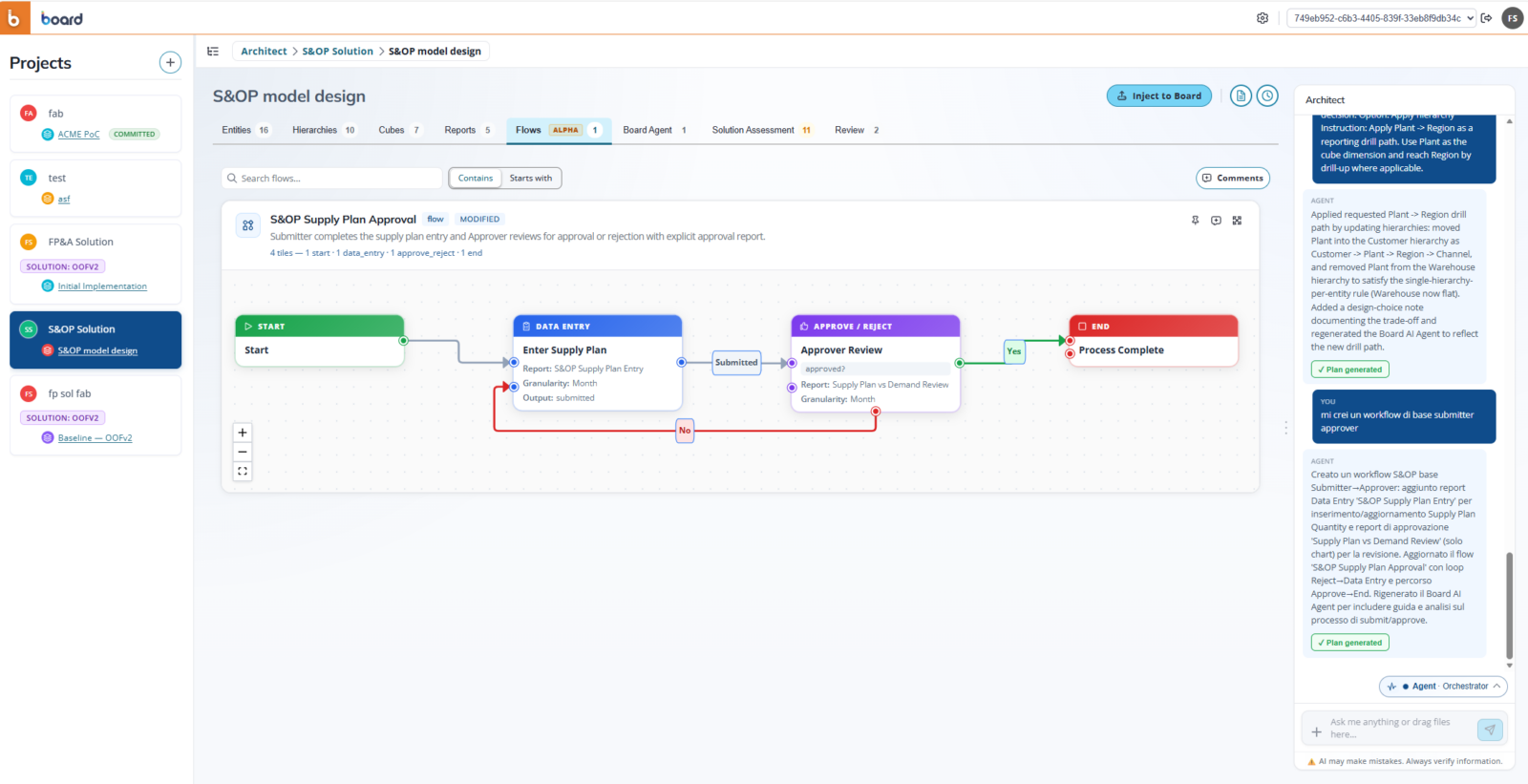
Approval workflows
Variance, driver, and exception views
Importantly, the intended experience is iterative rather than one-shot. Proposed structures can be reviewed in the new Board Modeler Workspace, refined through natural language conversation with Architect Agent, and improved through successive controlled iterations.
This will help teams move faster from documented requirements to a reviewable planning applications, while keeping business and technical stakeholders involved throughout the design process.
Assess: Understand Planning Applications Before Changing Them
But creating new planning applications is only the beginning. Many organizations rely on planning applications that have grown over several years.
And while those applications contain valuable business logic, they may also include unused components, duplicated calculations, inconsistent structures, fragile dependencies, or workflows that are no longer aligned with the current operating model.
Understanding those environments often requires significant manual investigation, particularly when the original implementation team has moved on. Today’s planners and developers simply do not have the cycles to focus on this.
The Board Architect Agent is designed to assess existing Board applications before enhancements are proposed. It will map components such as cubes, entities, hierarchies, calculations, screens, and workflows, creating a clearer view of how the solution is structured.
The agent also identifies potential areas for improvement, including:
Unused model components
Duplicated or redundant logic
Inconsistent structures
Fragile dependencies
Gaps between the application and current business requirements
Opportunities to simplify or improve the solution
The result is not simply technical documentation. It is a structured assessment that helps teams understand change readiness, prioritize improvements, and plan enhancements with greater confidence.
This “understand before changing” approach is central to the Board Architect Agent concept helping reduce the risk of treating a mature planning application as if it were a greenfield build.
Evolve: Enhance Planning Applications Without Starting Over
But let’s get down to “brass tacks.” The highest cost of a planning application is rarely the initial implementation. It is the lifetime cumulative cost of changing it over time.
A new reporting requirement, business unit, forecasting method, or approval process can trigger significant analysis and development efforts. When changes are made without a complete understanding of the current application, teams risk introducing duplicated logic, disconnected workflows, or unexplained model drift.
The Board Architect Agent is designed to help organizations build on what already works.
A user will be able to describe the required outcomes in natural language. The Architect Agent would first evaluate the existing application, then propose how the model, reports, screens, and workflows could be extended to support the new requirement.
The aim is to preserve existing business logic while adding new capabilities through controlled changes. As the underlying planning model evolves, related reports and workflows can evolve with it, helping the application remain aligned with the business process it supports.
This will be particularly valuable for organizations that want to modernize planning incrementally rather than undertake costly rebuilds whenever requirements change.
Governed Change, Not Autonomous Change
AI-generated applications may be fast to create, but speed alone is not enough for enterprise planning.
Finance, supply chain, merchandising, and operational planning environments require control, accountability, and the ability to understand what changed. An AI agent should not make opaque alterations to a production planning application without human-in-the-loop review and approval.
The Board Architect Agent is therefore designed around governed change.
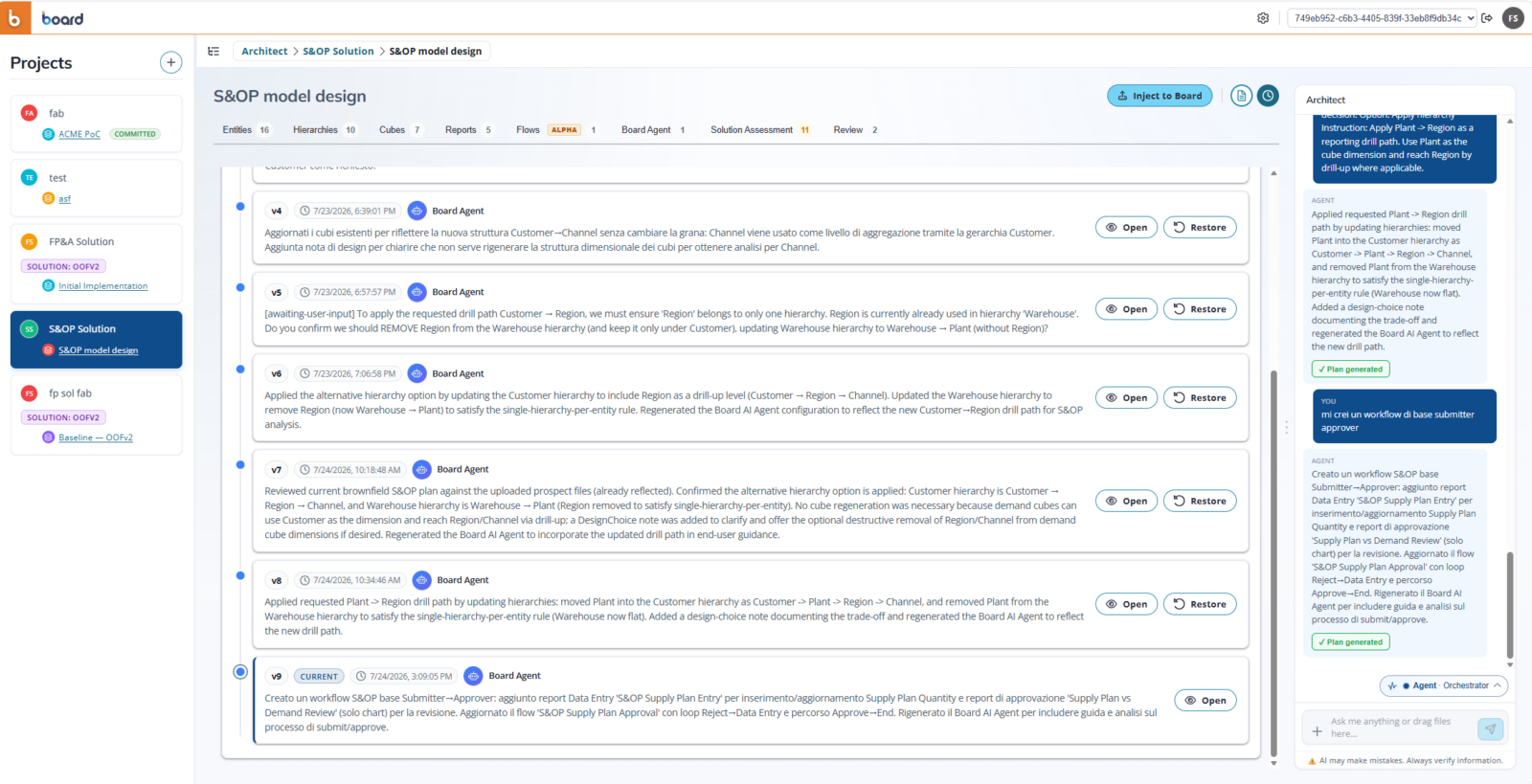
Each proposed iteration will be visible, reviewable, and traceable. Version history will show how the application has evolved, while teams can compare changes and restore an earlier version when needed. The agent will propose and explain changes, but human users remain responsible for reviewing and approving them.
This reflects Board’s broader approach to enterprise AI: agents should augment expertise while operating within defined permissions, business context, and governance controls. Board positions its agents as domain-aware specialists that work within the multidimensional planning environment rather than as generic copilots operating outside it.
The Foundation Behind Every Board Agent
The Board Architect Agent also plays a strategic role in the wider Board Agents ecosystem.
Board’s domain-specific AI agents such as the FP&A Agent, Controller Agent, Merchandiser Agent, and Supply Chain Agent depend on planning applications that accurately reflect how the business operates. They need governed business definitions, hierarchies, calculations, workflows, and trusted data context to deliver relevant analysis and recommendations.
The Board Architect Agent is designed to help create, assess, and evolve that foundation over time.
In that sense, it is not simply another domain assistant. It is the Board Agent designed to help maintain the entire planning environment upon which the other agents rely.
As business requirements change, the planning model must change with them. As models improve, domain agents can operate with a richer and more accurate business context. This creates the potential for a continuously improving relationship between the planning application itself and the Board Agents that use it.
The goal is to give solutions architects, developers, or business experts a more intelligent way to turn business requirements into planning applications, assess model complexity, manage iterative change, and keep planning solutions aligned with the business.
Instead of treating the planning system as a fixed environment that changes only through lengthy development cycles, the Board Architect Agent points toward a future in which applications are created faster, understood more clearly, and evolved continuously.
The Board Architect Agent is currently in preview. Capabilities and availability may evolve as development and preview feedback continue.