This website will offer limited functionality in this browser. We only support the recent versions of major browsers like Chrome, Firefox, Safari, and Edge.
Meet Your New FP&A AI Agent: An Always-On Finance Teammate
What if your FP&A team started every morning with answers—before the questions are even asked. See how an always-on AI Agent transforms modern FP&A.
It’s 8:00 a.m. on Monday morning. Before your analysts start logging in, your new FP&A teammate has already been at work.
Overnight, it reviewed updated financial and operational data, validated relationships across the P&L, balance sheet, and cash flow statement, detected early signals, and prepared decision-ready outputs for your morning review. By the time your team connects, the FP&A AI Agent has flagged the biggest changes, run multiple scenarios, and surfaced the most important questions to address next.
This isn’t a future vision. It’s what an FP&A AI agent can do today, continuously, with finance in control.
TL;DR: What an FP&A AI Agent does
Monitors performance continuously (not just at close or on request)
Explains drivers across statements and highlights cause-and-effect
Runs scenarios automatically when conditions change
Flags risks and opportunities early with clear reasoning
Keeps humans in control with governance, approvals, and auditability
What is an FP&A AI Agent?
An FP&A AI agent is an always-on digital teammate that monitors finance and operational signals, explains what’s changing and why, runs scenarios, and escalates what matters: all under finance-approved controls.
Unlike traditional tools that wait for prompts, the agent works continuously in the background so FP&A can move faster with more confidence.
FP&A’s New Reality: More Complexity, Less Time
Finance teams are navigating shifting demand patterns, evolving margin dynamics, faster planning cycles, and constant performance questions. Often with the same or fewer resources.
Data is bigger. Decisions are faster. Leadership expectations are rising.
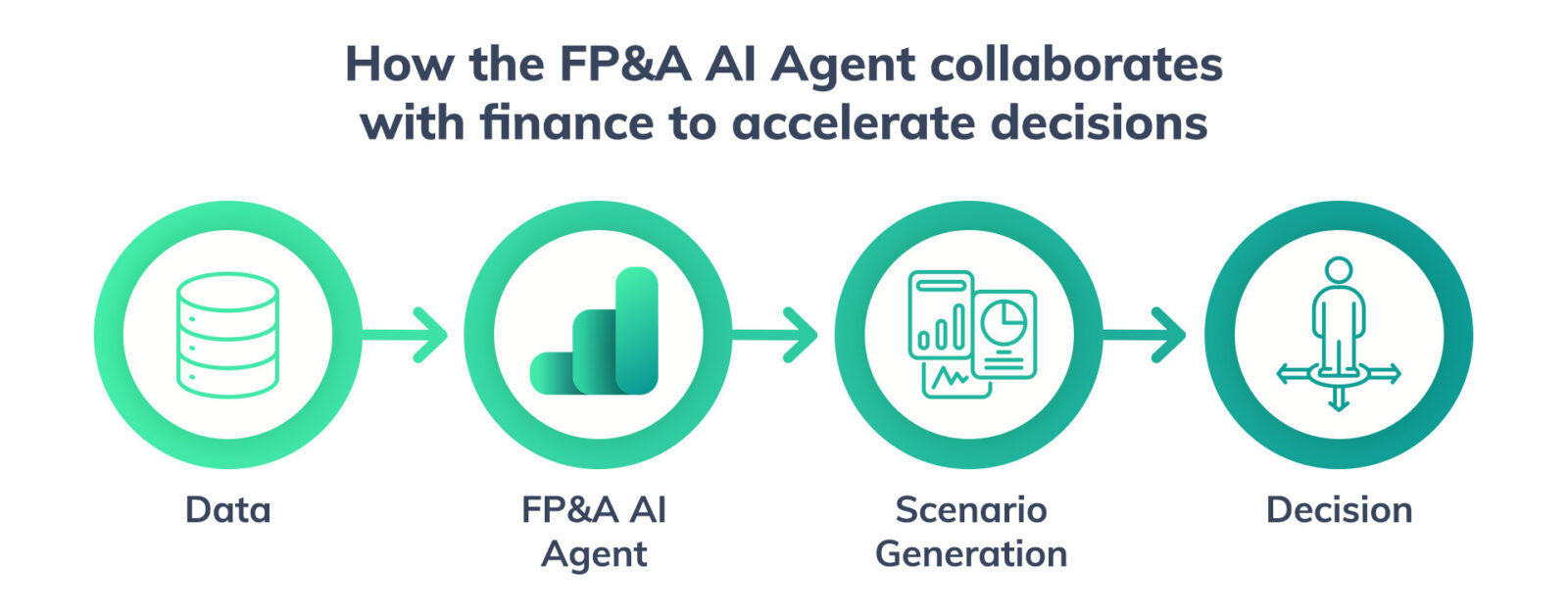
The FP&A AI Agent is built for exactly this moment: an autonomous teammate that monitors, models, analyzes, and explains performance continuously.
Assistive AI vs. an FP&A AI Agent
Most AI tools in finance are assistive: useful for drafting narratives or responding to a prompt. An FP&A AI Agent is proactive and operational.
Assistive AI (copilot-style):
Responds when prompted
Helps draft, summarize, or answer questions
Outputs depend on what the user asks
FP&A AI Agent (agentic):
Monitors data continuously
Surfaces cross-statement impacts
Evaluates scenarios automatically as assumptions change
Highlight potential risks and opportunities
Prepares recommendations and decision paths
Supports human decisions with explainability and governance
It doesn’t just answer questions. It identifies what questions matter.
The FP&A Agent continuously validates relationships across the P&L, balance sheet, and cash flow statement, checking assumptions and identifying financial impacts as they occur.
What it watches: cross-statement linkages, reconciliation breaks, assumption drift What it produces: exception flags, root-cause hints, updated impacts Why it matters: faster close cycles, fewer errors, higher confidence—without extra manual work
With the FP&A Agent, integrated statement analysis becomes continuous and insight-driven, not periodic or reactive. As trends, anomalies, or shifts emerge, the agent connects movement across statements and highlights the underlying drivers so FP&A can see cause-and-effect clearly.
What it watches: revenue/margin shifts, cost movements, balance sheet drivers, cash impacts What it produces: “what changed / why / so what” summaries with driver attribution Why it matters: FP&A moves from reviewing results to shaping decisions in near real time
The FP&A Agent continuously monitors cash positions and working capital dynamics across entities, detecting changes and explaining them as they happen.
What it watches: collections, payables timing, inventory swings, liquidity thresholds What it produces: early warnings, forecast adjustments, liquidity scenario options Why it matters: intervene sooner, improve cash forecasting accuracy, spend less time chasing movements after close
Day-to-Day Impact: What This Changes in Practice
Instead of triangulating statements, rebuilding models, or reconciling variances, FP&A can jump directly into scenario thinking, decision alternatives, and strategic guidance.
The difference isn’t “automation.” The difference is acceleration: faster insight, faster alignment, faster action
The FP&A Agent becomes the first line of financial visibility, while humans validate direction, apply judgment, and drive strategy.
Why This Matters Right Now
Business conditions can change materially within days, not quarters. Demand patterns shift, margin pressure can appear suddenly, and liquidity positions can move quickly as market dynamics evolve.
Traditional FP&A processes were designed for periodic visibility and linear cycles. But the business now operates continuously.
An FP&A AI Agent helps finance respond at the speed decisions are needed:
Detect early signals before they hit results
Explain drivers while there’s time to act
Evaluate paths forward before decisions become urgent
The outcome isn’t just faster reporting: it’s higher decision velocity, better forecast quality, and greater strategic impact from finance.
Your First 30 Days with an FP&A AI Agent (a practical rollout)
Week 1: Connect + baseline
Align on key KPIs, statements, and driver definitions
Establish what “good” looks like (thresholds, tolerances, alert rules)
Week 2: Monitor + explain
Turn on continuous variance and driver monitoring
Validate statement linkages and surface exceptions early
Week 3: Scenario automation
Standardize outputs into decision briefs
Trigger scenario refreshes when key drivers move (volume, price, COGS, FX, working capital)
Week 4: Embed in cadence
Operationalize weekly exec readouts and monthly close support
Track time saved, forecast accuracy improvements, and earlier risk detection
The Future of FP&A Is Human + AI
Agentic AI elevates FP&A by increasing the tempo of insight while preserving the judgment, governance, and experience that finance leaders bring.
The agent works in the background, monitoring data, identifying patterns, and offering decision paths. Human expertise still sets guardrails, validates direction, and chooses the best course of action.
Finance isn’t becoming automated. It’s becoming more strategic, more adaptive, and more influential. With confidence.
See it in action
Want to see what an FP&A AI Agent could do for your team? Request a demo
A copilot responds when someone asks. An FP&A AI Agent is proactive. It monitors continuously, escalates what matters, and prepares decision outputs automatically.
Most teams start with 3-statement validation, continuous variance/driver analysis, and cash & liquidity monitoring because they produce fast wins and build trust.
Finance defines thresholds, approvals, and guardrails. The agent prepares outputs and explanations; people validate decisions and sign off where required.
Decision briefs, driver attribution, exception flags, scenario deltas, and narrative drafts, packaged for your existing weekly and monthly cadences.
No. It removes the repetitive mechanics of monitoring and prep so analysts can focus on judgment, business partnering, and strategic guidance.