This website will offer limited functionality in this browser. We only support the recent versions of major browsers like Chrome, Firefox, Safari, and Edge.
The Rise of Agentic AI in Finance: From Automation to Autonomy
Finance is entering its next evolution. From spreadsheets to autonomy, agentic AI is reshaping how CFOs and their FP&A and Controlling teams monitor the business, anticipate risks, and guide decisions. This shift will fundamentally transform analysis, accelerate decision-making, and elevate the Office of Finance into an era of continuous insight, proactive action, and seamless human–AI collaboration.
The next evolution of finance intelligence has arrived
A thousand years ago, finance ran on the abacus, beads sliding on rods, turning arithmetic into insight.
Centuries later came the calculator, the accountant’s constant companion that transformed speed and accuracy. Then, in the 1980s, spreadsheets like Excel redefined how finance operated, putting modeling, forecasting, and data manipulation into every analyst’s hands.
Each of these breakthroughs marked a turning point — from manual tabulation to digital computation, from static reporting to dynamic analysis. Now, finance stands at another inflection point that is as profound as the move from paper ledgers to Excel. This time, the shift isn’t about faster math or prettier charts.
What’s emerging today is more than a smarter algorithm or chatbot. It’s the dawn of a new paradigm, agentic AI, where intelligent digital agents analyze data or generate text, but they can also reason, plan, and act on behalf of the enterprise. That is, this next wave of AI won’t simply assist finance. It will partner with it.
From static dashboards to self-driving finance
Over the past decade, automation and machine learning have reshaped the finance function. Robotic process automation (RPA) handled repetitive tasks like reconciliations and report preparation. Predictive models improved forecast accuracy. Generative AI brought conversational insights to dashboards. But these technologies have largely operated in silos — reactive, one-directional, and dependent on human initiation.
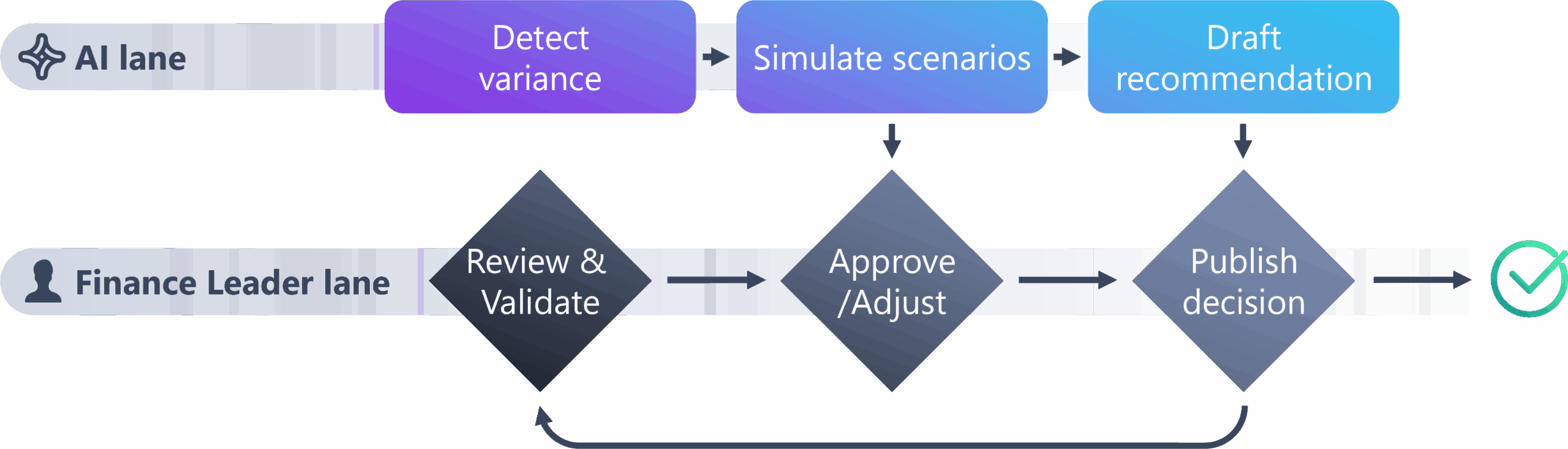
Agentic AI changes the equation. These systems can autonomously decompose goals (“improve forecast accuracy by 5%”), break them into subtasks (“simulate scenarios,” “update models”), execute actions across systems, and learn from feedback — all while remaining under human supervision. It’s finance’s equivalent of moving from cruise control to autopilot.
According to McKinsey, autonomous agents could capture up to $4 trillion in annual productivity gains across industries, with the greatest near-term impact expected in corporate finance, operations, and supply chain decision-making.
Why the Office of Finance is ground zero for agentic AI
Finance is uniquely positioned for this transformation because it already deals in structured data, repeatable cycles, and defined decision rules. Consider the areas ripe for intelligent autonomy:
FP&A: Instead of analysts manually running scenarios or refreshing assumptions, AI agents could continuously monitor deviations, test drivers, and recommend course corrections in real time.
Financial Consolidation: Agents could proactively identify data mismatches across entities, trigger validation workflows, or even pre-populate adjustments before the controller reviews.
Disclosure and Reporting: Narrative drafts, variance explanations, and even audit-ready reconciliations could be generated, refined, and validated autonomously.
As Gartner notes in its Finance Trends research, the next generation of CFO technologies will move from “assisting” to “acting,” enabling autonomous financial decision-making that remains fully explainable and controllable. Gartner also projects that by 2030, more than 80% of finance functions will embed AI-driven autonomy in core processes.
From copilots to colleagues
Most finance leaders are familiar with AI “copilots”, assistants that respond to prompts or summarize information. Agentic AI goes further as it introduces goal-driven collaboration.
Incorporates interest rate movements and how they directly impact the balance sheet,
Simulates the P&L and cash impact automatically with recommended actions,
Flags the complete risk exposure to margin,
And then presents a recommendation to management — all before the next forecast cycle.
That’s not futuristic fiction. Early pilot programs across Fortune 500 finance organizations are already testing these capabilities. Accenture projects that AI-enabled decision agents could reduce manual finance workload by up to 40%, freeing teams for strategic analysis and business partnering.
Human-in-the-loop: governance, control, and trust
For CFOs, autonomy doesn’t mean relinquishing oversight. The most effective agentic systems embed human-in-the-loop frameworks, where AI handles data-driven reasoning and execution while finance leaders steer direction, validate outcomes, and govern guardrails.
As Deloitte’s CFO Signals survey highlights, finance executives increasingly view AI not simply as a speed enabler but as a path to trusted intelligence — achieved through strong human involvement and structured governance.
Gartner reinforces this balance of human and machine. In its AI Agents report, Gartner describes interaction models where agents can function with “different levels of human involvement, such as human-in-the-loop versus human-out-of-the-loop.” This distinction is critical in finance: AI should automate data-driven tasks while keeping people firmly in charge of interpretation, judgment, and accountability.
ISG Research echoes this principle in its 2025 AI Agents Buyers Guide, noting that enterprise-grade agents must engage with humans to achieve desired outcomes. For finance functions, that means ensuring AI-driven processes remain transparent and adaptable at key decision points.
These insights converge on a common theme: the most valuable AI in finance won’t eliminate the human factor, it will elevate it. Clear escalation rules, audit trails, and governance frameworks ensure that autonomy never compromises accountability.
In the end, human-in-the-loop isn’t just a safeguard; it’s the foundation for trusted, explainable, and resilient finance intelligence.
A glimpse of tomorrow’s finance function
Fast-forward three years. You walk into your Monday morning forecast review. Overnight, your FP&A Agent has already:
Incorporated real-time external economic signals, enabling more proactive, accurate revenue forecasts
Simulated the margin impact of new supplier contracts or unexpected customer churn,
Flagged anomalies in expense run rates with recommended actions for remedy, and
Delivered a summary narrative with deep analysis and financial insights directly in your Board dashboard for accelerated and confident decision-making.
Your role? To question, validate, and steer — not to chase spreadsheets. This is the future of finance intelligence where human judgment is powered by autonomous reasoning.
The bottom line
Agentic AI isn’t a distant dream. It’s the next logical step in finance’s digital evolution. From the abacus to the calculator, from Excel to AI, finance has always evolved to meet the moment. Now, it’s time to take the next leap: from automation to autonomy, from copilots to colleagues.
This technology will reshape how CFOs, FP&A teams, and Controllers operate, make decisions, and create value. And in just a few months, that future will take its first real form with the arrival of Board Finance AI Agents, designed specifically for FP&A and financial close, consolidation, and reporting.
Self-driving finance is closer than you think, enabling continuous planning with human-in-the-loop. The era of Finance AI Agents that reason and act is coming. Ready to lead with more confidence and generate more value for your organization? Explore use cases now at Board AI agents.