

Whitepaper
Board & Microsoft Fabric
From Governed Data and AI to Trusted Enterprise Decisions
A reference architecture for connecting Microsoft Fabric with Board’s Contextual Decision Layer. Microsoft Fabric provides the governed data and analytics foundation. Board adds the business context, planning logic, scenarios, workflows, and decision governance required to turn intelligence into coordinated action.
Trusted data and intelligent models are only the beginning.
Enterprises have invested heavily in modern data platforms, governed data products, machine learning, and generative AI.
But trusted data and intelligent models do not, by themselves, produce trusted business decisions.
Enterprise decisions also depend on planning assumptions, business rules, financial logic, scenarios, ownership, approvals, operational constraints, and human judgment. These capabilities often remain distributed across spreadsheets, applications, and departmental processes.
This reference architecture explains how Board and Microsoft Fabric work together to close the gap between enterprise intelligence and coordinated business action.
Why This Guide Matters
Enterprise AI is moving from analysis toward action.
The challenge is no longer only preparing, governing, and serving enterprise data and AI assets. The challenge is activating those assets inside business planning and decision workflows that are:
- Governed
- Explainable
- Scenario-based
- Collaborative
- Operationalized across the enterprise
Without clear architectural boundaries, organizations risk duplicating data, embedding planning logic in the wrong systems, and generating recommendations that cannot be trusted, approved, or executed at scale.
This guide shows how Microsoft Fabric and Board connect through secure, governed interfaces to transform governed data products, analytical models, predictions, and reusable insights into coordinated enterprise decisions.
Enterprise AI needs clear boundaries and connected decision architecture.
Microsoft Fabric unifies and governs enterprise data and analytics assets.
Board activates governed data through planning and decision context.
Together, the platforms connect:
- Enterprise data and operational systems
- Governed data products and analytical outputs
- Business semantics and planning logic
- Scenario modeling and workflow
- Decision governance and auditability
- Enterprise planning and decision solutions
- Business execution and measurable outcomes
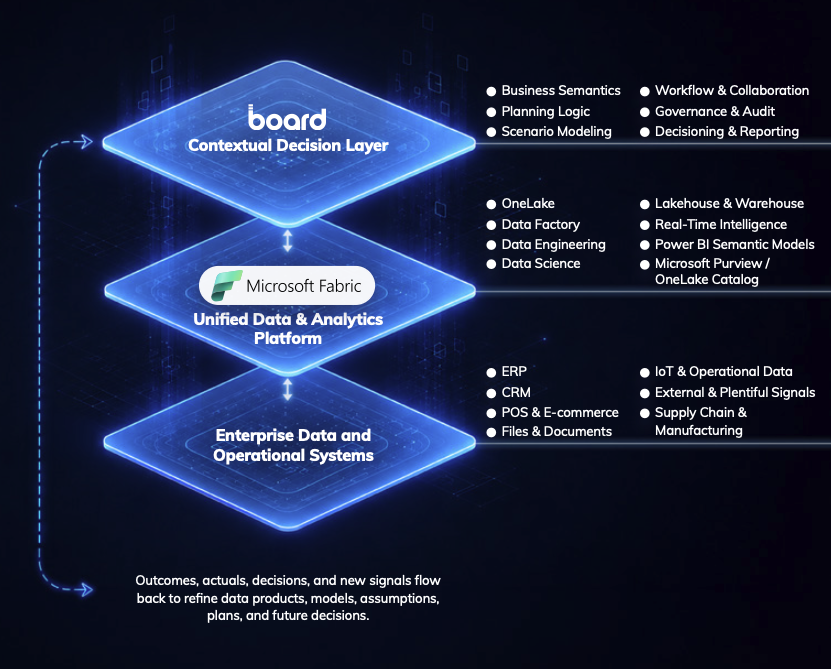
The result is a continuous flow from governed data and AI to coordinated plans, approved actions, and feedback that improves future decisions. The report’s architecture emphasizes that outcomes, actuals, decisions, and new signals should flow back to refine data products, models, assumptions, plans, and future decisions.
Featured Framework: From Governed Data to Trusted Decisions
Discover how Board and Microsoft Fabric connect:
Enterprise Data and Operational Systems → Microsoft Fabric Unified Data & Analytics Platform → Board Contextual Decision Layer → Enterprise Planning and Decision Solutions → Business Execution and Outcomes
The guide illustrates how Microsoft Fabric prepares and governs enterprise data and analytical outputs, while Board applies business semantics, planning logic, scenarios, workflows, governance, and collaboration to make those assets actionable for business users.
From Enterprise Data to Enterprise Decisions
What You’ll Learn
See how Microsoft Fabric provides the governed data and analytics foundation, while Board adds the contextual decision layer needed to plan, simulate, coordinate, govern, and decide.
Learn why Microsoft Fabric is best suited to governing, preparing, analyzing, and serving enterprise data and analytical outputs, while Board supports planning logic, business rules, scenarios, collaboration, and decisions about what the business should do next.
Explore how governed data products, predictions, and reusable insights can be activated through business semantics, planning models, rules, workflows, approvals, and reporting.
Understand how plans, decisions, annotations, outcomes, and new signals can flow back to Microsoft Fabric to improve analytics, models, assumptions, and future planning cycles.
Review practical architecture principles for keeping enterprise data in Microsoft Fabric, exposing trusted data products, maintaining deterministic planning logic, using open interfaces, and building for continuous planning.
See how Fabric data and analytics products can be enriched by Board’s Contextual Decision Layer to support FP&A, financial consolidation and reporting, merchandise planning, supply chain planning, and industry-specific solutions.
Recommended for:
CIOs
Chief Data Officers
Chief AI Officers
Enterprise Architects
Data Platform Leaders
Analytics Leaders
Digital Transformation Leaders
Enterprise Planning Leaders
From Enterprise Data to Enterprise Decisions
What You’ll Learn
See how Microsoft Fabric provides the governed data and analytics foundation, while Board adds the contextual decision layer needed to plan, simulate, coordinate, govern, and decide.
Learn why Microsoft Fabric is best suited to governing, preparing, analyzing, and serving enterprise data and analytical outputs, while Board supports planning logic, business rules, scenarios, collaboration, and decisions about what the business should do next.
Explore how governed data products, predictions, and reusable insights can be activated through business semantics, planning models, rules, workflows, approvals, and reporting.
Understand how plans, decisions, annotations, outcomes, and new signals can flow back to Microsoft Fabric to improve analytics, models, assumptions, and future planning cycles.
Review practical architecture principles for keeping enterprise data in Microsoft Fabric, exposing trusted data products, maintaining deterministic planning logic, using open interfaces, and building for continuous planning.
See how Fabric data and analytics products can be enriched by Board’s Contextual Decision Layer to support FP&A, financial consolidation and reporting, merchandise planning, supply chain planning, and industry-specific solutions.
Recommended for:
CIOs
Chief Data Officers
Chief AI Officers
Enterprise Architects
Data Platform Leaders
Analytics Leaders
Digital Transformation Leaders
Enterprise Planning Leaders
You may also be interested in



Let’s see what Board can do for you.
Get a tour of the Agentic Planning Platform in action.