Your Plan Says Grow 5%. Which Numbers Change?
Meet Board MCP: Governed Planning for Your AI Ecosystem
Board MCP lets compatible AI assistants call Board Agents through one governed door. The question travels; the decision stays in Board.
This website will offer limited functionality in this browser. We only support the recent versions of major browsers like Chrome, Firefox, Safari, and Edge.

Board MCP lets compatible AI assistants call Board Agents through one governed door. The question travels; the decision stays in Board.
Enterprise AI is moving quickly from experimentation into daily work. Finance teams are asking assistants to explain performance. Supply chain leaders are testing agents against demand and inventory questions. Merchandising teams want faster ways to explore trade-offs. Meanwhile, technology leaders are trying to connect a growing set of AI platforms to the systems that hold trusted business information.
The integration challenge is becoming easier, but the decision challenge is not. A general-purpose AI assistant may be able to reach a data source, but it does not automatically know which version of the forecast is current, how a product hierarchy rolls up, which allocation rule applies, what assumptions are approved, or whether the user is allowed to see a particular slice of the plan. Those details are not incidental; they are the context that makes enterprise planning coherent.
That is the problem Board MCP is designed to address. Board MCP provides a governed front door for bringing Board planning intelligence into your wider enterprise AI ecosystem. It lets a licensed Board user call specialized Board Agents from a compatible AI assistant. Each agent answers from Board’s live metrics, hierarchies, and models, under that user’s own identity and permissions.
Model Context Protocol, or MCP, is an open standard for connecting AI systems to external data sources and tools. IDC describes its importance in practical terms: an MCP server can move trusted information from a destination that users visit into an input that an AI agent can call inside an existing workflow. That can reduce the manual copying, re-prompting, and context rebuilding that often separates an AI assistant from enterprise knowledge.
But the protocol is only a connection layer, not a planning model. IDC notes that an MCP server alone is not a permanent differentiator. What makes the difference is what sits behind the connection: its structure, its logic, and its governance. Gartner makes a similar point in its 2026 research, advising technology leaders to design MCP services around bounded domains, tool governance, and accountable ownership.
For enterprise planning, the bounded domain is especially demanding. An answer may depend on shared business definitions, multidimensional hierarchies, deterministic calculations, scenarios, versions, workflow status, approvals, and user permissions. Making those elements available as planning context is different from giving an assistant broad access to a data platform or a collection of documents.
Board MCP is the governed connection between compatible enterprise AI platforms and planning intelligence in the Board Agentic Planning Platform. Currently in preview, it lets teams ask questions of the business and test what-if scenarios through Board’s domain-specific agents from the AI tools they already use.
That distinction is important. The value is not a static copy of planning data for an assistant to interpret on its own. Board MCP brings the assistant to governed planning context: live metrics, business hierarchies, models, permissions, and the logic that gives those elements meaning. The assistant does not query Board datasets directly: it asks a Board Agent, which answers on the governed model and returns the provenance of each answer, meaning which datasets it used and as of when.
Board MCP is organized around four practical outcomes:
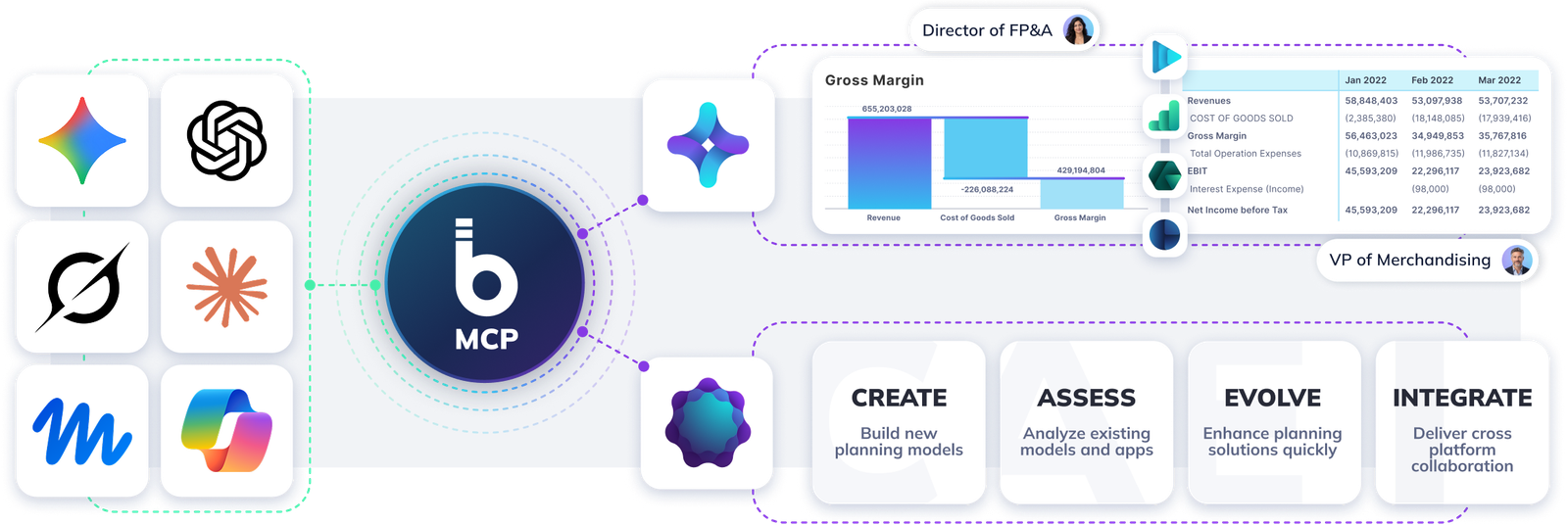
Consider a director of FP&A investigating why gross margin came in two points below forecast. A generic assistant can summarize the spreadsheet it is given or produce a plausible list of drivers. It cannot tell whether that spreadsheet holds the current forecast version, how products roll up into categories, or how shared costs were allocated.
In Board, the same question lands on a multidimensional planning model. Gross margin exists at every intersection of version, period, entity and product, and of any other dimension the company plans on, such as customer or channel. Every level of every hierarchy aggregates by the rules the company defined, and actuals, budget, forecast and scenarios sit side by side in the same structure. So “below forecast” means the approved forecast version, not the last file someone shared.
That structure is what lets a Board Agent go beyond a summary. Through Board MCP, the director asks from the assistant already open on the desktop. The FP&A Agent can break the variance down along the dimensions of the model, from the group total to the entities, product categories and months behind it, and separate a real margin problem from a shift in mix. If the director then asks what happens if a price increase holds in one region, the what-if runs on the Board engine across the same dimensions and is not saved as a new plan version.
The answer comes back with the context that makes it usable: which version, which slice of the model, and as of when. The director’s entitlements apply throughout, so a regional controller asking the same question sees only what they could see in Board.
The same pattern can extend beyond finance: a merchandising leader comparing category sell-through against plan, or a supply chain planner checking how a demand signal changes the constrained plan. Each answer is computed on the dimensions, hierarchies and versions of the model the planner already works in.
The value is not simply fewer clicks. It is continuity of meaning. An assistant can be swapped; a planning model cannot be improvised. Teams can use different AI experiences while drawing on the same multidimensional foundation, so every assistant reads the same definitions, the same hierarchies and the same version of the plan, instead of reconstructing its own.
One important note: While interoperability expands what AI can reach, it also expands the trust boundary. In May 2026 guidance on MCP, the U.S. National Security Agency highlighted risks associated with dynamic tool invocation, implicit trust relationships, and context sharing. Gartner argued in May 2026 that governance should reflect an agent’s autonomy and scope of access rather than forcing every use case into a simple choice between fully locked down and fully trusted.
That is why Board MCP is presented as a governed front door, not an open back door. In the preview, that means four things. Only licensed Board users can call it. Every call runs under the caller’s own Board identity, resolved again on every request, with no shared service account. A Board Agent is reachable only after it is explicitly enabled for MCP. And the question travels while the decision does not: approving, locking, and committing a plan stay on Board’s governed surfaces.
For buyers, this should change your evaluation criteria. The question is not only whether an AI assistant can connect, but whether identity, entitlements, allowed capabilities, usage visibility and human accountability remain coherent after it does.
The reality is that most enterprises will use more than one model, assistant, or agent platform. An enterprise planning strategy likely won’t depend on one conversational front-end becoming the universal place where every decision happens.
Board MCP supports this more durable architecture. AI experiences can evolve at the edge while Board remains the Agentic Planning Platform where governed business semantics, planning models, deterministic calculations, scenarios, workflows, and permissions come together. In Board’s broader architecture, the Contextual Decision Layer connects governed data and AI services with the decision context required for Continuous Planning.
As your organization explores MCP for planning and decision workflows, five governance questions are useful in determining the most appropriate approach:
MCP is helping enterprise AI move beyond isolated chat and one-off integrations. The next test is whether those connections carry the context and controls required for real business decisions.
Apply to join the Board MCP preview. We are selecting a small group of design partners to validate governed MCP access end to end, from first connection to audit.
Get a tour of the Agentic Planning Platform in action.