This website will offer limited functionality in this browser. We only support the recent versions of major browsers like Chrome, Firefox, Safari, and Edge.
From Spreadsheet Wrangling to Fully Agentic Planning: A Maturity Model for Modern Enterprises
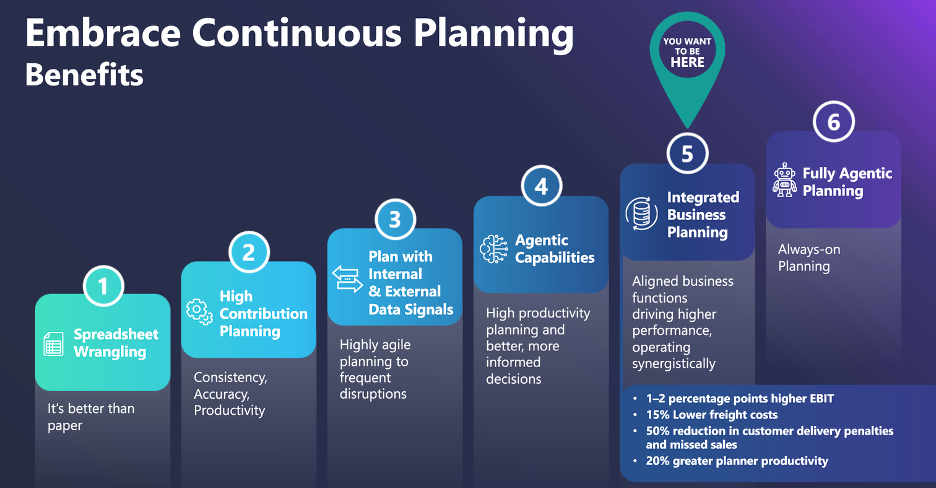
Board’s Continuous Planning Maturity Model maps an enterprise’s continuous planning journey, giving a clear progression for how technology, data, and governance combine to create continuously aligned, decision-ready organizations.
Enterprises don’t wake up “agentic.” They evolve sometimes painfully from manual, siloed forecasting to continuous, integrated, and ultimately agent-enabled planning that can sense, reason and act. Board’s Continuous Planning Maturity Model maps an enterprise’s continuous planning journey from Spreadsheet Wrangling → High-Contribution Planning → Plan with Internal & External Data Signals → Agentic Capabilities → Integrated Business Planning → Fully Agentic Planning giving a clear progression for how technology, data, and governance combine to create continuously aligned, decision-ready organizations. The remainder of this post details each stage, explains the organizational hallmarks and risks, and links each stage to recent, reputable market evidence and business outcomes.
Stage 1 — Spreadsheet Wrangling: The default is a costly baseline
What it looks like:
Planning still lives in Excel for many organizations: emailed workbooks, manual reconciliations, fragile formulas and last-minute consolidations. That “Excel-first” habit produces brittle plans with poor lineage, frequent reconciliation work, and long cycle times.
Why it persists:
Market research in 2025 shows this isn’t a nostalgia problem, it’s a practical one. One 2025 Workforce Planning & Analysis Market Study found that “export data to Excel” and “Excel-based data entry and import” rank among the top integration and additional features users expect from planning systems, signaling that spreadsheets remain the default working artifact for planners and that vendors must explicitly support Excel workflows. This is not a peripheral preference: Excel integration is one of the most consistently desired capabilities across geographies and functions in the 2025 study.
Leading vendors are competing to offer cloud FP&A platforms that preserve the familiar, Excel-like experience (for example, Board’s Flex Grid is noted for its Excel-like interface) while delivering auditability, centralized models, and scenario simulation—a commercial acknowledgement that eliminating spreadsheets requires offering comparable usability with even stronger governance.
Business consequences:
The result is predictable: finance teams spend hours on low-value, manual tasks instead of shaping strategy. Errors, lack of lineage and slow cycle times translate into lost decision agility and hidden operational costs.
How to move on:
Start by treating Excel as a governed front end rather than the system of record: centralize plan data, implement versioning, and workflow and provide a sanctioned Excel integration that preserves user productivity while eliminating the file-based risks that create the majority of spreadsheet headaches. The good news: Board for Microsoft 365 with our updated Excel add-in capabilities will be generally available in Board 15.
Stage 2 — High-Contribution Planning: Planners become analysts
What it looks like:
Organizations standardize models on an EPM platform that supports driver-based planning, scenario simulation, and workflow. Planners spend less time collecting and more time interpreting and advising.
Market evidence:
Many analysts explicitly mention that modern enterprise planning solutions must enable integrated, continuous planning with in-memory modeling, workflow, versioning, and scenario simulation allowing finance to shift from consolidation to value-added analysis. Vendors are explicitly positioning features to increase planner productivity and reduce spreadsheet dependency.
Business impact:
Faster scenario execution, fewer manual errors and materially higher planner productivity — the typical early ROI for disciplined platform adoption.
Practical next step:
Invest in an enterprise planning platform that preserves Excel-style flexibility (so change management isn’t brutal) while introducing auditability, process controls, and templates that elevate planners’ work. Concretely, pick a platform whose planning surface delivers the familiar, spreadsheet-equivalent ergonomics planners expect and the enterprise-grade data/model governance you need.
Re-imagining the core planning experience is one of the highest-leverage levers to make this practical. Flex Grid sits at the center of Board’s modern planner experience: a high-performance, spreadsheet-familiar, self-service workspace that lets planners move seamlessly from analysis to execution at enterprise scale. Board 15 is a substantial step in that evolution: it brings live, interactive visualizations inside the grid and layout improvements that eliminate many Excel export/workarounds today and prepares the grid to become fully spreadsheet-equivalent.
Board 15: What’s in it for planners
NOW:
Docked Charts — live, interactive visualizations embedded inside the grid so storytelling and analysis happen in one place (reducing exports to Excel).
Vertical Layouts — spreadsheet-like orientations that align to how planners naturally think and work, improving readability and model ergonomics.
NEXT:
End-user formatting — basic and advanced formatting control in the grid so planners can present analysis without leaving the platform.
End-user formulas & functions — making Flex Grid functionally equivalent to a spreadsheet for formulas and custom functions, enabling a true one-stop planner experience.
These enhancements materially reduce the friction of leaving file-based planning behind: planners get the comfort and power of a spreadsheet experience while IT and finance get the versioning, auditability and linkage that deliver true High-Contribution Planning.
Stage 3 — Plan with Internal & External Data Signals: Contextual, not just historical
What it looks like:
Plans are informed by a single, reconciled demand signal that blends internal operational telemetry (sales, inventory, promotions, store/customer signals) with curated external indicators (macro/industry/market feeds). Forecasts are produced at the right level for the decision — from strategic category/regional outlooks to SKU × location × day demand units that drive replenishment and execution.
Why it matters:
Forecasting is no longer an isolated technical exercise: it must be embedded inside your enterprise planning platform so “decisions, scenarios, and outcomes live in the same planning model” and the organization can act on a forecast together. After all, decisions beat predictions every day. At Board, we believe every company should implement two complementary forecasting approaches: Foresight Econometric Forecasting and Foresight Operational Forecasting as the backbone of a continuous, cross-functional forecasting ecosystem that converts external signals and internal performance into defensible, explainable plans.
How Board Foresight’s two forecasting approaches complement each other:
Use Econometric Forecasting when decisions require causal explanation and alignment across finance and strategy (e.g., 6–12 month category growth planning, scenario-driven budget and S&OP reconciliation).
Use Operational Forecasting when decisions need high-frequency, high-granularity forecasts for replenishment, allocation, and daily operational execution. Together they produce a single executable demand signal that aggregates and reconciles across horizons.
Business impact:
The practical payoff is threefold: (1) better decision confidence and defensibility (explainable drivers and narrative), (2) actionable alignment between finance, commercial, and operations (one reconciled demand signal), and (3) operational improvements resulting in fewer stock-outs and overstocks, faster reforecasting cycles, and a quantifiable lift to financial outcomes where Board customer examples show substantial working-capital and P&L benefits.
Practical next step:
Choose an enterprise planning platform like Board with both external and internal signals converging into a single semantic model and multi-level forecast: (a) start by diagnosing which decisions (horizon + granularity) matter most; (b) pilot Board Foresight Econometric models where causal explanation is mission-critical; (c) pilot Board Foresight Operational Forecasting at a single high-value demand-unit cohort (SKU × location) to validate methodology & scalability (using a LightGBM / Prophet hybrid approach); (d) instrument multi-level rollups so all functions use the same reconciled demand signal; and (e) seed scenario libraries that combine econometric scenarios with operational re-plans. In Board 15, this becomes practical because the platform natively supports both Board Foresight Forecasting flavors, integrated external signals, and the operational forecasting engines needed to scale to millions of demand units.
Purpose-built agents (FP&A, Controller, Supply Chain, Merchandiser) continuously monitor signals, run prioritized what-ifs, detect anomalies and surface finance-grade recommendations. Agents automate time-consuming tasks while being explicit about lineage and rationale.
Market evidence:
Key AI analysts call out GenAI and agentic roadmaps as major differentiators, from automated scenario refreshes to explainability and assistant workflows. One key analyst’s 2025 market study clearly documents growing interest in embedded GenAI capabilities for narrative and analysis within planning workflows. This is concretely represented by the vast number of agentic capabilities that have been promised to the market across all industries.
Business impact:
Agents can reduce repetitive work, enable orders-of-magnitude faster scenario runs (customer anecdotes report scenario generation dropping from hours to seconds), and surface root causes far faster, freeing planners to focus more insight and confident decision-making. But be wary, one trusted analyst firm predicts over 40% of agentic AI projects will be canceled by the end of 2027 unless cost, value, and risk are tightly controlled.
Practical next step:
Pilot narrow agents (reconciliations, anomaly detection, narrative generation) with strong human-in-the-loop controls and audit trails. Measure trust and accuracy before broadening autonomy. Consider running a “Proof of Value” workshop with Board Agents enabled in Board 15.
Stage 5 — Integrated Business Planning (IBP): You want to get here.
Integrated Business Planning is the moment a company stops arguing about whose spreadsheet is “right” and starts running as one organization. At its best IBP replaces siloed cycles with a single semantic model, a reconciled demand signal and a regular, executive-grade decision loop that aligns finance, commercial, and operations. That’s not just tidy process thinking—when done right, IBP produces hard, measurable outcomes:
1–2 percentage points higher EBIT
15% lower freight costs
50% reduction in customer delivery penalties and missed sales
20% greater planner productivity.
Why these magnitudes are plausible, and repeatable, becomes obvious when you follow the causal chain. First, IBP creates one reconciled demand signal that everyone uses: finance uses it to roll up to the P&L, commercial teams use it for assortment and promotion planning, and supply chain uses it for replenishment and capacity planning. When the “number” is shared and explainable, debates move from finger-pointing to trade-offs—and trade-offs are where margin is won or lost. Furthermore, Board Foresight (econometric + operational) and Board Signals (millions of external indicators) embed external context into that shared demand signal so executives can defend the forecast, not just present it. That explainability is a first-order enabler of the EBIT uplift.
Second, IBP eliminates the hidden costs of fragmentation. When planning is integrated with S&OP and inventory models, companies reduce expedited shipments, optimize networks, and schedule decisions to minimize rush freight. The 15% lower freight costs is the result of fewer expedites, better load planning, and better balance between inventory and service. Those savings flow straight to operating profit.
Third, a reconciled forecast reduces execution failures. Stock-outs and late deliveries are not just tactical problems—they translate to contractual penalties and lost sales. The roughly 50% reductions in delivery penalties and missed sales when enterprises move to one executable demand signal coupled with planning that actually closes the loop to execution. The logic is simple: better accuracy at the demand-unit level, coherent rollups, and scenario-driven trade-offs mean fewer costly misses in the field.
Finally, the people effect compounds the technical gains. IBP platforms automate the plumbing, version control, and reconciliation that used to occupy planners’ time; they provide guided workflows, scenario libraries, and explainable models so planners spend more cycles on interpretation and less on aggregation. Across Board’s IBP accounts a ~20% increase in planner productivity is a typical—and conservative—result: planners move from towing spreadsheets to running decision dialogues. Analyst research from ISG and BARC (2025) supports this mechanism: integrated platforms shorten cycle times, reduce rework, and increase the proportion of planner time spent on high-value analysis rather than data prep.
Those outcomes are not magic. The analyst literature from 2025 (BARC, ISG) corroborates the how even where it stops short of quoting identical point estimates: integrated planning and analytics reduces errors and rework, accelerates scenario-based decisioning, and raises planning’s impact on outcomes—the exact mechanisms that produce EBIT gains, logistics savings, and productivity improvements.
Practical takeaway for leaders:
Treat those statistics as achievable ranges, not guarantees. The path to delivering them requires four ingredients in combination: (1) a single data and planning model used by all functions, (2) external signals and driver-based forecasting that make the number explainable, (3) operational forecasting and reconciled rollups that make the forecast executable, and (4) governance and a cadence that forces trade-off conversations and executive decisioning. The Board Enterprise Planning Platform (Board 15 + Board Foresight + Board Agents) aligns those four elements into a deliberately integrated stack — and that is what produces the EBIT uplift, freight savings, service improvements, and planner productivity gains cited above.
fully agentic, integrated business planning—where the platform doesn’t just advise; it reliably senses, decides, and acts—is still science fiction. Today there are interesting early builds, roadmaps, and agentic capabilities (including Board’s own intelligent network of AI agents and multi-agent orchestrator vision), but a world in which an “IBP agent” autonomously runs S&OP trade-offs, negotiates capacity with suppliers, reprices promotions, and executes replenishment changes across ERP with limited human oversight remains an aspirational future, not mainstream reality.
What “fully agentic IBP” would look like
A network of domain agents (FP&A agent, Supply-Chain agent, Merchandiser agent, Controller agent) constantly monitoring internal and external signals, running multilevel scenarios, proposing trade-offs and — when safe — executing low-risk actions.
An agent orchestrator that routes tasks, enforces policy and composes multi-agent plans into coherent enterprise actions (the platform itself operating as the coordinating, decisioning fabric — “Board-as-an-agent”).
Always-on planning: continuous sensing → prioritized remediation → executed changes with fast rollback, full lineage and explainability.
Complete agentic AI interoperability across the entire enterprise IT ecosystem.
Capability gap: The technical plumbing exists in fragments: scalable operational forecasting, econometric signals, GenAI assistants, and RPA-like executors are real, but stitching them into a robust, auditable, safety-first agent network that can act in high-stakes financial and operational processes is nontrivial. While agentic projects are now on vendor roadmaps, one trusted analyst firm predicts over 40% of agentic AI projects will be canceled by the end of 2027 unless cost, value, and risk are tightly controlled. The market is moving, but many agentic programs still have show-room demos rather than production evidence.
Governance & trust: Fully agentic behavior requires ironclad data quality, model governance, explainability, role-based controls, and legal / audit frameworks. Enterprises will only entrust agents with actions when they consistently produce defendable outcomes, and when rollback, traceability and human escalation are built in.
Economic & risk friction: The cost of constant execution (compute, integrations, testing) plus the reputational and financial risk of a mistaken automated decision make broad autonomy unattractive until ROI and risk controls are proven at scale.
Final reality check
Board and other vendors are building toward this future: Boards’ AI agent roadmap and analyst coverage show the promise and the pitfalls, but the fully agentic IBP where the platform reliably executes across the enterprise without heavy human oversight is still an emerging frontier. It is plausible and powerful, but it must be earned through careful pilots, governance, and demonstrable, measurable outcomes.
Conclusion: An actionable horizon, not a leap of faith
The maturity model in this piece is a map, not a prophecy. Organizations progress from Spreadsheet Wrangling (still dominant) to High-Contribution Planning, then to signal-driven planning, to agentic assistance, into full Integrated Business Planning, and perhaps someday to fully agentic IBP with a “Board-as-an-agent” orchestrator. Analyst research from 2025 and Board’s product and customer evidence show the route is real and the business outcomes (margin, logistics, service and productivity uplift) are achievable, but the last mile (fully autonomous AI agents making enterprise actions) is still nascent and governance-heavy.
Do this well and you’ll capture measurable EBIT, logistics, and service gains today, and be ready to adopt agentic automation safely when it moves from science fiction to industrial reality.
FAQs
Continuous planning is an always-updated planning cycle where forecasts and scenarios refresh as new signals arrive—rather than on fixed monthly/quarterly cadences.
S&OP balances demand and supply (operational focus). IBP extends that discipline across finance, commercial, and operations to align decisions to enterprise goals and financial outcomes.
Agentic planning uses AI agents to monitor signals, run scenarios, detect issues, and recommend actions with rationale—while humans approve and govern decisions.
The next step is fully agentic planning: the system can move from recommending to executing low-risk actions with guardrails, traceability, and auditability.