

Brochure
Retail Industry Playbook
Learn how leading retailers can move beyond fragmented planning cycles and align merchandising, supply chain, and finance around faster, more confident decisions.
Orchestrating Retail Performance Through Continuous Planning
Retail is no longer held back by a lack of data. The challenge is turning signals into aligned action before margin, inventory, and customer outcomes are at risk.
This playbook shows how retailers can shift from static, siloed planning to continuous, decision-centric planning, where every decision is modeled, evaluated, and aligned across the enterprise before execution.
Why This Playbook Matters
Retailers are operating in a market defined by volatility: shifting demand, fragmented channels, supply disruption, fluctuating costs, and rising customer expectations. Traditional planning cycles cannot keep pace.
The issue is not visibility. It is not data. It is not forecasting. The issue is the ability to continuously align decisions across merchandising, supply chain, and finance as conditions change.
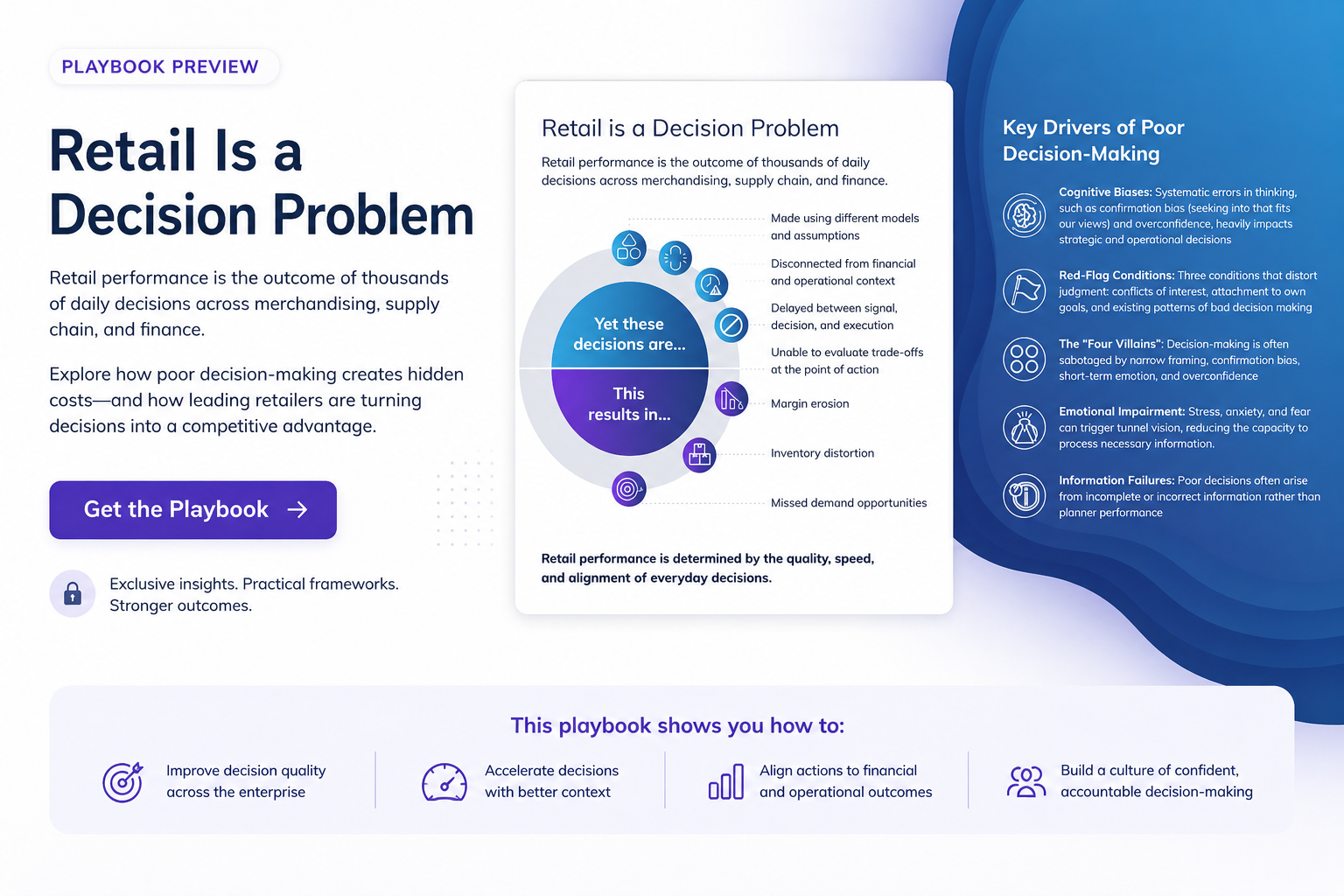
When decisions are made using different models, assumptions, and timelines, retailers face:
- Margin erosion
- Missed demand opportunities
- Inventory distortion
- Slower response to disruption
- Weak financial accountability
This playbook provides a practical operating model for closing that decision gap.
Retail does not need more disconnected AI. It needs better decisions.
Retail performance is shaped by thousands of daily decisions across merchandising, supply chain, and finance. The retailers that win will not be those with the most plans, but those that make the best connected decisions.
Board helps retailers connect these decisions in one unified planning model, enabling:
- Shared assumptions
- Aligned constraints
- Consistent outcomes
- End-to-end visibility
- Clear financial impact before action
Board connects merchandising, supply chain, and finance into a single decision system, not separate planning functions.
Featured Framework: From Signals to Financial Impact
The playbook introduces a retail operating model where signals are interpreted in context, decisions are modeled and evaluated, execution reflects aligned choices, and financial outcomes are understood before action.
Signals: Interpret demand, supply, cost, and market changes in context.
Decisions: Evaluate scenarios and trade-offs before acting.
Execution: Align actions across merchandising, supply, and finance.
Financial impact: Understand margin, cash, cost, and working capital before decisions are made.
Ready to move from fragmented planning to connected retail decisions?
What You’ll Learn
Understand why retailers are moving from forecast-led planning and periodic cycles to decision-led execution, continuous planning, and financially aligned outcomes.
See how integrated business planning in retail becomes more effective when merchandising, supply chain, and finance operate as equal decision domains, not sequential functions.
Learn why AI must operate inside a unified decision system, where recommendations are context-aware, financially aligned, explainable, and governed.
Explore the three stages of retail transformation: Connect, Align, Orchestrate, moving from unified data and planning processes to AI-enabled scenario modeling and continuous decision orchestration.
Recommended for:
Chief Merchandising Officers
Chief Financial Officers
Chief Supply Chain Officers
Chief Operating Officers
Retail planning leaders
Merchandise planning teams
Demand planning leaders
Supply chain planning teams
Retail transformation and IT leaders
Ready to move from fragmented planning to connected retail decisions?
What You’ll Learn
Understand why retailers are moving from forecast-led planning and periodic cycles to decision-led execution, continuous planning, and financially aligned outcomes.
See how integrated business planning in retail becomes more effective when merchandising, supply chain, and finance operate as equal decision domains, not sequential functions.
Learn why AI must operate inside a unified decision system, where recommendations are context-aware, financially aligned, explainable, and governed.
Explore the three stages of retail transformation: Connect, Align, Orchestrate, moving from unified data and planning processes to AI-enabled scenario modeling and continuous decision orchestration.
Recommended for:
Chief Merchandising Officers
Chief Financial Officers
Chief Supply Chain Officers
Chief Operating Officers
Retail planning leaders
Merchandise planning teams
Demand planning leaders
Supply chain planning teams
Retail transformation and IT leaders
You may also be interested in




Let’s see what Board can do for you.
Get a tour of the Agentic Planning Platform in action.