
Part 1: Agentic AI – A Paradigm Shift for Integrated Business Planning

Intro
Integrated Business Planning (IBP) is entering a new era powered by agentic AI, AI agents that can autonomously plan, decide, and act in pursuit of business goals. For CIOs, CTOs, CAIOs, and CFOs, this represents a paradigm shift from using AI merely for insights to deploying AI for end-to-end orchestration of critical business processes. By 2028, Gartner predicts at least 15% of day-to-day work decisions will be made autonomously by such agents (up from essentially zero today). Integrated Business Planning (IBP) traditionally connects strategy, finance and operations into a unified planning process. Agentic AI supercharges this integrated planning process by eliminating traditional planning silos between data, decisions, and teams. Instead of periodic, siloed planning processes, organizations will embrace continuous, AI-driven planning across departments in real time enabling agility and cross-functional alignment. The result is a paradigm shift: planning is more proactive, data-driven, and adaptive than ever before.
This goal-driven autonomy promises more adaptable planning and faster decision cycles, but it must be implemented with robust oversight to maintain trust. Gartner’s analysts urge enterprises to design agentic AI with transparency, guardrails and human oversight from the start, noting that these agents “embed autonomous, goal‑driven behavior… but also increase complexity and risk, requiring clear boundaries, oversight and observability to maintain trust.” In short, agentic AI is on the rise as a transformative force, yet its success will hinge on marrying autonomy with responsible governance.
The Vision of Enterprise Planning with AI Agents
Traditional AI and even generative AI (GenAI) have largely acted as recommendation engines or assistants providing insights or content when prompted. Agentic AI takes it a leap further: it moves AI from the passenger seat to a true partner in enterprise planning and operations. Gartner has named agentic AI the #1 strategic technology trend for 2025, underscoring that this is more than a hype term. Furthermore, agentic AI offers a path to break out of the trap McKinsey calls the “GenAI paradox” – broad adoption but limited impact. Unlike generic chatbots that provide isolated assistance, AI agents can be woven deep into core business processes as proactive, goal-driven collaborators.
This means planning cycles compress from weeks to days (or hours), and responses to changes (like a sudden supply disruption or market fluctuation) become instant and intelligent. Crucially, these agents act as partners to their human planners. They interpret data, generate insights, and even initiate actions, all while keeping humans in the loop for judgment calls and approvals. In other words, agentic AI transforms planning into collaborative intelligence between human expertise and machine intelligence, rather than a static report or spreadsheet.
Enterprise planning functions are each poised for transformation:
- Financial Planning & Analysis (FP&A): One specific domain ripe for agentic AI is FP&A – traditionally a labor-intensive cycle of gathering data, building forecasts, and generating reports. With the advent of GenAI and agentic AI, FP&A is shifting from static, periodic planning to a more continuous and insight-driven practice.
According to research by the FP&A Trends Group, AI is “elevating FP&A from traditional analysis to continuous, context-rich insight generation. Rather than simply highlighting what happened, agentic AI will help explain why it happened – and what might come next.”
- Financial Close, Consolidation and Reporting (FCCR): Within FCCR, agentic AI will streamline the financial close process while ensuring data integrity. Picture an agent that automates month-end workflows, reconciles transactions, checks for anomalies in consolidation, and alerts controllers to any discrepancies. Such an agent, armed with accounting rules and your company’s consolidation model, can quickly identify why balance sheets are unbalanced or where an intercompany elimination went wrong. By continuously monitoring financial data, the agent can catch errors before reports are final, reducing fire drills at quarter-end. Accountants will spend less time on tedious ticking-and-tying, and more on analyzing what the numbers mean with AI ensuring accuracy and compliance.
- Merchandising Planning: The retail sector provides a vivid illustration of agentic AI’s paradigm shift from prediction to execution. Retailers have long used AI for forecasting demand or recommending products (predictive insights), but the next leap is autonomous orchestration with AI agents that dynamically manage everything from pricing to inventory in real time. As Consumer Goods Technology reports, “in the next five years, the heart of retail intelligence will shift from predictive insights to autonomous orchestration. By 2030, agentic AI… will connect data, decisions and execution in real time.” A merchandiser armed with an AI agent will more confidently decide how much of the winter coat line to send to each store, because the agent has crunched historical sell-through rates, current trends, and even local climate data. A 2025 NVIDIA survey reports that 9 out of 10 retailers are now piloting or adopting AI solutions, while Salesforce finds 76% of retailers are planning to increase investment in AI agents over the next year, with customer service being their top use case.
- Supply Chain Planning: One area already seeing dramatic change is supply chain and operations planning, where uncertainty and disruptions are constant challenges. EY describes agentic AI as a powerful new ally for supply chain teams facing volatile demand, logistics hurdles, and cost pressures. For example, if a key supplier has a delay or a spike in raw material costs, the agent could immediately alert planners and simulate alternatives, sourcing from a backup supplier or rerouting shipments. These agents will excel at scenario planning running countless what-if simulations (e.g. “What if demand spikes 20% next month?” or “What if a port closes?”) and present the outcomes in dashboards or narratives for both planners and executives to review. The result is a supply chain that is both agile and accountable where AI handles the heavy lifting of day-to-day adjustments, and humans provide guidance and governance to ensure optimal outcomes and risk mitigation.
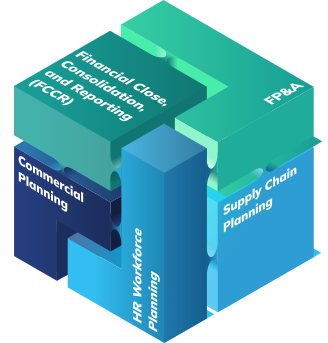
All these changes underscore a fundamental shift: planning is becoming a continuous, collaborative intelligence process rather than a periodic, manual one. Agentic AI allows each planning function to not only become more efficient but also more interconnected. Finance, accounting, merchandising, and supply chain plans no longer live in separate silos as AI agents help thread them together by sharing insights and aligning actions instantaneously. This paints an exciting vision for CXOs: a future where plans adjust in real time as conditions change, guided by AI but supervised by human expertise. The competitive advantage will go to those organizations that harness this symbiosis early.
From Vision to Reality: The Current State of Agentic AI in Enterprise Planning
The vision is obviously compelling, but what is the reality today? It’s important to acknowledge that regardless of what some vendors may claim, agentic AI in enterprise planning is still in its infancy. In the last 1 to 2 years, we’ve seen a flurry of announcements from planning software vendors about new AI “agents” and “copilots.” Industry insiders have called it an “AI announcement arms race,” with vendors touting everything from ML-powered forecasting to generative and agentic AI being added to their platforms. The hype can be overwhelming: almost weekly, a software provider proclaims some new AI feature that promises to transform planning.
However, savvy tech leaders must know how to separate hype from substance. As one finance software provider candidly noted, “many of these so-called AI features are rudimentary or experimental, impressive demos, but not yet delivering reliable value in production.” For example, an AI “forecasting” feature might just automate a simple statistical model, or a generative AI tool might produce slick-looking narrative reports that still need heavy vetting for accuracy. Early adopters have found that it’s relatively easy to stand up a proof-of-concept AI agent that answers basic questions or generates a plan for a narrow scenario. What’s hard is deploying AI agents that can handle the true scale and complexity of enterprise planning with immensely large data volumes, intricate business rules, and cross-functional processes—without breaking or hallucinating.
The current market for AI planning agents is thus in a learning phase with both vendors and enterprises experimenting with what works and what does not. Below are a few patterns to look out for in the current landscape:
- Early focus on specific roles and use cases: A notable trend is that vendors are not creating one monolithic super-AI, but rather a constellation of specialized agents or assistants. This makes sense: the questions a CFO might ask (“What’s driving the earnings gap this quarter?”) differ from what a supply chain manager needs (“How can we optimize safety stock levels?”). This indicates that the market reality is a set of narrow AI partners each tackling a piece of the planning puzzle, rather than a single general AI. It’s a pragmatic approach that acknowledges the complexity of enterprise planning with no single agent today credibly capable of mastering everything from financial consolidation to demand forecasting at once.
- Private previews and pilots abound: Another sign of the nascent state is that many of these AI agent solutions are in limited release or “preview” mode. Even vendors that announced generally available features often label them beta or first-generation. This underscores that vendors (wisely) are testing these capabilities with select customers and iterating. While the technology is maturing rapidly, most do not have AI Agents ready to be deployed for use in most enterprises. CIOs and CTOs evaluating such solutions should expect ongoing refinement and should pilot these agents in non-critical environments first, before wide rollout.
- Be wary of the hype cycle: Thought leaders in this space advise caution amid the enthusiasm. As we like to put it, innovation isn’t about being first to market with flashy AI headlines; it’s about delivering trustworthy, value-generating solutions that truly work in the real world of finance and operations. Many planning leaders recall the hype cycle of earlier tech (big data, blockchain, etc.) and are appropriately skeptical of grandiose claims. The consensus in the enterprise planning community is to demand evidence: AI agents must prove they can produce accurate forecasts, sensible recommendations, and real productivity gains before being entrusted with critical planning tasks. There is little appetite for AI that merely adds “wizardry” without substance, especially in finance, where errors or false insights can have material business impact. For now, most organizations are wise to view agentic AI as promising but not magic and to implement it in a controlled, incremental way.
In summary, the current state of agentic AI in enterprise planning is one of energetic progress with a healthy dose of reality. The paradigm shift is underway and accelerating, but we are still on the foothills of the journey. For CAIOs, CIOs, CTOs, this means now is the time to start laying groundwork – not to instantly believe every claim, but also not to fall behind. The next sections will discuss how to approach this opportunity with a clear focus and a human-centric lens. In the next sections, we will see how Board’s approach to agentic AI is mitigating the risk of hallucinations with a focused, use-case specific strategy.
Next Steps
Part 2 of our guide will discuss how to approach this opportunity with a clear focus and a human-centric lens. In the next sections, we will see how Board’s approach to agentic AI is mitigating the risk of hallucinations with a focused, use-case specific strategy (coming soon).
You may also be interested in





Let’s see what Board can do for you.
Get a tour of the Agentic Planning Platform in action.