

Why This Story Matters
Auping’s journey shows how manufacturers can move from fragmented, spreadsheet-based planning toward a more continuous planning approach that connects demand, supply, and finance and enables faster scenario evaluation as conditions change.
- Transformed disconnected planning processes into an integrated business planning framework, connecting demand, supply, and financial planning in one platform.
- Faster planning and scenario evaluation. Replacing spreadsheet-driven forecasting helped reduce planning time by more than 50% and made it easier to respond to changing market conditions.
- Stronger alignment between sales forecasts, production plans, and financial outcomes, creating a single source of truth across the organization.
- Enabled better long-term and short-term decision-making, with greater visibility into capacity, order book development, and future business performance across different planning horizons.
Key Learnings
- Learning 1: Start with a clear functional design
Auping found it valuable to begin with a functional design and first draft, ensuring requirements were clearly defined before expanding the solution. - Learning 2: Rethink processes rather than simply recreating them
- Simply copying existing processes has its limits and leaves valuable optimization opportunities untapped. Auping learned to rethink processes rather than replicate spreadsheet-based ways of working.
- Learning 3: Plan for future “what if” scenarios
By considering potential future challenges early, Auping was able to build a more flexible and future-proof planning process.
The Company
Founded in 1888, Royal Auping is the Netherlands’ largest independent bed manufacturer, with its own production facility in Deventer and a presence across Europe through sales offices and distribution partners. The company produces beds, mattresses, and box springs and combines premium design, craftsmanship, innovation, and a strong commitment to sustainability.
Its make-to-order manufacturing model creates a particularly demanding planning environment: customer demand must translate into production requirements and financial expectations without relying on large stocks of finished goods.
The Challenge: Aligning Demand, Supply, and Financial Planning in a Complex Make-to-Order Environment
As a make-to-order manufacturer of beds and mattresses, Auping operates a complex planning environment. Demand is driven by multiple channels—including B2C, B2B, and export bulk orders—each with different forecasting horizons, levels of detail, and planning requirements. Forecasts must be managed across product groups as well as individual SKUs, with some demand planned weekly (B2C) and other demand planned monthly (B2B and Bulk).
On the supply side, Auping must balance capacity across three distinct production lines for wood, steel, and mattresses, while maintaining an efficient and steady production flow. Accurate forecasts are essential not only for production planning but also for providing reliable forecasts to suppliers and ensuring sufficient material availability.
Having transitioned from a make-to-stock to a make-to-order business model, Auping needed a robust S&OP process to align demand, supply, and financial planning. The challenge was to replace fragmented views with one reliable planning foundation connecting:
- sales forecasts
- production forecasts
- capacity requirements
- financial outcomes
Bringing these elements together was essential for improving visibility into future order book development and overall business performance.

Erwin Flierman
S&OP was like solving a puzzle with pieces spread across different boards. Without one complete picture, it was difficult to know which information to trust for decision-making.
“Most of the puzzle pieces to build the S&OP process were put down in their own silos instead of one solid integrated base. We had the available data but needed one unified planning platform. Board provided that solution from the moment we started”, says Erwin.
As Erwin explains, the necessary data already existed, but individual parts of the S&OP process remained in silos. Auping needed a unified planning platform that could bring those pieces together and create a common foundation for decision-making.
The Solution: Building an Integrated Business Planning Process with Board
Auping began its Board journey in 2020 with a clear objective: replace increasingly complex spreadsheets with a scalable solution for budgeting and forecasting. Initially focused on P&L planning and demand planning, the project quickly evolved into a broader initiative to bring financial and operational planning together across the business.
Why Auping Chose Board
As a make-to-order manufacturer, Auping needed more than a financial planning tool. The company wanted to make product volumes and mix visible alongside financial forecasts, ensuring that sales targets could be validated against realistic demand and production assumptions. Board provided the flexibility to combine financial and operational data in a single platform. This enabled Auping to connect sales forecasts, production volumes, capacity requirements, and financial outcomes while supporting the development of its S&OP and Integrated Business Planning processes.
From Demand Planning to Integrated Business Planning
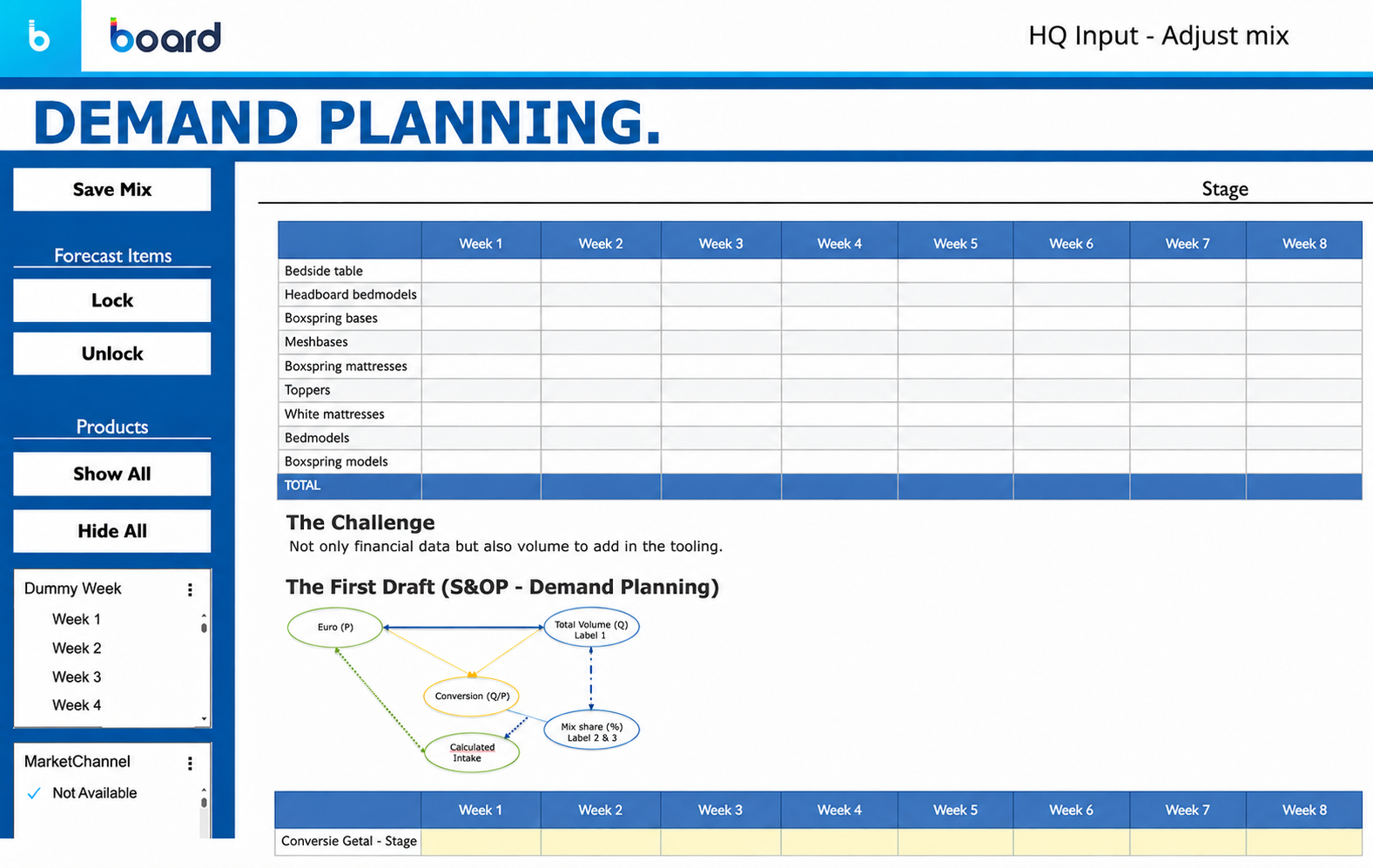
The first phase focused on creating a structured demand planning process. Forecast volumes were linked to financial targets through conversion factors, providing a reliable check between expected product intake and forecasted revenue. Forecasts could be analyzed at different aggregation levels and time horizons, supporting both weekly and monthly planning requirements across B2C, B2B, and export channels.
Building on this foundation, Auping gradually expanded Board into a fully integrated business planning process. Today, the company operates a unified planning cycle that links:
- Budget & Sales Planning for strategic and financial targets
- Demand Planning for sales forecasting and scenario analysis
- Supply Planning for production forecasting and capacity planning
- Financial Planning for order book visibility, GSV calculations, and P&L forecasting
This approach creates one view of how demand translates into production requirements and financial performance, helping sales, operations, finance, and management maintain aligned plans and make more informed, data-driven decisions.
Enabling Faster Decisions Through Scenario Planning
As market conditions have become increasingly volatile, scenario planning has become a critical capability. With a stable planning baseline established in Board, Auping can quickly create and evaluate alternative demand and supply scenarios to support decision-making.
The company combines long-term forecasting—looking at least two quarters ahead and planning for major events such as Black Friday—with short-term demand sensing to respond rapidly to changing market conditions and bulk orders. Key demand drivers such as seasonality, promotions, and market trends can be incorporated into forecasts, helping teams proactively manage capacity and inventory requirements.
Scenario planning allows Auping to understand potential operational and financial implications before making decisions, supporting faster responses when business conditions change.
Most recently, Auping extended the solution with enhanced order book visibility, providing a clearer view of future demand development and strengthening the connection between operational planning and financial forecasting.
By bringing these planning processes together in Board, Auping has created the foundation for Continuous Planning, allowing teams to update assumptions, evaluate scenarios, and keep operational and financial plans aligned as business conditions change.
The Benefits: More Than 50% Faster Planning and Greater Visibility for Decision-Making
- More than 50% less planning time. Compared with its previous Excel-based processes, Auping has reduced the time required for planning by more than 50%, with particularly significant time savings in long-term planning and scenario creation.
- Real-time visibility across the planning process. Planners can work at the appropriate level of aggregation while maintaining visibility across product groups, sales channels, production lines, and the developing order book.
- Faster scenario evaluation. Auping can create and compare alternative demand and supply scenarios more quickly, helping teams assess how changing assumptions could affect capacity, production, and financial performance.
- Stronger alignment between finance and operations. Board connects sales forecasts, production plans, capacity requirements, and financial outcomes, giving teams a shared basis for planning and decision-making.
- More confident, data-driven decisions. Sales, operations, finance, and management work from the same data and assumptions, helping Auping respond faster to change while keeping short-term and long-term plans aligned.
Board also helps bridge the gap between sales and operations by connecting sales items with production items, making the relationship between customer demand and manufacturing requirements more transparent.
Board helps us make complexity visible and use those insights constructively for better decision-making!
Erwin Flierman
Conclusion
Auping’s transformation demonstrates how a make-to-order manufacturer can replace spreadsheet-based planning with a unified approach across demand, supply, and finance. With Board, the company has reduced planning time by more than 50%, improved cross-functional alignment, and established the foundation for Continuous Planning. Teams can now update assumptions, evaluate scenarios, and keep operational and financial plans synchronized in real time, enabling faster responses to changing business conditions and more confident, data-driven decision-making.