This website will offer limited functionality in this browser. We only support the recent versions of major browsers like Chrome, Firefox, Safari, and Edge.
Enterprise AI needs more than models, data platforms, and semantic layers. Learn why a decision layer is critical for trusted, governed, AI-driven planning and decision-making.
Over the past eighteen months, enterprise AI has matured remarkably quickly. Foundation models have improved, copilots have become commonplace, and agentic AI has moved from research labs into production roadmaps. Many organizations have also accelerated investments in modern data platforms, semantic models, and governance in preparation for wider AI adoption.
These investments are necessary. They are also exposing an architectural question that, until recently, wasn’t particularly visible.
Where does enterprise decision-making actually reside?
Historically, the answer was distributed across applications, spreadsheets, business processes, and the experience of individual teams. Finance understood the planning assumptions behind a forecast. Supply chain understood operational constraints. Commercial leaders understood the trade-offs between growth and margin. Few organizations ever attempted to make those relationships explicit because people, not software, provided the connective tissue.
AI changes that equation.
As organizations ask intelligent systems to explain performance, recommend actions, or eventually automate aspects of decision-making, they are discovering that access to enterprise data alone is insufficient. AI can retrieve information remarkably well. It is considerably harder for it to understand how an organization makes decisions.
That distinction is becoming increasingly important.
Much of the industry’s attention has understandably focused on data. Modern lakehouses, data fabrics, semantic models, and governance frameworks have all improved the quality and accessibility of enterprise information. They create the foundation AI requires to reason over business data with greater confidence.
But data, however well governed, is only part of the problem.
Business decisions depend on context that rarely exists in transactional systems or analytical platforms.
A financial forecast isn’t simply a prediction. It represents an agreed view of the business, supported by assumptions, approved scenarios, planning hierarchies, ownership, business rules, and governance. An inventory decision isn’t merely an optimization problem. It reflects financial objectives, customer commitments, operational constraints, and acceptable levels of risk.
These relationships are well understood by experienced planners. They are much harder for AI to infer.
This is where we believe enterprise architecture is beginning to evolve.
Over the past decade, organizations invested heavily in systems of record to standardize transactions, followed by data platforms to unify information and analytics platforms to improve visibility. AI now introduces the requirement for a new layer that provides the context in which enterprise decisions are made.
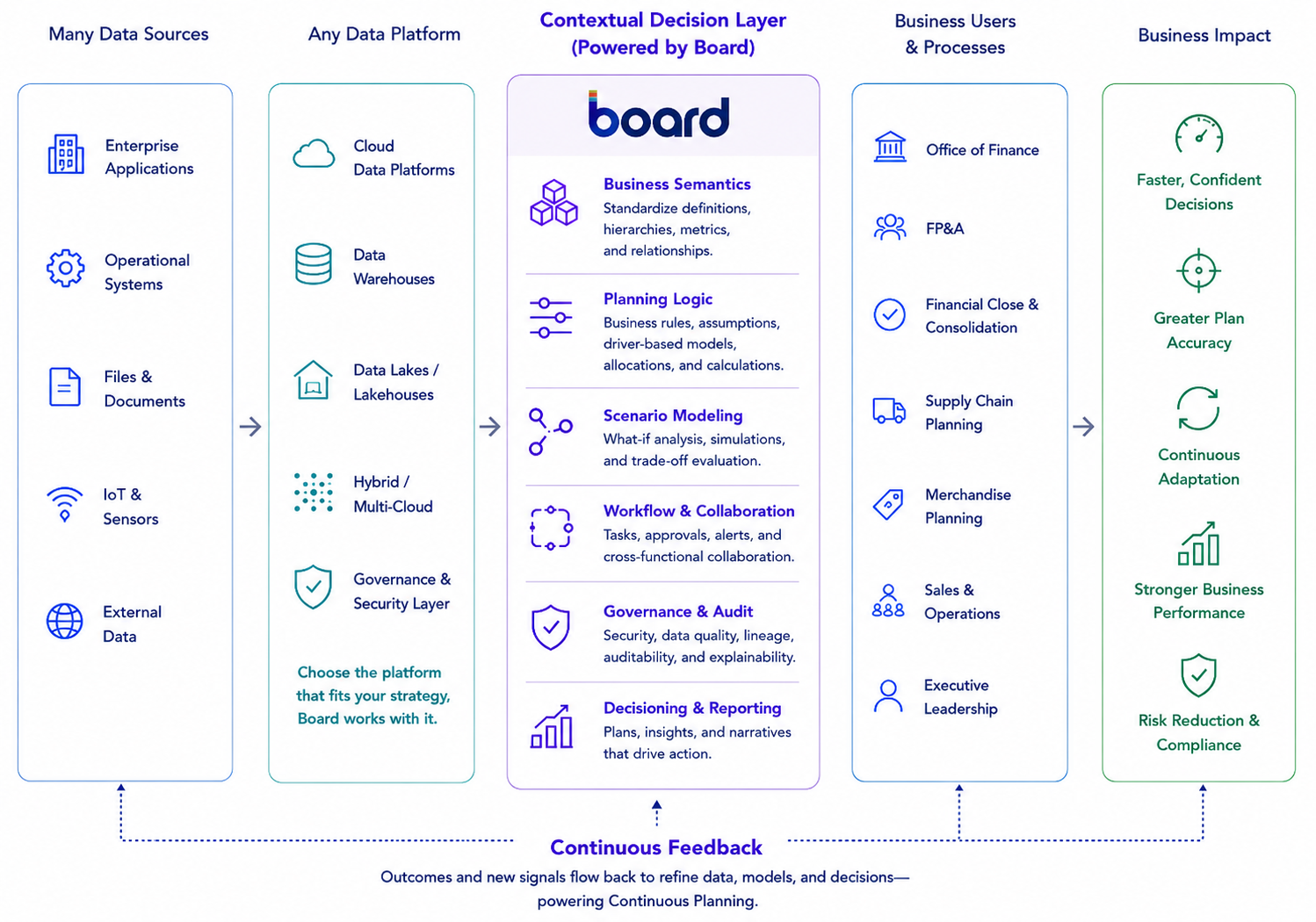
We think of this as the Board Contextual Decision Layer.
Not another application.
Not another semantic model.
Rather, a business context layer that captures planning logic, assumptions, scenarios, constraints, workflows, governance, and organizational accountability in a form that both people and AI can work with consistently.
Its purpose isn’t to replace ERP, CRM, or data platforms. Quite the opposite. It allows them to participate in a coherent decision-making process rather than remaining isolated sources of information.
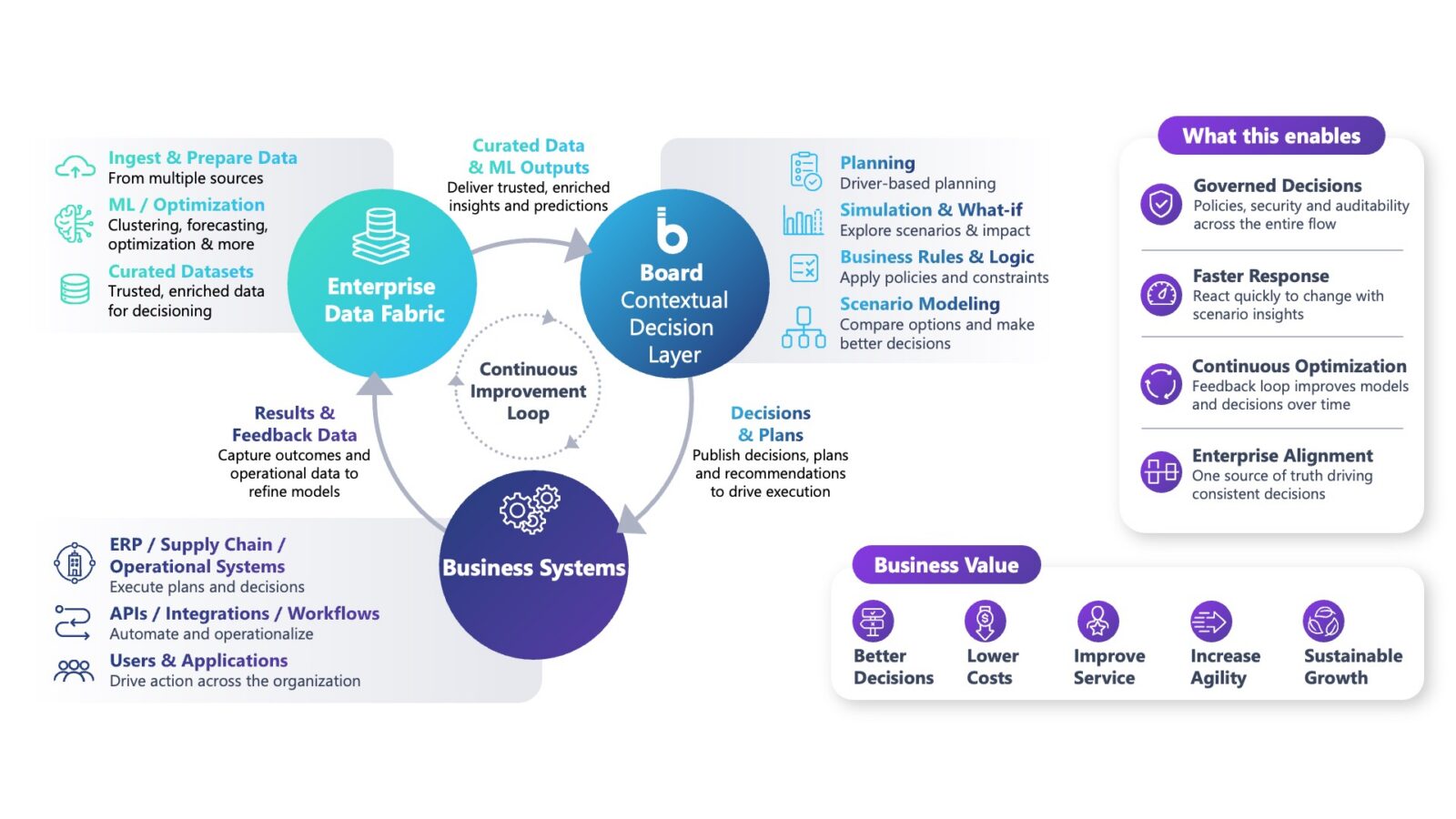
Board’s Continuous Planning and Decisioning Loop
What’s interesting is that many organizations already possess parts of this capability without necessarily recognizing it as an architectural pattern.
Planning platforms, particularly those supporting Integrated Business Planning (IBP) and enterprise performance management, have quietly accumulated many of the elements AI now depends upon: business rules, versioning, scenarios, write-back, workflow, approvals, allocations, and financial logic. Historically, these capabilities existed to support planners. Increasingly, they provide the operating context AI agents require to make trustworthy recommendations.
This changes how we should think about planning. Planning is no longer simply a periodic business process.
It should be part of your enterprise AI architecture. Discover more about Board Agents here.