
Part 2: Agentic AI – A Paradigm Shift for Integrated Business Planning

Focused vs. Generic Agents: Tackling Complexity and Avoiding Pitfalls
One of the key lessons from early deployments is that focus matters. Enterprise planning is exceedingly complex, rife with company-specific hierarchies, business rules, constraints, and data nuances. An AI agent that is too broad or generic in its approach will struggle in this environment. Why? Because a one-size-fits-all large language model (LLM) that isn’t tuned to specific use cases may produce plausible-sounding outputs that completely miss the mark on accuracy or relevance.
These AI “hallucinations” are confident but inaccurate answers. And these answers are not just academic errors; in a business context, they can misdirect team and department decisions and erode trust in the entire planning process.
At Board, we believe the antidote is a use case-specific, focused approach to agentic AI. By narrowing an agent’s scope to well-defined critical planning tasks and training it on your authoritative business data, we will greatly improve reliability. As Scott Zoldi, Chief Analytics Officer at FICO, says taking a “Focused Language Models (FLM)” to tailor your AI to a specific domain, workflow, or even a specific task is simple yet powerful idea: use a smaller model trained on higher-quality, relevant data (say, your company’s financial and operational datasets and rules) is far less likely to hallucinate than a giant generic model trained on the whole internet or every planning process a Fortune 100 company may have.
As Zoldi’s FICO Analysts recently noted, using domain-focused AI with tight vernacular and context is a proven way to thwart hallucinations before they occur. In practical terms, an AI agent for enterprise planning should be deeply aware of your business context, from your chart of accounts and product hierarchy to your budgeting calendar and approval workflows. If it knows those ground truths, it won’t suggest actions that violate your constraints (e.g., recommending more spend than the budget or a production plan that exceeds factory capacity).
The true complexity of enterprise planning is linking operational drivers to financial outcomes, handling multi-dimensional data (by product, region, channel, etc.), and enforcing business rules—which requires an AI agent that is purpose-built for that use case. That’s why Board is developing specialized, use-case specific agents for FP&A, Financial Consolidation and Reporting (FCR), Merchandising Planning, Supply Chain Planning, and Economics.

In short, to avoid the pitfalls of AI in planning, enterprises should favor focused AI agents instead of overly generic ones. This means:
- Use your data and models as the grounding for the AI. Ensure the agent is hooked into your single source of truth (Board Agentic Planning Platform) so that it bases answers on actual company data and expert-curated external industry signals, not just general knowledge. A planning agent should ideally live within the same environment as your planning models to be context aware. At Board, our AI Agents are Board Aware, as stewards of your unique data structures, security requirements, and relationships.
- Define clear use cases and even clearer boundaries for the agent. Rather than telling an agent to “optimize my forecast” (an overly broad mandate), start with narrower missions. For example, using Board’s use-case specific agents for FP&A assign tasks like, “write a summary for Q2 consolidated performance” or “what’s our forecasted cash at the end of Q4?” By giving the agent a clear job with defined inputs and outputs, you will reduce the chance it wanders into unsupported territory. These focused agents excel at specific use cases (e.g. 3-Statement Modeling, Integrated Financial Statement Analysis, Cash Flow & Liquidity Management, etc.) and can be evaluated and trusted within those scoped boundaries.
- Incorporate business rules and logic into the AI’s training or prompting. If certain actions are off-limits (e.g., cannot violate a regulatory constraint or a corporate policy), those need to be hardwired. The beauty of agentic AI in a platform context is that it can inherit the platform’s trusted security and governance rules. For example, Board’s AI agents will operate strictly within the existing security framework and expose their data sources for transparency, ensuring they don’t pull information a user isn’t permitted to see or act on outside of pre-defined, approved processes. This kind of disciplined approach keeps the AI from becoming a “rogue actor.”
By focusing on specificity and guardrails, companies can reap the benefits of AI automation without the nightmares of AI-driven mistakes. Indeed, early results suggest that a carefully scoped agent can dramatically improve productivity, handling the grunt work and analysis within a confined domain, while consistently producing outputs that a human planner can trust and act on. The next section will highlight how Board Agents will execute this focused philosophy and why we believe it’s the most pragmatic path forward.
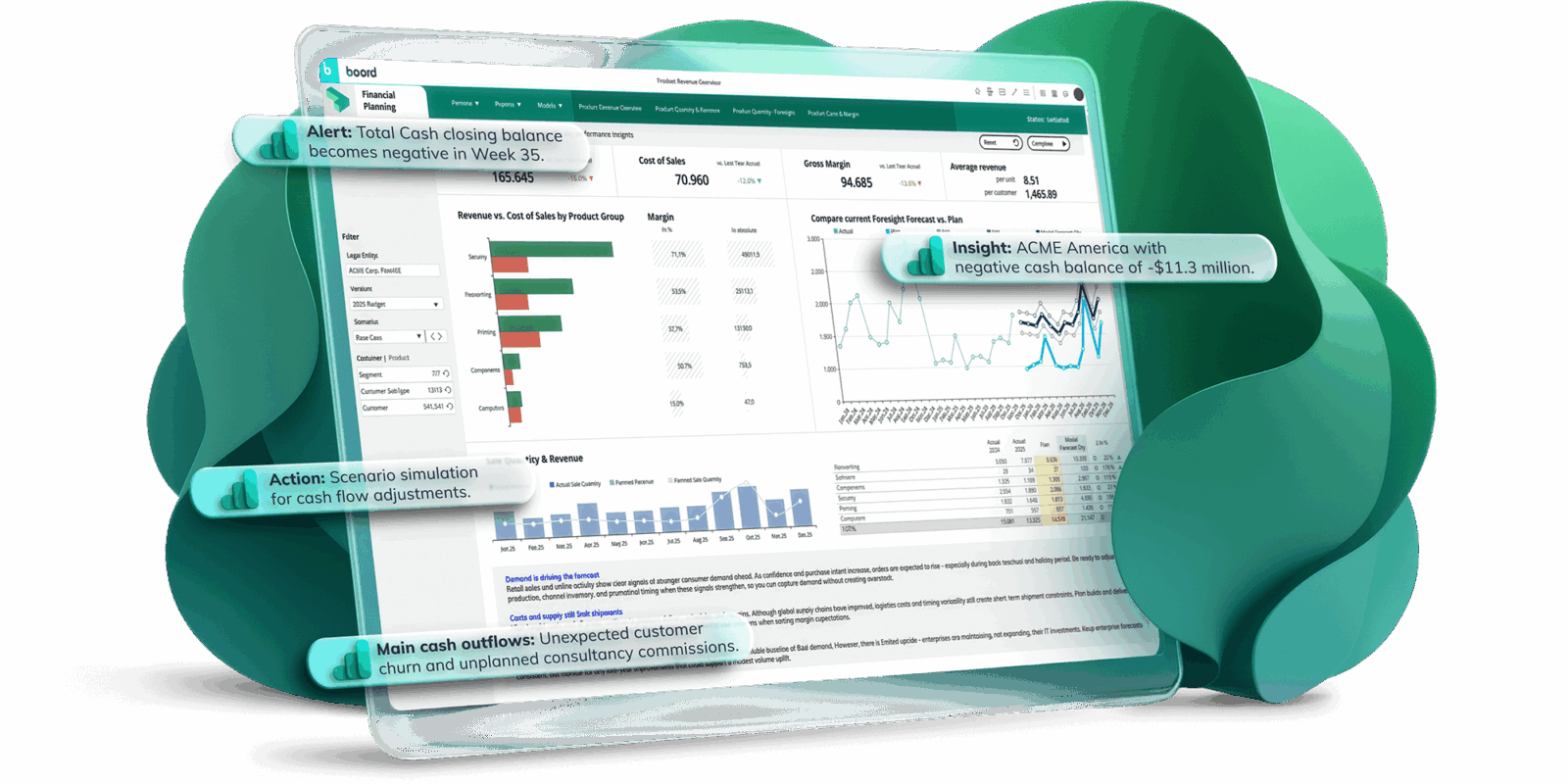
Board’s Focused Approach to Agentic AI
At Board, we have spent over 30 years helping enterprises unify their financial and operational planning processes. Our belief is that agentic AI should be an evolution of that journey with our clients. Rather than pursuing a generic “AI assistant,” Board is developing persona-based, use case-specific AI agents for core planning areas: FP&A, FCR, Merchandising Planning, Supply Chain Planning, and Economics. The guiding principle is to deliver immediate, tangible value by focusing on well-defined use cases in each domain, while ensuring the AI’s outputs are accurate, relevant, and auditable.
Furthermore, Board Agents will leverage the strength of being built on a proven enterprise planning platform – running on a hardened multidimensional planning core. Our agentic capabilities are layered on top of that core, so every workflow will operate with or without generative components. That’s why we’ve been recognized as a Leader in the 2025 Gartner Magic Quadrant for Financial Planning Software (our fourth consecutive year as a leader).
What makes Board’s agentic AI approach different?
- Persona-Based Interactions with Defined Use Cases: Board Agents will deliver critical planning use cases out-of-the-box: For the Office of Finance, our FP&A Agent guides FP&A teams on critical use cases such as three statement reconciliation, comprehensive financial statement analysis, and cash flow & liquidity management, while our Controller Agent aides accounting teams on focused use cases such as integrated financial statement analysis, financial statement narrative creation, and Chart of Accounts (CoA) mapping. While on the operational side of planning, our Merchandiser Agent helps planners respond to customer and market signals with precision. It interprets demand shifts, aligns them to product mix and inventory strategies, and recommends the most profitable actions across channels and categories. Our Supply Chain Agent equips supply teams to stay ahead of risk. It detects disruptions early, evaluates trade-offs through rapid what-ifs, and guides planners to the most resilient and cost-effective choices—keeping supply, demand, and financial objectives tightly aligned. By focusing on these discrete use cases, Board Agents will perform at a high level on the tasks that matter most, leaving little room for hallucinations or off-track behavior.
- Board Aware Leveraging Board’s Multidimensional Database: Board’s AI agents are “native” to our platform, meaning they leverage the same data model, business hierarchies, and calculations that your planners use daily. The Board platform’s multidimensional semantic model provides a rich, contextually-aware foundation for the AI agents. In practice, this means the agent knows how your business is structured, understands how products roll up into categories, how cost centers aggregate, how sales connect to supply chain, and more. The agent isn’t inventing its own view of the world; it’s using your established single source of truth. This deep contextual awareness allows Board Agents to generate insights and recommendations that reflect your actual planning model, not a generic planning framework. For example, if you have a custom KPI or a unique way to calculate profitability, Board Agents will factor that in. By contrast, competitors’ generic agents might ignore those nuances and give one-size-fits-all analysis. Additionally, the Board Platform has native sparsity management, enabling our agents to intelligently focus on the data that truly drive business outcomes—delivering the required performance while optimizing for both cost and efficiency.
- Collaborative Intelligence with the “Human-in-the-Loop”: A human-centric philosophy is at the heart of Board’s AI design. We recognize that enterprise planning is as much a human collaboration exercise as it is a number-crunching one. Thus, Board Agents are designed to enhance, not replace, the expertise of a human planner. In practical terms, a “human-in-the-loop” operating model is emerging as the norm. Rather than thinking of AI agents as completely autonomous, leading companies design processes where AI handles the routine 90% of work and flags the 10% of exceptional cases for human decision. As one BCG report notes, “human oversight works best when combined with system design elements and processes that make it easier for people to identify and escalate potential problems.” For instance, a Board Agent might identify an anomaly and suggest a cause, while the planner verifies that insight and subsequently green lights the Board Agent to execute a corrective action under the planner’s supervision. The planner can converse with Board Agents in natural language, ask follow-up questions, and drill down into their reasoning. By elevating human planners rather than seeking to cut them out, Board AI unlocks productivity while preserving accountability and transparency.
- Engineered for Enterprise-Ready AI: Delivering reliable AI at an enterprise scale requires a strong technical backbone. The Board Agentic Planning Platform is architected for performance and governance—two critical enablers for AI. Our in-memory calculation engine and sparsity optimizations allow AI agents to run complex analyses or simulations in real time, even on large, multi-dimensional datasets. This means Board Agents can instantly run new forecasts across thousands of products and regions when a planner asks a ‘what-if’ question, giving near-instant answers. Equally important, Board’s platform enforces enterprise-grade security and role-based data access for every interaction. Board Agents will operate within the same security confines as end users, and any action they take (like writing a value or launching a process) will respect the permissions and audit trails already in place. For CIOs, this addresses a major concern with AI: data governance. With Board Agents, you’re not letting a black-box AI run wild; you’re deploying an agent in a controlled, IT-governed environment. Finally, being built on a trusted cloud-scalable architecture like Microsoft Azure, Board AI can scale out as your data or user base grows. In summary, the plumbing is there to ensure Board Agents are fast, secure, and scalable.
Board’s approach to agentic AI stands out as measured and effective. We intentionally avoided the trap of a “do-it-all-but-master-of-none” AI. Instead, we are delivering focused AI agents with well-defined use cases and deep integration to your company’s specific planning processes. This ensures that when Board Agents step into your business, they operate properly and provide immediate, demonstrable value.
Conclusion: Let’s Embrace the Future of Planning, Together
Agentic AI represents a paradigm shift for continuous Integrated Business Planning and forecasting: one that is both visionary in its possibilities and grounded in practical steps that organizations must take. We are moving into an era where AI agents can truly act as extensions of our workforce: planning across silos, executing routine decisions at digital speed, and continuously optimizing outcomes for more confident decision-making. For business leaders in the C-suite, the message is clear: this is not science fiction but a rapidly emerging reality. Those who leverage agentic AI to create more agile, responsive planning processes will gain a competitive edge in navigating volatility and complexity: a future where your planning cycle is no longer a cycle at all, but rather a live, self-adjusting system, where AI agents crunch numbers, test scenarios, and implement decisions in real time, while your human planners and analysts drive strategy, innovation, and oversight.
The winners of this new era will be those who blend innovation with pragmatism. They will harness agentic AI to elevate confident decision-making and efficiency, but do so with focused purpose, domain understanding, and respect for human judgment. They will choose substance over hype, adopting AI agents enabled on focused use cases that solve real business problems and demonstrably improve core continuous planning processes, rather than chasing flashy demos that could be rife with hallucinations. And they will keep people at the heart of the transformation, ensuring that technology serves to amplify human creativity and expertise, not sideline it.
For organizations still on the fence, it’s time to lean forward. Start exploring how Board Agents can augment your team to make them faster or your plans more confident. Engage your technology and business leaders in envisioning what’s possible. As noted earlier, the competitive landscape is not standing still with nearly all software providers infusing some form of agentic AI into their planning tools, and in the next few years, it will likely be the standard.
Now is the time to start exploring agentic AI’s potential, guided by both ambition and responsibility. The businesses that succeed in this next evolution will be those that are bold in innovation, wise in governance, and unwavering in keeping humanity at the heart of AI-driven planning. With that balanced approach, agentic AI can indeed become the driving engine of enterprise planning in the years ahead – a goal that is increasingly within reach.
The paradigm shift has begun; the question is, who will seize its advantage?
In case you missed it, you can read Part 1 of our guide here.
You may also be interested in





Let’s see what Board can do for you.
Get a tour of the Agentic Planning Platform in action.