This website will offer limited functionality in this browser. We only support the recent versions of major browsers like Chrome, Firefox, Safari, and Edge.
Planning Will Become the Decision System of Record
Forecasts don’t run your business. Decisions do. Most organisations already have more forecasts than they can use. Demand forecasts, financial forecasts, supply forecasts, revenue forecasts. The problem is not a lack of…
Forecasts don’t run your business. Decisions do.
Most organisations already have more forecasts than they can use. Demand forecasts, financial forecasts, supply forecasts, revenue forecasts. The problem is not a lack of prediction. It is that decisions still happen across disconnected systems, teams, and assumptions.
By the time leaders align on what to do, the market has often moved on.
That is why enterprise planning is changing. It is no longer just a process for building forecasts or setting budgets. It is becoming the place where signals are interpreted, scenarios are tested, trade-offs are understood, and decisions are aligned across the business.
Planning is becoming the decision system of record.
What is a decision system of record?
A decision system of record is the enterprise layer where signals, assumptions, scenarios, and actions are brought together to support better business decisions.
It does not simply store data. It helps organisations understand what is changing, model the impact, align teams, and act in time.
ERP became the system of record for transactions. CRM became the system of record for customer relationships. Finance systems became the system of record for performance.
But one critical layer has never been fully owned: decisions.
Not the data behind them. Not the reports about them. Not the forecasts that inform them. But the way decisions are made, aligned, and executed across the business.
That is the role planning is now beginning to play.
Why forecasts are not enough
Most organisations already have forecasts. What they often lack is a consistent way to turn those forecasts into aligned action.
Demand teams may have one view of the future. Supply teams may have another. Finance may be working from a different set of assumptions altogether. Each function may be using its own tools, models, and planning cycles.
The result is not just operational complexity. It is decision complexity.
Plans break when assumptions do not match. Decisions slow down when teams debate which forecast to trust. Actions come too late when planning is disconnected from execution.
The gap is not prediction.
The gap is decision-making.
Better forecasts matter, but they are not enough on their own. A forecast only creates value when the business can use it to make timely, aligned decisions.
Why ERP was not built for enterprise decisions
ERP is essential for control, governance, and transactional accuracy. It records what has happened across orders, inventory, revenue, and operations.
It tells the business what was sold, what was shipped, what was spent, and what was recorded.
But ERP was not designed to decide what should happen next.
It is retrospective by nature. It is built around transactions, not future scenarios. It can show the business where it has been, but it cannot, on its own, connect market signals, model future options, align assumptions, and guide decisions across functions.
That creates a growing challenge for organisations operating in volatile conditions.
When demand changes quickly, when supply is constrained, when customer behaviour shifts, or when financial targets move, leaders need more than a record of what already happened. They need a way to understand what is changing and decide how to respond.
ERP remains critical. But it is not the decision layer.
Why point solutions create fragmented answers
Many organisations have invested in planning tools to improve specific parts of the business.
Demand planning tools help improve demand forecasts. Supply planning tools help optimise inventory and capacity. Financial planning tools help manage budgets, targets, and performance.
Each solution may improve its own area. But when these tools operate in isolation, they can also create new problems.
Different functions end up working from different models. Assumptions become fragmented. Outputs conflict. Teams spend time reconciling plans instead of making decisions.
A demand plan may look right from a commercial perspective, but be impossible to fulfil from a supply perspective. A financial plan may protect margin, but limit the ability to respond to market demand. A supply plan may optimise efficiency, but reduce flexibility.
The issue is not that these tools lack value. It is that functional optimisation does not automatically create enterprise alignment.
Point solutions can produce better answers within a function. But they do not always produce better decisions across the business.
Why spreadsheets break under pressure
Spreadsheets remain common because they are familiar, flexible, and easy to adapt. For many teams, they become the place where gaps between systems are filled.
But that flexibility comes at a cost.
As complexity increases, spreadsheets create fragmentation, manual reconciliation, version control issues, and delays. Teams spend time checking numbers, chasing updates, and debating which version of the plan is correct.
Spreadsheets can support analysis. They can model scenarios. They can help teams move quickly in isolated moments.
But they cannot reliably align decisions across functions at scale. They cannot continuously respond to changing signals. They cannot provide a single, trusted view of assumptions, trade-offs, and actions across the enterprise.
When the business is stable, spreadsheets may be manageable.
When volatility increases, they become a risk.
From planning cycles to decision systems
Traditional planning was built around cycles. Annual plans. Quarterly reforecasts. Monthly reviews. Weekly updates. That rhythm no longer matches the speed of business.
Market signals change continuously. Demand shifts faster. Supply disruption can appear suddenly. Financial targets need constant adjustment. Customers, competitors, and external conditions move in ways that do not wait for the next planning cycle.
This is why planning needs to become continuous.
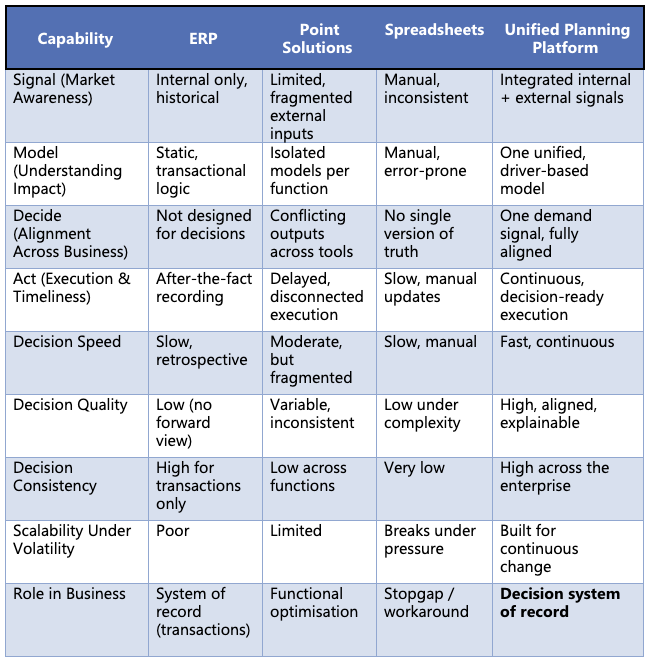
A modern planning approach connects four activities that are often separated across the enterprise: signal, model, decide, and act.
It starts with signals. What is changing in the market? Which demand drivers are shifting? Where are external conditions creating risk or opportunity?
Those signals then need to be modelled. What do they mean for revenue, inventory, capacity, margin, service levels, cash flow, and profitability?
From there, the business needs to decide. Not through isolated functional plans, but through shared assumptions and one aligned view of demand, supply, and financial impact.
Finally, the business needs to act. Plans must update, decisions must flow into execution, and teams must respond while there is still time to make a difference.
This is what turns planning from a periodic process into a decision system.
Why integration alone is not enough
Many organisations try to solve planning fragmentation by connecting more systems together.
Integration is important, but it does not solve the whole problem.
Connecting tools does not automatically align assumptions. It does not create one version of demand. It does not remove conflicting logic across functions. It does not guarantee that decisions are made using the same view of the business.
A connected set of fragmented systems is still fragmented.
What organisations need is not just more integration. They need a unified planning model that allows teams to work from the same assumptions, understand the same trade-offs, and make decisions through one continuous process.
That is the difference between connected planning and decision-ready planning.
How a unified planning platform turns signals into action
A unified planning platform changes the role of planning.
Instead of stitching together separate systems and reconciling outputs after the fact, it creates one model across the business. Demand, supply, finance, operations, and commercial teams can work from shared assumptions and understand the impact of decisions across functions.
When conditions change, the business can recalculate plans continuously. When new signals appear, teams can model the impact quickly. When trade-offs need to be made, leaders can see the consequences before acting.
This creates a different way of working.
ERP records what happened. Point solutions optimise individual functions. Spreadsheets fill the gaps between processes. A unified planning platform helps the business align decisions and act continuously.
That is why platform matters.
It gives organisations the ability to move from forecast debate to decision confidence.
What decision-ready planning looks like
When planning becomes the decision system of record, forecasts become inputs, not final outputs.
The goal is no longer simply to produce a more accurate forecast. The goal is to make better decisions using the best available signals, assumptions, and scenarios.
Decision-ready planning gives the business a shared view of what is changing, what it means, and what to do next. It helps teams align faster, act with more confidence, and reduce the delay between insight and execution.
In practice, this means:
One demand signal across the business
One unified model for understanding impact
Shared assumptions across teams
Continuous planning as conditions change
Decisions that are explainable, aligned, and executable
This is what modern organisations need from planning.
Not another disconnected forecast. Not another isolated model. Not another spreadsheet workaround.
They need a system that helps them make decisions.
The future of planning is decision-making
The goal was never just better forecasts.
It was always better decisions.
The organisations that win will not simply be those with the most data or the most advanced models. They will be those that can align decisions across the business, respond continuously to change, and act with confidence at speed.
Planning is no longer just a process. It is becoming the decision system of record.
Board Foresight: turning signals into decisions
Board Foresight is built for this shift.
It helps organisations move beyond fragmented forecasts and disconnected planning processes by creating one demand signal, one unified model, and one continuous decision process.
With Board Foresight, businesses can turn market signals into insight, insight into aligned decisions, and decisions into action.
Because the future of planning is not just more accurate forecasting.
It is faster, more confident decision-making across the enterprise.
Turn signals into decisions
Move from forecast debate to decision confidence with Board Foresight.