This website will offer limited functionality in this browser. We only support the recent versions of major browsers like Chrome, Firefox, Safari, and Edge.
TLDR Supply chains do not need more dashboards or isolated AI pilots. They need decision readiness: one unified planning model that connects demand, supply, inventory, capacity, and finance so teams…
TLDR
Supply chains do not need more dashboards or isolated AI pilots. They need decision readiness: one unified planning model that connects demand, supply, inventory, capacity, and finance so teams can sense change, simulate trade-offs, and act faster with confidence.
Why Unified Planning, AI, and Scenario Orchestration Matter More Than Ever
In today’s supply chains, being “planned” is no longer enough.
Most organizations already have forecasts, supply plans, inventory targets, S&OP meetings, dashboards, and increasingly, AI pilots. Yet when disruption hits — a supplier delay, demand shock, tariff change, logistics issue, or margin squeeze — decision-making still slows down.
Why? Because most supply chains are not actually decision ready.
They are operating on fragmented models, disconnected hierarchies, inconsistent assumptions, and workflows designed for periodic planning cycles rather than continuous response.
The next generation of supply chain performance will not be defined by who has the most dashboards or the most AI. It will be defined by who can continuously make complete, financially aligned decisions at speed.
That requires becoming decision ready. Always.
The future supply chain will not be measured by forecast accuracy alone, but by how quickly it can evaluate and execute trade-offs under uncertainty.
Decision Ready Means More Than Planning Faster
Many organizations confuse faster planning with better decision-making.
But speed alone is not the issue. The real challenge is decision coherence:
Can your organization evaluate service, cost, inventory, capacity, supplier, and financial trade-offs simultaneously — and respond with confidence?
In most enterprises, the answer is still no.
A demand planner updates a forecast. Supply planning reacts later. Finance reconciles impact afterwards. Executives review disconnected scenarios in meetings. Teams manually align spreadsheets and assumptions.
The result is planning latency.
And in volatile markets, planning latency becomes operational risk.
Being decision ready means your organization can continuously absorb change, simulate impact, align stakeholders, and execute decisions using one connected operational and financial view of the business.
That changes the role of Supply Chain Planning entirely.
Planning stops being a cycle.
It becomes a continuous decision system.
The Foundation: A Unified Decision Model
Decision readiness starts with architecture.
Not AI. Not agents. Not copilots.
The most advanced supply chain organizations are discovering a simple truth:
Autonomy cannot scale on fragmented planning foundations.
If demand, supply, inventory, production, finance, and commercial assumptions all live in disconnected models, then every disruption creates reconciliation work before action can happen.
This is why the unified decision model matters.
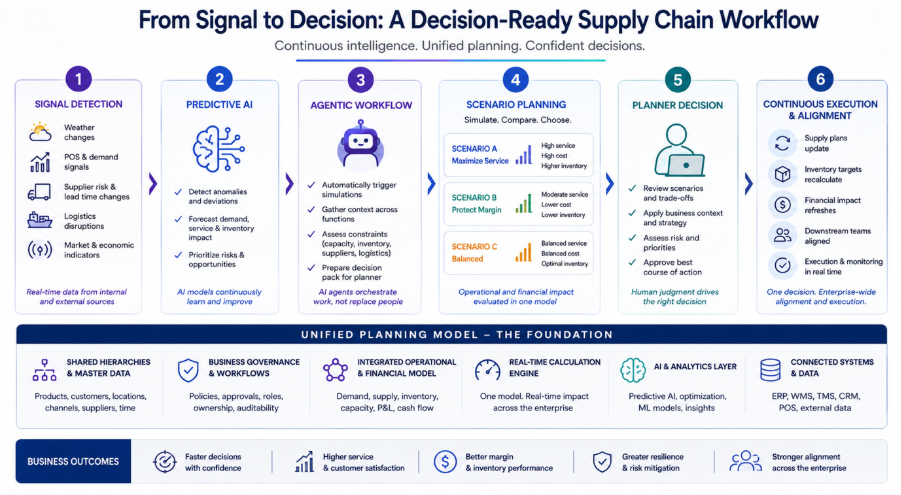
A unified decision model connects:
Shared hierarchies
Common business definitions
Integrated operational and financial logic
Standard governance
Cross-functional workflows
Real-time recalculation across plans
Instead of synchronizing multiple systems after decisions are made, the organization operates from one continuously aligned decision framework.
This becomes the operational backbone for:
Demand Planning
Supply Planning
Inventory Optimization
S&OP / IBP
Financial alignment
Scenario simulation
AI-driven recommendations
Agentic workflows
Without this foundation, AI simply accelerates fragmentation.
With it, AI becomes transformational.
This is also where the difference between disconnected planning platforms and unified decision architectures becomes critical.
Organizations cannot continuously orchestrate supply chain decisions if operational, financial, and commercial logic are fragmented across multiple systems and workflows.
Decision readiness depends on operating from one continuously synchronized model — where planning, simulation, AI, and execution remain aligned in real time.
Why Hierarchies and Governance Matter More Than Most Companies Realize
One of the biggest barriers to decision readiness is not technology. It is inconsistency.
Different business units define products differently. Regions use different planning structures. Finance operates at one level of aggregation while supply chain operates at another. Scenarios are built on conflicting assumptions.
This creates hidden friction everywhere.
A truly decision-ready organization standardizes:
Product hierarchies
Customer hierarchies
Channel structures
Time buckets
Cost logic
Margin assumptions
Workflow ownership
Approval governance
These may sound operational.
But they are strategic.
Because AI agents, predictive models, and scenario engines can only operate effectively when they are grounded in trusted, governed enterprise context.
The future supply chain is not just AI-enabled.
It is governance-enabled.
Predictive AI Changes the Nature of Planning
Traditional planning systems were designed to explain the past and coordinate the present.
Modern supply chains need systems that anticipate the future.
Predictive AI changes planning from reactive coordination into proactive decision support.
Instead of waiting for planners to identify issues manually, predictive systems continuously detect:
Demand shifts
Supplier risk
Inventory imbalance
Service threats
Margin erosion
Capacity bottlenecks
Logistics disruption
Emerging market signals
But predictive AI alone is not enough.
Insight without orchestration creates alert fatigue.
The real value comes when predictive intelligence is embedded directly into the planning and decision process itself.
This is where decision-ready organizations separate themselves from AI experimentation.
They move from: “Here is what happened” to: “Here is what is likely to happen” to: “Here are the best actions available now.”
Agents Become the Operational Layer of Decision-Making
Agentic AI is becoming one of the most important shifts in enterprise planning.
But the role of agents is often misunderstood.
Agents are not replacing planning systems.
They are operating them.
In a decision-ready supply chain, agents help orchestrate workflows across forecasting, inventory, supply balancing, scenario analysis, and financial trade-offs.
For example:
Detecting demand volatility automatically
Triggering constrained supply simulations
Comparing service vs margin outcomes
Recommending inventory reallocation
Escalating exceptions to planners
Coordinating approval workflows
Monitoring execution outcomes
But critically, agents only work effectively when connected to a unified decision environment.
Otherwise they simply automate disconnected processes faster.
The future is not isolated AI assistants.
It is coordinated human-agent planning operations grounded in one decision model.
Scenario Planning Becomes Continuous
Historically, scenario planning was episodic.
Quarterly. Monthly. Executive-led. Often spreadsheet-driven.
That model no longer works in environments where volatility changes daily.
Decision-ready supply chains treat scenario planning as a continuous capability.
Every forecast adjustment.
Every sourcing issue.
Every transportation disruption.
Every pricing decision.
All become scenario triggers.
Modern scenario planning enables organizations to:
Simulate multiple outcomes instantly
Understand operational and financial impact simultaneously
Compare trade-offs before execution
Align stakeholders around one version of impact
Move from reactive firefighting to proactive orchestration
This fundamentally changes organizational confidence.
The goal is not prediction perfection. The goal is preparedness.
A Simple Example: What a Decision-Ready Workflow Looks Like
Imagine a global consumer goods company detects a sudden demand spike for a key product category following an unexpected heatwave.
In a traditional planning environment, this triggers a familiar chain reaction:
Demand planners manually adjust forecasts
Supply planning reviews capacity later
Inventory teams assess stock positions separately
Finance evaluates margin impact afterwards
Leadership waits for alignment across functions
The organization spends days reconciling decisions while demand conditions continue changing.
A decision-ready supply chain operates differently.
Predictive AI identifies that demand for specific SKUs is accelerating beyond forecast tolerance thresholds.
Instead of waiting for a planner to discover the issue manually, the system proactively flags:
– Potential stock-out risk – Service exposure – Margin opportunity – Capacity constraints likely to emerge within days
An AI agent automatically launches a structured response process. It:
– Triggers a constrained supply simulation – Assesses available inventory across regions – Evaluates supplier lead-time flexibility – Reviews transportation capacity – Calculates financial implications of alternative actions
The planner is no longer starting from scratch. They are entering an orchestrated decision environment with context already assembled.
The platform generates multiple scenarios automatically.
Scenario A — Maximize Service Expedite replenishment Increase production overtime Prioritize retail availability Result: Higher service levels, but increased logistics and production costs.
Scenario B — Protect Margin Limit premium freight usage Reallocate inventory selectively Accept lower service in lower-priority channels Result: Margin preserved, but increased stock-out risk in some regions.
Because the organization operates on one unified decision model, every function moves together from the same decision logic.
No lag. No conflicting assumptions. No disconnected plans.
This Is What “Decision Ready” Really Means
Decision readiness is not about replacing planners with AI.
It is about creating an operating model where:
Signals are detected earlier
Decisions are evaluated faster
Trade-offs are visible instantly
Operational and financial impact stay aligned
Humans and AI work together continuously
That is the shift from traditional planning to continuous decision orchestration.
And increasingly, it will define the difference between supply chains that react to volatility — and those designed to thrive within it.
Decision Readiness Is the Real Competitive Advantage
Over the next five years, most enterprises will adopt some form of AI in supply chain planning.
But technology adoption alone will not create differentiation.
The winners will be organizations that build the operational architecture required to continuously make complete decisions under uncertainty.
That means:
One unified decision model
Shared hierarchies and governance
Embedded predictive AI
Agentic orchestration
Continuous scenario planning
Financially aligned decision-making
In other words: Supply chains that are always decision ready.
Because in the autonomous business era, competitive advantage will not come from who has the most data.
It will come from who can turn uncertainty into confident action fastest.
And that starts with building a supply chain designed for decisions — not just plans.
Is Your Supply Chain Truly Decision Ready?
AI alone will not make supply chains autonomous.
Decision readiness requires a unified operational and financial decision model, embedded AI, governed workflows, and continuous scenario orchestration.
The organizations leading the next era of supply chain performance are not simply adding AI to fragmented planning processes.
They are building continuously aligned decision environments — designed to evaluate trade-offs, orchestrate actions, and execute with confidence in real time.
That is the foundation for a truly decision-ready supply chain.